Table of Contents
There’s no doubt that even relatively modern times could be an incredibly cruel place, especially for animals. Even when they weren’t being tormented for entertainment, such as in the horrific ‘comedy’ of roasting cats alive or bear-baiting, it was literally law that some animals must be made to suffer excruciating torment. It was required by law in Elizabethan England that beef had to be ‘baited’: that is, come from bulls who were forced to fight packs of dogs before being slaughtered. The ‘baiting’ was believed to make the meat more tender and palatable for consumption.
If we today regard such practices as horrific, we find the concept of putting animals on trial for crimes such as murder or property damage similarly appalling. Yet, animal trials were popular in early modern Europe.
Creatures ranging from rats and locusts to pigs and donkeys were put on the stand – sometimes literally – to face charges for various transgressions. Some were even assigned lawyers to defend them.
There were two types of animal trials: secular and ecclesiastical. Domestic and farm animals, which were considered to be under the control of their owners, headed to secular courts. Critters like rats and other vermin, believed to be under the control of God, went to ecclesiastical church courts.
From there, animal trials played out much like typical human trials. And if the creatures were found guilty, they faced banishment – or worse.
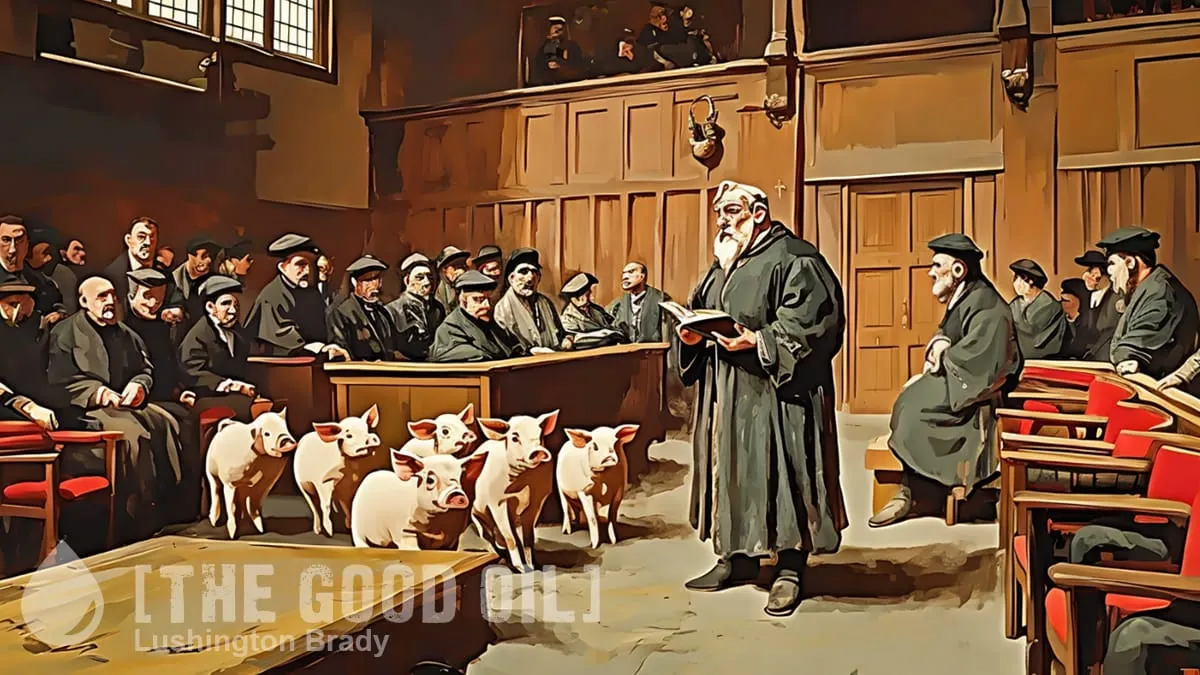
In one famous trial, in 1457 in Savigny, France, a sow and her six piglets were tried for the crime of killing and eating a human child. Scottish author Robert Chambers recorded the event in his 1869 Book of Days.
According to Chambers, “The sow was found guilty and condemned to death; but the pigs were acquitted on account of their youth, the bad example of their mother, and the absence of direct proof as to their having been concerned in the eating of the child.”
This wasn’t a rare event. Pigs were seemingly the most common animals that were put on trial. In European villages, pigs roamed freely and could grow large and dangerous. Sometimes they attacked small children. A 1386 case in Normandy likewise saw a pig sentenced to death for killing an infant in its crib. The sow was dressed in a white shirt and marched to the gallows. The entire town gathered to watch, and some farmers even brought their own pigs to witness the hanging so they would remain on their best behavior.
Sometimes human owners were put on trial alongside their animals.
In 1750, a peasant named Jacques allegedly sodomized his donkey, and both parties were charged with the crime. However, a character witness for the donkey testified that he was chaste, so he was acquitted, while Jacques was burned at the stake.
A similar case took place in Connecticut in 1662, when William Potter purportedly committed “the unnatural deed of carnal lewdness” with several cows, sheep, and pigs. They were all found guilty, and Potter had to watch each of his animals die before he was hanged himself.
Wild animals, though, had no ‘owner’ but God. Therefore, they were subject to ecclesiastical trials, which might see them excommunicated or cursed.
Edward P Evans, in his 1906 book The Criminal Punishment and Capital Prosecution of Animals, wrote that rats were often “sent a friendly letter of advice in order to induce them to quit any house, in which their presence is deemed undesirable.”
In 1519, the Alpine town of Stelvio, Italy, brought a case against moles (or possibly mice) for damaging crops. A lawyer argued that the rodents helped the soil and should not be punished harshly. The creatures were instead sentenced to banishment.
It wasn’t just a European thing, either. Animal trials were recorded in places like Brazil, New Zealand and the Congo. Even today, ducks and goats might be tried as witches in parts of Africa or in New Guinea. And in Ancient Greece and Rome, dogs were tasked with keeping armies alert to sneak attacks. A dog who failed to do so might be ‘court-martialled’.
As recently as 1915, a circus elephant named Mary was hanged for murdering a circus handler. Twelve years earlier, in a bizarre intersection of modernity and mediaeval barbarity, another elephant named Topsy was executed for murder by electrocution, with the event filmed by the Edison Studios (the film is extant).
Looking on from the lofty hill of modernity, we no doubt view such events as cruel and inexplicable. Animal activists strenuously oppose them.
Yet, here’s the thing: the animal activists are hypocrites. On the other hand, the ‘superstitious’ mediaevals were doing exactly what animal rights groups demand – treating the animals as fully sentient beings.
In the Middle Ages, unlike now, people treated animals more as sentient beings than as objects. Continuous human interaction with the animals they owned, which amounted to up to 16 hours per day into the 19th century, left owners with more sympathy for them.
When animal activists demand that animals be accorded legal personhood, they conveniently ignore half of the equation. Personhood is a ‘forensic’ quality: that is, it doesn’t just accord rights, it demands responsibilities. A person is morally culpable for their actions. If an animal is incapable of distinguishing right from wrong, how can it be considered fully a ‘person’?
Interestingly, a recent case of putting an animal to criminal trial echoed the mediaeval practice of assigning responsibility for wild animals to the church. In 2008, a bear in Macedonia was convicted of theft after stealing honey from a beekeeper. Since the bear was part of a protected species, the government ended up paying the damages.