Table of Contents
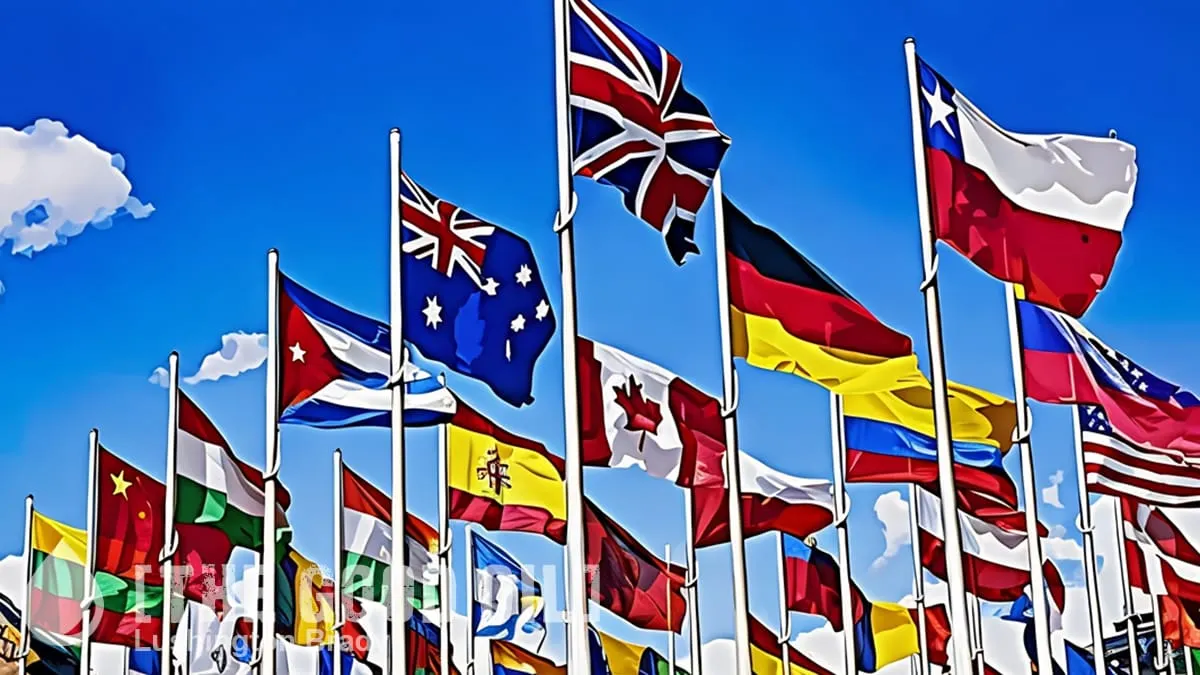
Flags: some people die for them; some people burn them. People salute them, or spit on them. Whichever way their convictions swing, there’s no denying that flags possess a unique symbolic value for human beings. Even those who insist that flag burning is no big deal wouldn’t actually be doing it if the flag really had no significance.
Flags have been around for at least three thousand years, probably longer. An Egyptian stele from c 3000 BC depicts a procession holding standards of some kind. Roughly half a millennium later came a bronze ‘Derafsh’: a flag-like banner from Iran. Cloth flags appear to have originated in India or China several centuries later.
Most early flags were used for military purposes, identifying military units or ships in battle. By the 17th century, the Law of the Sea mandated ships to fly flags to identify their nationality. With the concept of the nation-state originating at roughly the same time, national flags began to rise in prominence.
The flags of some nations are today some of the most recognisable symbols in the world. Few more so than the ‘star-spangled banner’ of the United States of America. The stars’n’stripes originated during the American Revolution, with the most famous being the ‘Betsy Ross’ flag. This design built on the flag flown by the Sons of Liberty, which featured nine vertical stripes of red and white. Ross’ design featured 13 horizontal stripes, and a blue quadrant with 13 white stars in a circle. These symbolised the 13 original colonies, with the circle design showing them unified in the new nation. As the USA expanded, the stars grew to, today’s 50, with each representing a state, while the 13 stripes remain, to commemorate the original colonies.
Red, white and blue remain the most popular colours on flags around the world (at 75, 70 and 50 per cent of all flags, respectively). Probably the next-most-recognised flag is that of the Revolutionaries’ old enemy, the United Kingdom.
The origin of the flag of the UK dates back to the middle ages. That is the first flag that was adopted by the English that featured St George’s cross painted red in the middle of a white background. After unifying with Scotland in the same 16th century as the flag was adopted, it was tailored to feature the flag of the Scots as well, which was the cross of St Andrew as a white X painted in the middle of a cyan background. The flag was called the Kings Colors all the way until 1801 with the unification of the Kingdom of Ireland. The Union Jack as it came to be, incorporated St Patrick’s cross alongside the St George’s and St Andrew’s respectively.
All that’s missing is the Welsh wyvern, because Wales was already incorporated into England and thus represented by the St George cross.
Britain’s hereditary enemy, the French, have used many flags over the years. Most used the design of the fleur-de-lis, symbolic of the French monarchy since the 1100s. But after the French Revolution, the symbol of the deposed royalty clearly wouldn’t do, so it was over to the red, white and blue.
The tricolor represents the three pillars of the French, those being the clergy representing the color white, the nobility representing the color red, and the bourgeoisie representing the color blue. The storming of the Bastille during the French Revolution, and the famous Liberté, égalité, fraternité meaning liberty, equality and fraternity are the words most famously attributed to the French flag of its origins.
The Russian tricolour long predates the French, being used since at least the time of Peter the Great.
The tsar had visited the city of Arkhangelsk in numerous occasions, to view the shipbuilding process and to tailor it to be similar to the ones used in Europe. During one of his visits, merchant ships from the Dutch Republic had docked and started unloading their cargo on the docks, when tsar Peter noticed the tricolor they use to this very day in the Netherlands. Fascinated the simplicity of this flag and how easily it can be distinguished, Peter the Great decided to model the Russian flag after the one he saw.
One of the simplest, yet most recognisable flags, is the Japanese ‘rising sun’. The sun is an important symbol in Japan’s native Shinto religion and emblematic of the goddess Amaterasu, said to be the progenitor of the imperial family. Japan being to the east of the centre of the Asian world, China, it thus became known as the ‘land of the rising sun’. The rising sun motif is said to have first been used in 701. After WWII, the bars on the flag of the Empire of Japan were removed, giving us the Rising Sun flag of today.
Both Ireland and India have flags of orange, green and white, but with very different symbology. The Irish flag represents Protestants (orange) and Catholics (green), unified in peace (white).
While its colours were likewise chosen to smooth over sectarian divisions, the Indian flag, orange (or more correctly, saffron) represents courage and sacrifice, white peace and truth and green chivalry and faith. Additionally, the centre of the flag displays a 24-spoke wheel in navy blue: this is the Ashoka Chakra, representing the wheel of Dharma.
Then there was the Islamic minimalism of the previous Iraqi flag: a uniform field of green. How would anyone have known if their ships were in trouble?