Table of Contents
Peter MacDonald
In the long annals of the second world war, certain names shine in bold print: Churchill, Montgomery, Eisenhower…Yet one man, a New Zealander of quiet resolve, deserves to be ranked among them as a saviour of Britain in its darkest hour. Air Chief Marshal Sir Keith Park, commander of No 11 Group during the Battle of Britain, was the man who broke the Luftwaffe and ensured Hitler’s invasion plans never took flight. He was not a man of glamour, nor of political gamesmanship, and for that very reason he was later pushed into obscurity. But without him, Britain might not have endured.
From Gallipoli to the Somme: a Restless Soldier
Born in Thames, New Zealand, in 1892, Keith Park was destined not for the battlefield but for the sea. He worked as a purser in the Union Steam Ship Company and was nicknamed “Skipper” by his family. Yet when war came in 1914, he enlisted in the New Zealand Expeditionary Force and soon found himself in the mud and fire of Gallipoli.
Gallipoli hardened him but did not satisfy him. Park was a man of action: restless in spirit and unwilling to be confined to narrow horizons. Where many New Zealand officers were content to stay with their batteries, Park sought greater engagement against the Germans, transferring to the British artillery – a bold move that gave him wider opportunities on the Western Front.
On the Somme, Park commanded guns under relentless fire. It was there, in the skies above the trenches, that he saw the new dimension of warfare. Aircraft, still clumsy contraptions of canvas and wire, hovered overhead, directing artillery and duelling for mastery. Soldiers in the mud looked up with a mixture of envy and admiration. The aviators risked sudden death but between flights they returned to clean beds, warm meals and a sense of freedom utterly unknown to infantrymen. Park, however, saw something more: the tactical value of air power.
Into the Air
In October 1916, Park was blown from his horse by a shell and declared unfit for artillery service. The injury became his turning point. He seized the opportunity to transfer to the Royal Flying Corps, where his artillery eye for precision and coordination became invaluable in the air.
By 1917 Park was flying Bristol Fighters over Flanders, scoring victories and surviving the dogfights that claimed so many of his peers. He rose to command No 48 Squadron. By war’s end, he was a seasoned ace, decorated with the Military Cross and Bar and scarred by the exhaustion of command.
Park had chosen the harder road at every turn, leaving New Zealand with the NZEF, leaving the relative safety of artillery and taking up the most perilous trade of the war. These choices, born of a restless desire for action and duty, forged the man who would later stand unflinching in 1940.
Between the Wars: the Professional
After the war Park remained in the newly formed RAF. He married Dorothy Parish, built his career in postings from South America to staff colleges and won a reputation as a professional’s professional. He was calm, precise and utterly dedicated. Unlike some of his peers, he was not flamboyant. He did not court the press or indulge in politics. He was, as one biographer noted, “a workhorse, not a showman”.
This lack of vanity was both his strength and his curse. Men trusted him and politicians overlooked him.
The Battle of Britain: Park’s Finest Hour
In 1940, as Hitler prepared Operation Sea Lion, the invasion of Britain, Park was given command of No 11 Group, charged with defending southeast England and London. His sector bore the brunt of the Luftwaffe’s onslaught.
Park’s tactics were as unshowy as the man himself. Where his rival, Trafford Leigh-Mallory, advocated the grand “Big Wing” massing squadrons into great formations that looked impressive but often arrived too late for battle, Park believed in speed, precision and conservation of resources. He scrambled small groups quickly – intercepting German raids before they could strike. He rotated his weary pilots, ensuring that no squadron was burned out. Above all, he fought a war of attrition that Germany could not win.
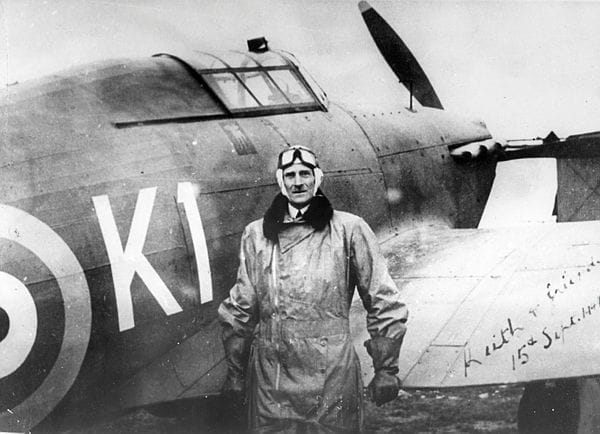
Park did not command from a distant office. He flew his own Hurricanes, visited squadrons, inspected conditions, and shared the risks his men faced. On at least one occasion, Luftwaffe fighters engaged him directly over Kent and he narrowly evaded death. His men revered him for this courage, calling him the “Defender of London”.
And it was the humble Hurricane, not the glamorous Spitfire, that bore the brunt of these sorties and shooting down the majority of Luftwaffe aircraft. Ironically, just as Park was later sidelined for his unflashy, effective leadership, so too was the Hurricane overshadowed in history by its more glamorous cousin. Both man and plane were unsung heroes.
Malta: Second Victory
Park’s genius was not confined to Britain’s skies. In 1942 he was sent to Malta, a battered island under daily siege from the Luftwaffe and the Italian Regia Aeronautica. Within weeks he transformed its defence by applying the same tactical brilliance he had used in 1940 to defeat the Luftwaffe: small, flexible interceptions, relentless rotation of squadrons and conserving every ounce of strength. Under his command, Malta not only survived, but struck back, and convoys once again broke through with supplies. Historians now acknowledge that Park won the Battle of Malta just as he did win the battle of Britain – two of the most decisive air campaigns of the second world war.
Even the Axis recognised his genius. Adolf Galland later admitted: “If any one man won the Battle of Britain, he did.” German records from Malta show frustration with his constant interceptions and the sudden impenetrable defence he established.
The Politics of Jealousy
Yet while the Germans grudgingly acknowledged his brilliance, many within his own command did not. Leigh-Mallory’s Big Wing faction, other jealous senior commanders and even some political overseers saw Park’s calm, systematic leadership as a threat to their ambition or prestige. They questioned his methods, emphasised spectacle over effectiveness and quietly pushed him aside.
Despite winning Britain’s most critical battles, Park was reassigned to training and less visible postings. The man who had saved London and Malta became a footnote, while others sought the credit he had earned in blood and strategy.
Legacy
Park went on to serve with distinction in the Middle East and India, retired in 1946 and returned to New Zealand, where he worked in aviation and local politics. He became an Auckland city councillor and died in 1975, largely uncelebrated for his role in the Battle of Britain and the Battle of Malta. Only veterans celebrated him.
However history is slowly restoring his place and Britain survived because of him.