Ani O’Brien
Like good faith disagreements and principled people. Dislike disingenuousness and Foucault. Care especially about women’s rights, justice, and democracy.
New Zealand is often described, with a kind of nostalgia, as a small country that functions much like a small town. No one is a stranger and everyone knows everyone. A nation that prides itself on pragmatism over ideology, on fairness over factionalism, and on a belief that despite differences, there exists a common civic identity. Yet that story, never perfect but once broadly shared, has begun to fracture. In its place, a more brittle narrative has emerged. One that increasingly divides the country into competing communities, often framed along Māori and non-Māori lines, each with its own account of history, justice, and entitlement.
This fragmentation is not merely a cultural or rhetorical shift, but a threat to social cohesion. The erosion of a shared national story in New Zealand risks entrenching an “us versus them” dynamic that is historically contingent. And, beyond being rather unpleasant to live through, this erosion fundamentally undermines the very foundations of things like our modern welfare state, which relies not only on redistribution but on trust, reciprocity, and a shared sense of belonging. Without a unifying narrative that is capable of complexity, both social cohesion and the institutions built upon it become increasingly fragile.
Nations are not just political arrangements: they are stories we tell about ourselves. These stories do not require uniformity, but they do require a degree of shared meaning. A sense that, despite disagreement, we inhabit a common cultural universe. For much of New Zealand’s modern history, that story rested on an uneasy but functional synthesis of a recognition of Māori as tangata whenua (people of the land) alongside a broader civic identity that encompassed all citizens.
It is important to note that the current intensity of ethnicised political framing is relatively recent. While tensions between Māori and Pākehā (non-Māori usually of British descent) have long existed, particularly around land, sovereignty, and the interpretation of the Treaty of Waitangi, the dominant political culture of the mid-to-late 20th century was oriented toward integration rather than separation. This was not without its failures or injustices, but it did reflect a prevailing belief that a shared national identity was both possible and desirable.
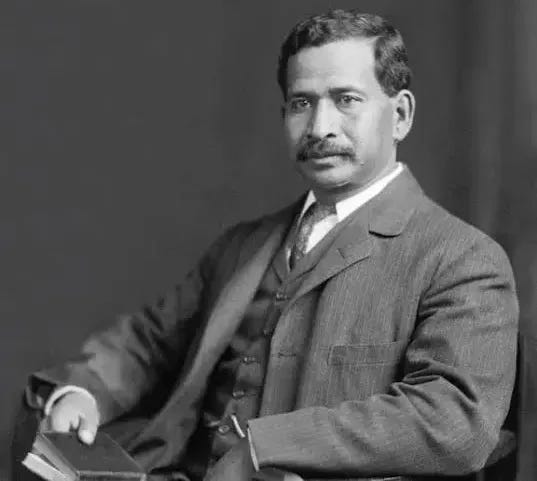
Few figures embody this more than Sir Āpirana Ngata, who in the earlier 20th century championed a kind of dual project of the revitalisation of Māori culture alongside full participation in New Zealand’s national life. A lawyer and parliamentarian, Ngata resisted both assimilationist erasure and separatist withdrawal. His vision was not of two nations in permanent tension, but of one society enriched by distinct cultural traditions. As he famously urged: “E tipu e rea mō ngā rā o tōu ao. Grow up and thrive for the days destined to you; your hands to the tools of the Pākehā for the welfare of your body; your heart to the treasures of your ancestors as a crown for your head.” This was not a call to division, but to synthesis.
Similarly, Dame Whina Cooper’s leadership, most notably during the 1975 Land March, was grounded in a moral appeal to the conscience of the nation as a whole. Her activism was not framed as a rejection of shared nationhood, but as a demand that it live up to its own principles. “Not one more acre of Māori land,” she declared, but she marched not to divide New Zealand, rather to call it back to itself.
Even Moana Jackson, often associated with more radical critiques of the state, articulated a vision of justice that did not seek to destroy the social fabric but to reweave it. Jackson argued that true justice required confronting historical wrongs while maintaining relationships: “The challenge is not simply to be right, but to be just – and justice must restore relationships, not end them.” This is a far more nuanced position than the binary that increasingly dominates contemporary discourse.
The existence of grievance is not new. Obviously grievances have always existed, but there is a new structure of the narrative through which those grievances are interpreted. A more explicitly ethnonational framing has taken hold, one that divides society into distinct groups: those who have been historically wronged, and those who are cast as beneficiaries of those wrongs.
It would be dishonest to deny that this framing has had a unifying effect within Māori communities. Shared narratives of dispossession, cultural suppression, and systemic inequality can, and often do, produce strong internal cohesion. This is neither surprising nor inherently illegitimate. Collective memory has always been a powerful force in shaping identity.
But this dynamic does not exist in a vacuum. As one group unifies around a narrative of grievance, those that they “other” may begin to unify in response. A counter-narrative emerges centred on perceived unfairness, exclusion, or moral indictment. The result is mutual alienation.
The danger is that once politics becomes framed primarily through ethnic hierarchy and inherited status, it does not remain confined to one side of the debate. Human beings are tribal creatures. If one form of ethnonationalism is normalised, another will eventually arise in opposition. It is a pattern repeated throughout history all over the world. Narratives of indigenous supremacy or permanent settler guilt run the risk of provoking backlash, particularly among those who feel themselves increasingly excluded from the community of the nation.
Across the Western world, there has been a visible resurgence in explicitly white identitarian and nationalist movements, many of which draw energy from the perception that majority populations are expected to endlessly accommodate increasingly racialised political structures while being denied any legitimate expression of their own group interests or identity. In New Zealand, this dynamic remains comparatively marginal, but it would be dangerously complacent to assume it doesn’t exist.
Part of the problem is that some contemporary Māori activist rhetoric increasingly mirrors the very logic it claims to oppose. The language of indigeneity and decolonisation can, at its most constructive, function as a call for historical honesty and institutional reform. But at its worst, it can slide into an essentialist politics that divides people into permanent categories of oppressor and oppressed, insider and outsider, tangata whenua and manuhiri, with legitimacy distributed accordingly. When political movements begin to imply that democratic legitimacy derives not from equal citizenship but from ancestry, bloodline, or indigeneity alone, they create the conditions for reciprocal ethnic politics to emerge.
This is particularly concerning in an integrated liberal democracy like New Zealand. Ours is a deeply intermixed nation, not two separate civilisations existing side by side. In such a context, the encouragement of competing ethnic consciousness is asking for instability.
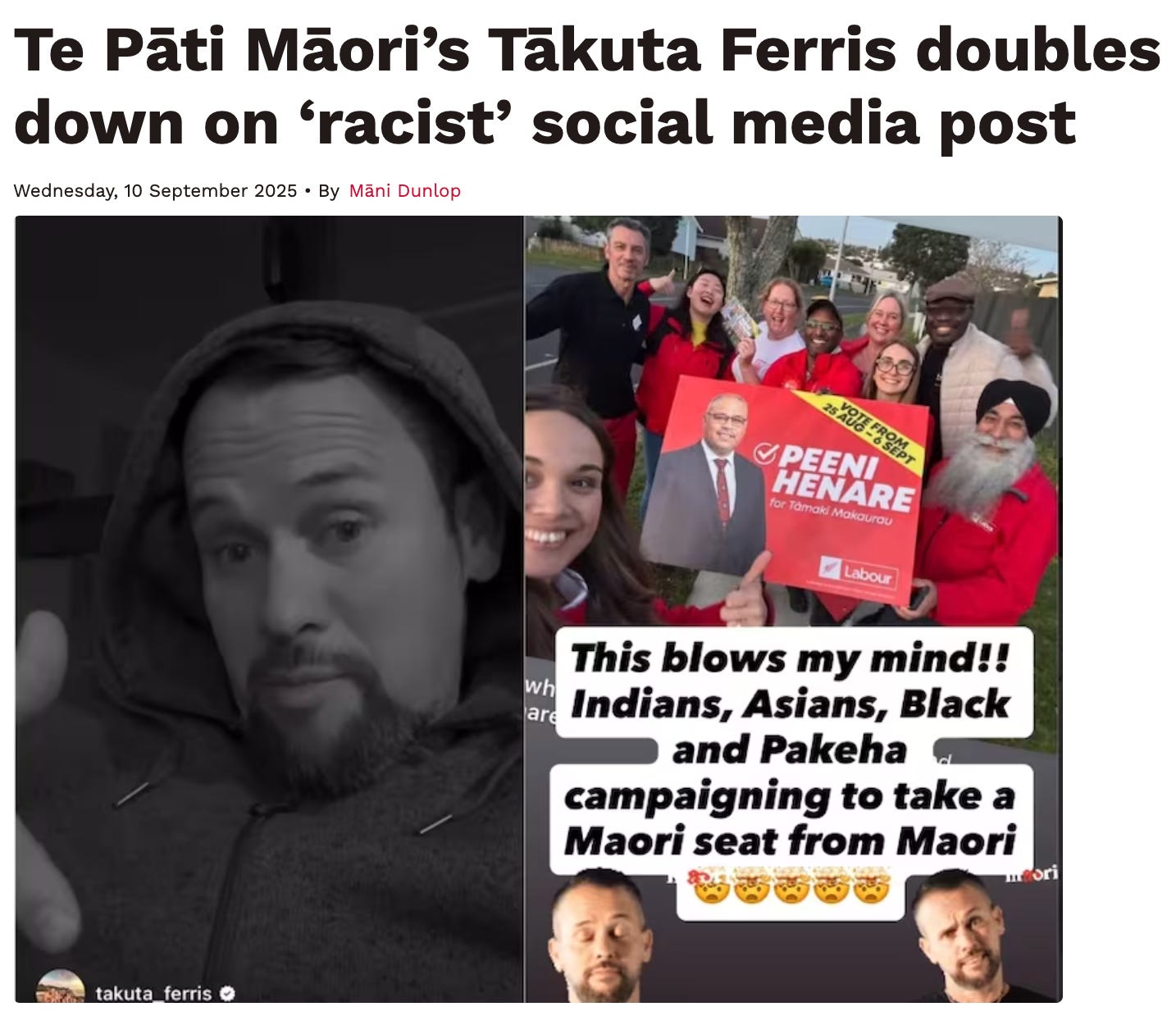
Some of the rhetoric now circulating in activist and political spaces reflects this escalation. Te Pāti Māori, for example, frames politics in overtly racialised terms, portraying Māori not simply as a people seeking justice within a shared nation, but as a fundamentally separate political collective whose rights and authority supersede ordinary democratic norms. Whether intentionally or not, this kind of messaging risks reinforcing the kind of ethnic obsession that healthy multiethnic democracies should be attempting to soften rather than intensify.
None of this means we should cast aside historical injustice, nor argue that Māori grievances are illegitimate. Mature societies are capable of confronting historical wrongs honestly. But there is a profound difference between pursuing reconciliation and constructing a permanent politics of ethnic antagonism. A nation cannot survive indefinitely if its citizens cease to see one another as part of a shared future.
Supremacy narratives, regardless of who advances them, are a powder keg in pluralistic societies. White supremacy is destructive. Māori supremacy is destructive too. The underlying logic is the same in that it promotes the idea that some citizens possess greater inherent moral or political legitimacy than others by virtue of ancestry. Once that principle is accepted, even selectively, social trust is not possible. People retreat into defensive identities and politics becomes zero-sum.
Complicating this is the reality that New Zealand is not composed of discrete, homogeneous groups. As I say, we are a deeply interwoven society. Many Māori have European ancestry; many non-Māori have mixed ancestry of other kinds. Cultural identities overlap, intermarry, and evolve. The idea of clearly separatist communities, of distinct groups bearing siloed collective responsibility or collective victimhood, sits uneasily with this. It oversimplifies what is, in truth, a complex and shared history.
To insist on rigid divisions is analytically flawed and socially corrosive. It transforms a shared past into a present binary of good versus evil and replaces the possibility of a common future with competing claims of entitlement and grievance.
And if the first consequence of narrative fragmentation is cultural division, the second is institutional strain. A key example is the functioning of our welfare state.
New Zealand’s welfare system is expansive and deeply embedded. It is also (including pensions), as a matter of fiscal reality, the largest area of government expenditure. But the sustainability of such a system is not merely a question of economics. It is, fundamentally, about reciprocity, trust, and the acceptance that we help one another when in hard times.
Excuse me while I throwback to my undergraduate days, but this understanding can be traced back to Enlightenment philosophers. For example, David Hume observed that justice arises not from abstract principles alone, but from conventions that enable cooperation among individuals with limited sympathy for one another. Adam Smith, often mischaracterised as a theorist of pure self-interest, grounded his moral philosophy in sympathy. The capacity to see oneself in others. Jean-Jacques Rousseau argued that the legitimacy of political authority rests on a “general will” that reflects shared interests rather than factional divisions. And John Rawls framed justice as fairness, rooted in principles that free and equal citizens would agree to under conditions of impartiality. Yes, I had to go back and fact check myself on these.
These thinkers recognise that stable societies depend on a social contract which is a shared understanding that individuals are part of a moral and physical community with obligations running both ways. It is the dissolving of the social contract that keeps me up at night. How we are led by some political leaders toward generational warfare and so collective acceptance of the obligation to support the elderly (who have been taxed their whole lives) diminishes. How the increasing divergence between the sexes has created a proliferation of men not wanting to be providers and women not wanting to form families. How old bigotries and projections of group hatred are being recycled. But I digress.
The welfare state is a concrete expression of the social contract. It rests on the premise that those who are able will contribute through taxation, and that those contributions will support those in need whether due to age, illness, disability, or circumstance. Crucially, it is contingent on the belief that this system is fair, and that its benefits are distributed according to need rather than group identity.
When this belief is compromised, so too is the system.
Resentment is the predictable consequence. Taxpayers begin to question whether their contributions are being used appropriately. They ask whether the system is being exploited, whether it rewards dependency, or whether it privileges certain groups over others. These concerns are not always well-founded, but they are politically potent. And, naturally, once trust is lost, it is difficult to restore.
Stay with me, this does connect back to the problem of a lack of a unifying narrative. Ethnonational frameworks, whether rooted in grievance or entitlement, undermine the universality upon which the welfare state depends. If individuals come to see themselves primarily as members of competing groups, rather than as participants in a shared civic project, the willingness to redistribute resources declines.
Why should one group support another, if the relationship between them is defined not by mutual obligation but by historical accusation or perceived injustice? Why contribute to a system that is seen not as a collective safety net, but as a mechanism for advancing the interests of others?
These questions begin on the fringes, but as division beds in they quickly become central. I fear that New Zealand currently sits on the precipice of the point where this resentment and siloing of communities moves from fringe to the broader populace. One one side of the issue this already exists as the accepted elite narrative. Funding, resources, housing initiatives are expected to address Māori separately sometimes framed as due to their special status as tangata whenua and sometimes in order to redress past wrongs. On the other side there has been resistance to this, objection to the Māori Health Authority and political power and representation based on race, for example. These objections have been framed as racist, but the real problem will be when this population stops objecting to anti-universalist policy and starts advocating for racialised policies of their own. Being the racial majority, this would likely result in swift dominance and potential oppression of those who oppose them.
I like to think that most New Zealanders do not want any of this to happen. We want unity and an integrated future. We do not want to be part of politics that essentialises based on the colour of our skin or who our ancestors were. The challenge for us is not to deny history, nor to suppress legitimate grievances. It is to integrate them into a narrative that sustains, rather than fractures, our social fabric.
This requires a return, not to a naive or romanticised vision of unity, but to a more sophisticated understanding of what unity entails. We cannot and should not attempt to rid society of difference, nor expect that we can erase conflict. What we should strive for is the capacity to hold those differences within a narrative of shared meaning and mutual obligation. Where we share resources with everyone and are not implicitly encouraged to assess what different ethnic groups are getting compared to our own.
As I said earlier, New Zealand has examples of such an approach in our own history. Ngata’s integrationism, Cooper’s moral appeals to national conscience, and Jackson’s emphasis on relational justice all point toward a model of cohesion that does not require uniformity. They suggest that it is possible to pursue justice while maintaining a common identity. But this possibility depends on the stories we choose to tell.
Most importantly, we need to reassert the principle that we are, ultimately, in this together. Without such a narrative, cultural division will harden into political conflict, trust will erode, and the social contract will collapse. The task of building a cohesive and inclusive narrative is not easy. It requires intellectual honesty, moral restraint, and a willingness to resist seductive simplistic narratives. But I reckon we have to try.
This article was originally published by Thought Crimes.