Table of Contents
I’ve been writing for some time that Big Social makes Big Tobacco look almost like an angel. This is an entire industry whose internal research has for years made clear to them just how harmful their products are, especially to children. Like Big Tobacco in the 1950s, they not only try to hide the evidence and silence whistleblowers, but is doubling down on marketing their poison to children.
A jury has finally, just a tiny bit, held them to account.
A US jury found Google and Meta liable for $US3 million ($4.3 million) in damages in a landmark social media addiction lawsuit that will influence thousands of similar cases against the tech companies.
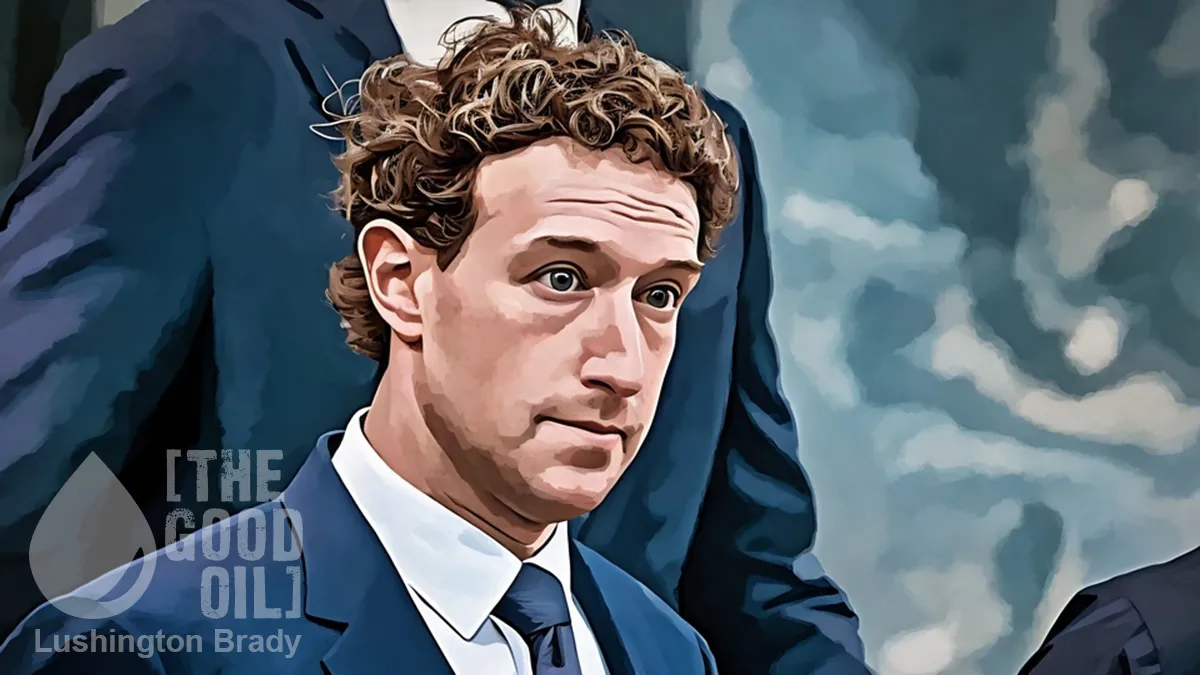
A few million is chump change to the robotic zillionaire, Mark Zuckerberg, and his minions. He spends less than that chugging barbecue sauce in an effort to try and convince us that he’s human. Still, it’s a start.
The plaintiff in the case, a 20-year-old woman, accused the tech companies of causing harm by deliberately designing addictive platforms.
She told the court she began using YouTube when she was six years old and Instagram when she was nine, and became addicted to using it “all day long”, which worsened her mental health.
Sure, she could have not used it. Her parents could have forbid her.
In just the same way that people stop smoking and children never take it up because their parents forbid it.
Because, just like Big Tobacco in the past, Meta did their internal research. As whistleblower Sarah Wynn-Williams, formerly a director of public policy at Facebook, exposed last year, they knew their products were detrimental to mental health, especially for children. So, they kept their research secret.
Worse: they used the research to deliberately target vulnerable children.
Ms Wynn Williams said on early Thursday morning (Australian time) that Meta could identify when a child was “feeling worthless or helpless or like a failure”.
“They will take that information and share it with advertisers. One of the things about advertising is advertisers understand that when people don’t feel good about themselves, it’s often a good time to pitch a product, you know, people are more likely to buy something.
“And so what the company was doing was letting these advertisers know that these 13- to 17-year-olds were feeling depressed and saying, now’s a really good time to serve them an advertisement. Or if a 13-year-old girl would delete a selfie, that’s a really good time to try and sell her a beauty product.
“Things that often do concern teen girls, like body confidence, that’s something else that they use to target – weight loss, or other things on children really, 13- to 17-year-olds.”
This is straight-up predatory behaviour. They know what they’re doing.
Now, they’re being made to pay.
After nine days of deliberations, the jury in Los Angeles, California, found the parent companies of Instagram and YouTube — Meta and Google — were negligent in the design or operation of their platforms.
They found that both companies knew, or should have known, that their services posed a danger to minors, that they failed to warn users of that danger adequately, and that a reasonable platform operator would have done so.
The jury also found the company’s negligence was a substantial factor in causing harm to the 20-year-old plaintiff, awarding her US $3 million (US $4.3 million) in damages.
“Today’s verdict is a referendum – from a jury, to an entire industry – that accountability has arrived,” the plaintiff's counsel said in a statement.
This is, hopefully, just the beginning of the accountability.
Laura Marquez-Garrett, a lawyer with the Social Media Victims Law Center, said this trial was “a vehicle, not an outcome”.
“This case is historic no matter what happens because it was the first,” she said during deliberations.
Tech companies Snap and TikTok had settled with the defendant before the trial began earlier this year […]
In a separate case this week, a jury in New Mexico found Meta violated state law by misleading users about the safety of Facebook, Instagram and WhatsApp and of enabling child sexual exploitation on those platforms.
Then there is their deliberate betrayal of their countries.
Ms Wynn-Williams […] alleged that the company also undermined national security.
This included briefing China on its artificial intelligence developments as early as 2015, giving Beijing the leg up to create its own low-cost model DeepSeek, as well as sharing American user data with the Communist Party and building censorship tools for the authoritarian regime […]
Senate Judiciary Committee chair Josh Hawley said Meta was “willing to give away American user data, but they were also trying to find out a way to make a buck on Americans, teenagers, children in times of distress”.
Bring on the comeuppance.