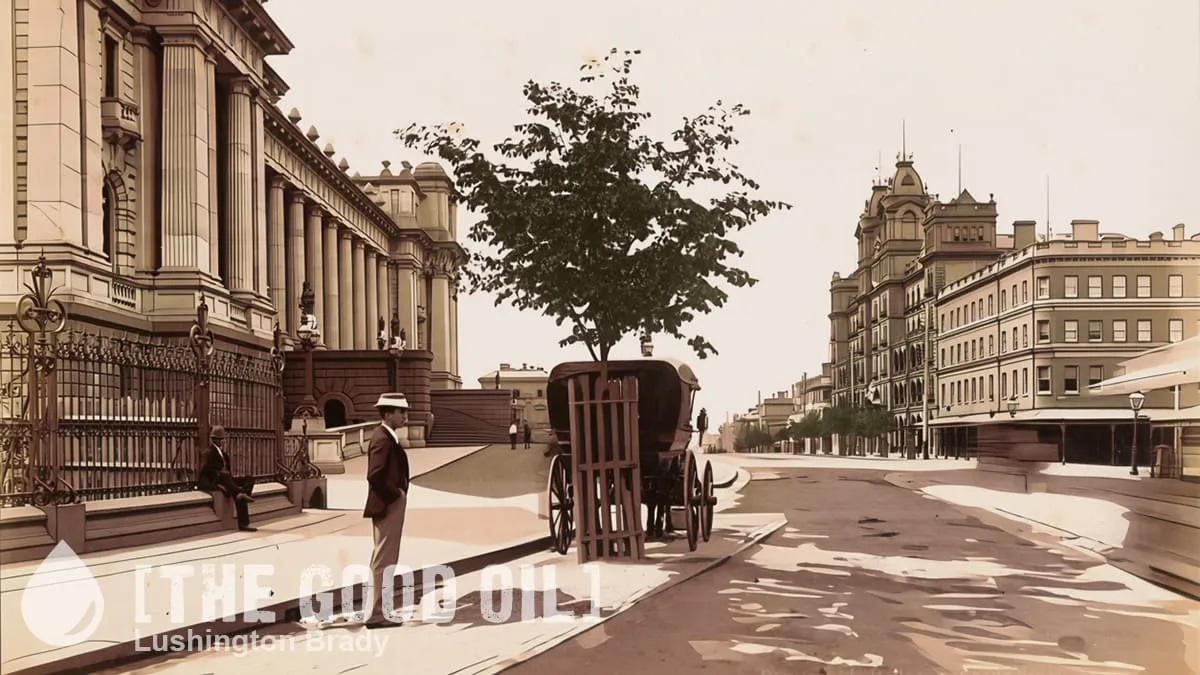
The more things change in Victoria, the more they stay the same. I’ve often written that, thanks to Dan Andrews, Tommy Bent can at least lie still in his grave knowing that he no longer wears the mantle of the most corrupt premier in the state’s history.
There are both eerie parallels and striking differences in the stories of these two premiers, ruling rotten state kleptocracies just over a century apart. Both built their power and fortunes on corrupt infrastructure projects. Like Andrews, Bent began his career in bayside Brighton: but at least Tommy never mowed down teenage cyclists with his horse and cart. Both presided over what was a booming state that suddenly collapsed into one of the worst depressions in Australian history. Most significantly, Bent’s state funeral attracted a huge crowd of mourners. One suspects that the only people who’ll line up for Dictator Dan’s last hurrah will be doing so with tomatoes in hand.
But, just as Andrews’ reign was marked by open criminality, with his signature ‘Big Build’ employing bikies and gangsters, to the tune allegedly of billions of taxpayer dollars, a very different crime scandal fascinated ‘Marvellous Melbourne’ in 1891.
In October of that year, the grand chambers of Victoria’s parliament played host to an outrage of the highest constitutional order, or so one might have imagined if this wasn’t the same state that 130 years later shrugged and re-elected Andrews not once, but twice. The colony’s ceremonial mace, widely and erroneously believed to be wrought from pure gold, vanished entirely from its resting place. One might have expected a citizenry steeped in British propriety to erupt in paroxysms of patriotic fury. Instead, as historian Sally Young observes in her meticulous historical account, the public reaction was somewhat more insouciant.
“Rather than being outraged by the theft, Melburnians seemed indifferent or bemused.”
Indeed, the populace preferred to treat the disappearance as prime fodder for salacious gossip. Melbourne was soon awash with delightful, ribald rumours that the purloined staff had ended up as a rather ostentatious phallic prop in a parliamentary-themed bacchanal hosted by the legendary Madame Brussels in her notorious Spring Street bordello (and no, I don’t mean Parliament House: that was just up the road). Whispers of secret tunnels burrowed beneath the parliamentary precinct to facilitate discreet nocturnal excursions for honourable members added a distinctly operatic flavour to the affair.
The mundane truth, however, was vastly more ruinous than any brothel fable. The mace itself was crafted from base metals of negligible intrinsic value, which partially accounts for the general lack of earnest consternation. More importantly, however, Melbourne had far larger fish to fry. The frenzied land speculation bubble of the 1880s, where politicians, property developers and bankers operated as an unholy trinity, had burst with catastrophic force, plunging the colony into economic darkness.
“At the end of 1891, large numbers of land and building companies were collapsing. Banks and financial companies that had lent enormous sums of money based on false and inflated land values were being forced into liquidation.”
The wreckage was total. Unfinished public monuments littered the landscape, while speculative rail lines wound through vacant green wedges, designed solely to line the pockets of well-connected insiders. At the epicentre of this sprawling web of incompetence and financial chicanery sat none other than the larger-than-life parliamentary speaker, Thomas Bent. A colonial-era Boss Tweed, Bent treated municipal and state coffers as his personal piggy bank, distributing council contracts to his relatives and manipulating electoral rolls with breathtaking impunity.
Contemporaries, observing the systemic rot from the press gallery, lamented that the colonial parliament was effectively run by what one writer bluntly termed “an aristocracy of criminals”.
Yet, the authorities’ inability to recover the missing mace became something of a template for Victoria’s farcical policing (just the sort of place Mike Bush would end up). The prime suspect was a parliamentary engineer by the name of Thomas Jeffrey, who was spotted by an eagle-eyed witness lugging a heavy, metal-clinking package wrapped in brown paper aboard a hi-tech tramcar. Despite this compellingly dodgy transit, Jeffrey was never formally charged, nor was anyone else, and he contentedly remained on the parliamentary payroll for decades afterwards.
One suspects that the Victorian political establishment was entirely content to let the public imagination run wild with brothel orgies and mace-wielding rakes. It provided a magnificently convenient smokescreen, deftly diverting attention away from an economic depression and systemic corruption scandal that could easily have sent half the legislature to the gallows.
Victorian politics still remains wonderfully consistent, 130 years later. Whether it is a 19th-century engineer sneaking maces onto trams or a modern regime funnelling billions into opaque transport projects while cronies feed at the trough, the ruling class always appreciates a good distraction. In 1891, they had a stolen mace and a Madame Brussels myth. Today, we have PR-engineered announcements and endless impotent inquiries. Some traditions, it seems, are simply too precious to lose.



![Marvellous Melbourne’s Big Day of Diversity [Updated]](https://storage.ghost.io/c/31/f4/31f4e20a-0315-499e-83ff-139e8eab53bf/content/images/size/w1304/format/webp/2026/10/The_GoodOil_YogiThemAgain.jpg)