Table of Contents
Back-of-the-envelope calculations, as the late Carl Sagan said, “cut through nonsense like a knife through butter”. They’re not detailed analysis by any means, but they are a high-speed bullshit filter. You might think you’ve just had a brainwave: well, prove it. As Sagan said, “appeal to your knowledge of fundamental physics, scribble a few approximate equations on the envelope, substitute in likely numerical values, and see”.
For instance, a recent Good Oil post pondered why we don’t more widely use the nuclear batteries still powering the Voyager probe after 50 years. A not-unreasonable question – until you do the back-of-the-envelope calculations. Long story short, to supply just New Zealand’s energy needs with nuclear batteries would require one to two billion kilograms of plutonium.
Oh, well, it sounded good in theory.
So does ‘renewable energy’. In reality, some simple back-of-the-envelope calculations show that it’s almost as unfeasible as nuclear batteries – and astoundingly expensive. Climate Cultists like Boofhead Bowen can blatherskite all he likes that ‘wind and solar are the cheapest forms of energy’, but we can all do the maths.
It’s just a pity so few do.
Fortunately for Good Oil readers, I have, several times. Now, some in the legacy media are catching up.
A looming second wave of the global energy transition could place unprecedented strain on resources, supply chains, and public finances, as most of today’s wind and solar infrastructure approaches the end of its working life by mid-century.
This is a glaring hole in the ‘Net Zero’ narrative. Climate Cultists talk as if ‘all’ we have to do is bulldoze vast swathes of wilderness, bury them under endless fields of glass and whirling bird-killing machines and rebuild our entire transmission grid – then we can all skip off into an endless ‘renewable’ summer.
Leaving aside the staggering cost of doing all that (which I’ve previously calculated as likely in the trillions – a higher proportion of the nation’s GDP than the entire cost of fighting WWI), there’s an even more mind-boggling problem.
We’ll have to do it ALL, all over again, every few decades.
Oh, of course, the grid won’t have to be rebuilt continuously. Thank Gaia for small mercies. But the rest of it? The wind turbines, the solar panels? It all has a very limited useful lifespan. Less than three decades.
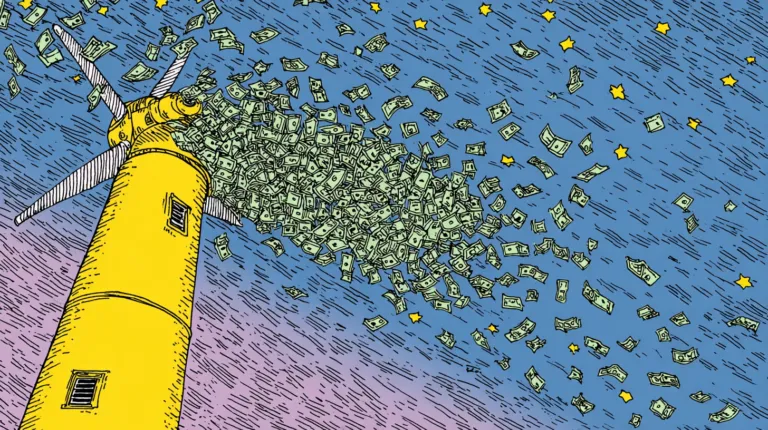
Climate researcher and author Peter Clack warns that by 2050 the majority of the world’s roughly 225,000 wind turbines – representing more than 1.2 terawatts of capacity – will need to be decommissioned or rebuilt, just as governments and companies are simultaneously pushing to install vast amounts of new renewable generation.
Wind turbines typically last just 20 to 30 years before they have to be replaced. While some of the components can be recycled, the vast physical bulk of the machines, the blades especially, cannot. So, not only will we face the Sisyphean task of completely rebuilding the generation infrastructure every few decades, there’s the mammoth task of disposing of a quarter of a million tons of fibreglass (conservatively, assuming 10,000 total turbines). That’s just for Australia.
Blade disposal presents another growing issue, with an estimated 43 million tonnes of wind turbine blade waste expected globally by 2050, including around two million tonnes in the United States alone.
At the same time, costs will likely rise, when everyone else in the world is trying to chase the same chimera. Over and over.
Solar is no better option.
Solar power faces a similar challenge. Modern solar panels have lifespans of around 25 to 35 years, and by 2050 billions of panels from today’s installed base – now exceeding 2.2 terawatts globally – will need to be retired and replaced. The cost of scrapping and rebuilding solar infrastructure is expected to run into the hundreds of billions of dollars, adding further pressure to the already vast financial burden of ‘decarbonisation’.
Just how vast a financial burden? You better be sitting down.
According to estimates cited by McKinsey, achieving net-zero emissions by 2050 will require around US$275 trillion in total physical asset spending, averaging US$9.2 trillion per year. Of that, roughly US$3.5 trillion annually represents spending above current investment levels. The added cost of replacing ageing renewable assets could significantly inflate that figure […]
Critics describe this looming rebuild as a “second transition” that could demand a level of industrial mobilisation comparable to wartime efforts. Unlike the initial rollout of renewables, however, it may occur in an environment of reduced subsidies, tighter restrictions on fossil fuels – despite diesel still powering much of the world’s mining equipment – and more cautious private investors following uneven returns from renewable projects.
These people are absolutely demented: and scientifically and mathematically illiterate.