Table of Contents
John McLean
Citizen typist. Enthusiastic amateur.

Pravda was the official newspaper of the Soviet Union’s Communist Party. Although Pravda means “Truth” in the Russian language, the Pravda newspaper wasn’t about truth. Quite the opposite. It was propaganda for the Soviet regime.
Our household still subscribes to the paper version of media channel Stuff’s Saturday broadsheet rag, the Post. Its main usefulness is as fire paper, but the Post’s Opinion section is guaranteed to amuse and bemuse. The Post’s 7 March edition was a prime example of Looney Leftist propaganda.
The editorial – presumably from Stuff’s editor Tracy Watkins – is headed There is no justification for this war. And a legitimate debate can certainly be had on whether the joint US/Israeli attack on Iran is lawful, under international law (I take no position). But to claim “no justification” is patently absurd.
Iran’s theocratic leaders freely, indeed gleefully, tell the world they are hell bent on Death to Israel. Iran is desperately dedicated to developing nuclear bombs, weapons that the Mullahs would – if they could – combine with Iran’s ballistic missiles to nuke Israel and its citizens into oblivion. Stopping Iran nuking Israel and other Western nations is undeniably a legitimate justification for the current war.

Cartoonist Jeff Bell portrayed President Donald Trump as having shot a dove. But the Iranian regime ain’t no dove. It’s quite the opposite. Through its terrorist proxies, Hamas, Hezbollah, Yemen’s Houthis, Iraqi and Syrian militias and numerous other murderous bands of Muslims, the Death Cult Iranian leadership has been attacking US and Israeli targets for decades, goading them into war in the hope of fomenting a global, civilizational religious conflagration. It’s impossible to negotiate with ideological terrorists. And it’s distinctly possible that the war on Iran may increase peace in the Middle East. Other Muslim countries all detest Iran. So Jeff Bell can shove his dead dove where the sun don’t shine.
The Post’s opinion section then allows Dr Sara McFall to catastrophize about treatment of wastewater in New Zealand. McFall’s piece is headed After Moa Point, New Zealand must confront its wastewater crisis. It’s fashionable amongst cultural elite Aotearoans to invent crises and otherwise catastrophize. In recent years, deliberately ignoring the voluminous and pristine Hutt River, Stuff has published countless articles claiming that Wellington is on the brink of running out of fresh water. Pure delusion.
All that’s required, in order to fix the current isolated problems with New Zealand’s wastewater, is to legislate away local governments’ entitlements to squander ratepayers’ money on vanity projects. That simple reform would free up the funds required for all necessary wastewater treatment remediation.

In her piece, Dr McFall describes herself as “head of systems, strategy and performance at New Zealand’s Water Services Authority – Taumata Arowai”.
The Water Services Authority was established by the Ardern administration to perform amorphous roles in relation to drinking water, wastewater and stormwater. The authority’s legislation provides that “In order to recognise and respect the Crown’s responsibility to consider and provide for Māori interests”:
The authority must have a “Māori Advisory Group” with a role to “advise the board and the Water Services Authority on Māori interests and knowledge, from a Māori perspective and in accordance with the group’s terms of reference”
The authority’s board must “take the advice of the Māori Advisory Group into account”
The authority’s “operating principles” include “building and maintaining credibility and integrity, so that the Water Services Authority is trusted by Māori” and “partnering and engaging early and meaningfully with Māori, including to inform how the Water Services Authority can…understand, support, and enable the exercise of mātauranga Māori, tikanga Māori, and kaitiakitanga”
The authority’s board must “maintain systems and processes to ensure that…the Water Services Authority has the capability and capacity to uphold the Treaty of Waitangi (Te Tiriti o Waitangi) and its principles and to engage with Māori and to understand perspectives of Māori”
Didn’t the current government promise to rid New Zealand of this brand of radical, racialist legislative content? Could the Nats be reneging on its coalition agreement with NZ First, which provides:
The coalition government will reverse measures taken in recent years which have eroded the principle of equal citizenship, specifically we will…
Remove co-governance from the delivery of public services [“partnering” is co-governance].
As a matter of urgency, issue a Cabinet Office circular to all central government organisations that it is the government’s expectation that public services should be prioritised on the basis of need, not race.
…
Conduct a comprehensive review of all legislation (except when it is related to, or substantive to, existing full and final Treaty settlements) that includes ‘The Principles of the Treaty of Waitangi” and replace all such references with specific words relating to the relevance and application of the Treaty, or repeal the references
Wasn’t the current government elected to dismantle the Māorification of New Zealand? But moving right along…

The Post’s opinion section then features an article by Josie Pagani. Now, Josie is usually reasonable, sensible and sane. But not this time. Josie has jumped the shark.

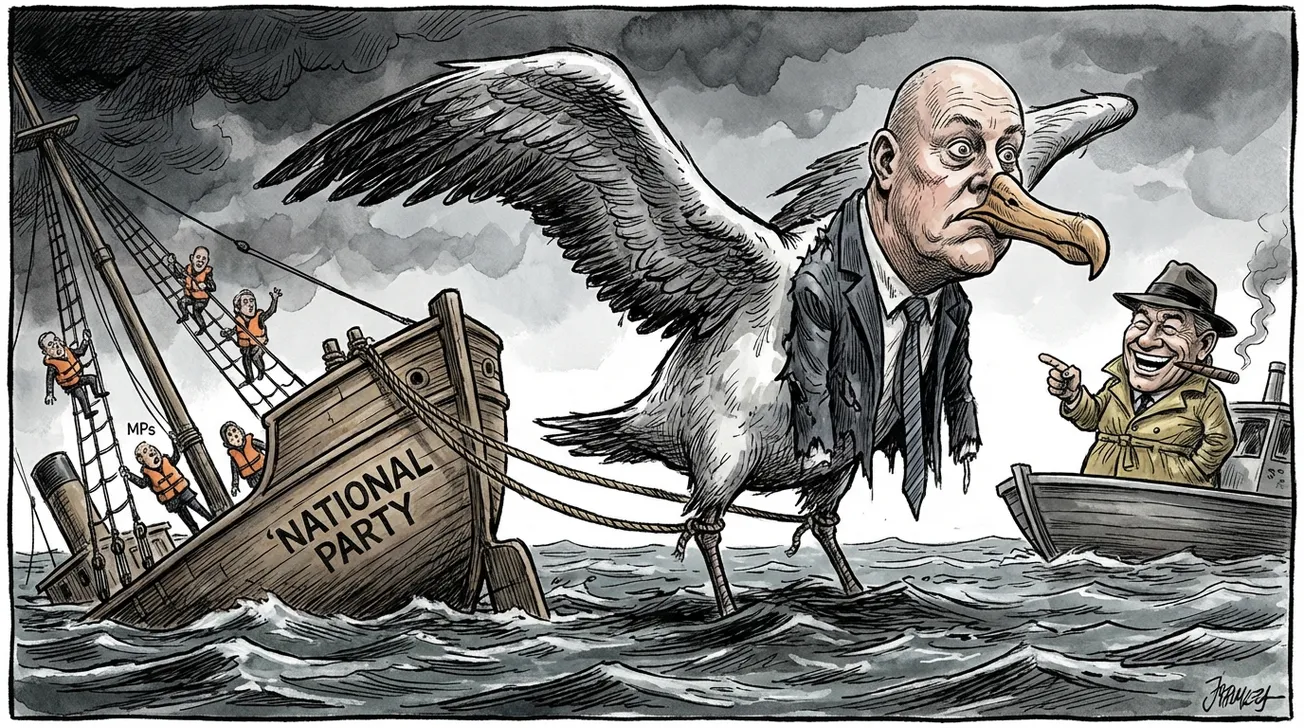
The clue is in Josie’s heading, Christopher Luxon is not the leader for times of war. To which the obvious rejoinder is – New Zealand is not at war. There are always wars going on…but we’re not at war. Am I missing something? Josie ends with, “The drums are beating for him [Luxon] now. This is not the leader we need in times of war. I can’t be any clearer, guys.” But Josie’s heading should’ve been clearer. It should’ve read, I don’t like Luxon and am trying to help change the government.
Luke Malpass follows with a piece headed, Dumping Luxon may be less risky than his party thinks. Luke’s article is superficially balanced. However, reading between the lines, it’s clear that what Luke really thinks is that swapping out Luxon would make a change of government more likely. And that’s what he’s trying to help achieve.
Malpass is oddly cryptic about New Zealand First, stating, “The fact that both Labour and NZ First reportedly regard Luxon’s premature departure as their biggest risk speaks volumes. There are of course risks around coalition partners, and Winston Peters in particular.” (Beware every reportedly you ever read.)
Apart from disparaging NZ First and Winston Peters, I have no idea what Malpass means. Perhaps he’s hinting that a collapse of support for National increases the chances of a National-Labour Uniparty Government, leaving NZ First again in the political wilderness. Who knows.
All I can find that Winston Peters said in the wake of the recent poor poll for the National Party was to Ryan Bridge (one of the few remaining mainstream journalists who’s still vaguely credible):
“It is not good, is it? You can’t say anything else. It is not the end of everything. But those of us who are not in the National Party, on this matter, on the outside, it is not good, no.”
That’s well short of Peters saying the prospect of Luxon leaving is NZ First’s “biggest risk”.
The Post’s 7 March opinions section ends with a contorted piece by our good friend Max Rashbrooke. I’ve specifically covered Mad Max before:
A RASH OF VIOLENCE...John McLean 23 October 2025
Max does his darnedest to take the heat off Labour for the reaction of Labour’s finance spokesperson, Barbara Edmonds, to Treasury’s analysis that reinstating Labour’s pay-equity settlement regime would cost New Zealanders an extra 12.8 billion dollars, over four years.

Questioned about that cost, Edmonds was unphased, “It’s a really big bill. But everything is a big bill, right.” Another big bill is the $30 billion spending out of Labour’s Covid Response and Recovery Fund that the second Covid inquiry has just found was unrelated to the pandemic. Thank Chippy Hipkins for that.

In response to Edmonds’ nonchalant attitude to big bills, Minister of Finance Nicola Willis suggested that Edmonds believes in “a forest of magical money trees”.
Rashbrooke’s proselytizing Post piece is headed, Sorry, conservatives, there is no magical money tree. Let’s call what Max is doing Projection by Proxy. On behalf of Labour, he’s accusing National of what Labour is clearly guilty of – feckless squandering of public money. Max glibly states, in his characteristic pseudo-intellectual style:
There is also, to deploy yet another literary term, a wider irony here, because it is Willis’ side of politics who show the greatest faith in the existence of magical money trees.
According to Max, National’s magical money trees are public-private partnerships and user-pays, things that National occasionally entertains and which Max ends his piece by describing as “a nightmarish money pit”. Nice try Max, but that’s a fail.
So there we have it. Stuff’s opinion writers have abandoned any pretence of rationality or adherence to truth and logic. They pine for the halcyon days of the Public Interest Journalism Fund, from which Stuff milked about $5 million. And they’re doing their best, with their ideologically warped ‘journalism’, to usher in a new government that will bring back those gory glory days.
This article was originally published on the author’s Substack.