The ability of certain groups to dodge accountability is almost impressive. When Māori families beat their precious ‘tamariki’ to death, it’s not their fault – it’s ‘the legacy of colonialism’. When Aborigines drink themselves into a stupor every day and beat each other into a coma while their kids run in feral packs because it’s safer than being at home… you guessed it, ‘legacy of colonialism’. Throw in some ‘intergenerational trauma’ and ‘racism’, and you’ve got the magic cocktail of dodging accountability.
It’s always someone else’s fault, you see.
And that is odd, because the Jews who emigrated to Australia after the war had intergenerational trauma and the legacy of racism up the wazoo. Yet, we never saw roving packs of Jewish children robbing, stabbing and raping on the streets of Melbourne and Sydney. Instead, we saw, head-for-head, possibly the most high-achieving immigrants in Australian history.
As writer and statistics enthusiast Steve Sailer once responded to a boiler-plate taradiddle about ‘racism’: if you’ve apparently been universally enslaved, everywhere and for always, you’d almost start wondering if it’s a ‘you’ thing. Not when you’ve go wicked whitey to be your scapegoat, though.
Gary, Indiana has spent generations carrying the weight of America’s industrial rise and decline. Now, thousands of its residents are facing another test of endurance after a historic storm left large portions of the predominantly Black city without electricity for nearly two weeks.
On August 11, 2026, a storm with 99-mph winds and tornadoes ripped through Northwest Indiana, creating the largest power outage in the history of Northern Indiana Public Service Company. More than 20,000 customers in Gary remained without power, with full restoration expected around August 25 […]
The disaster has intensified a larger conversation about race, wealth and infrastructure. Gary is roughly 76 per cent to 80 per cent Black, and residents have questioned why restoration has moved faster in wealthier surrounding communities.
Probably because the locals in wealthier surrounding communities aren’t shooting at the workers desperately trying to restore power.
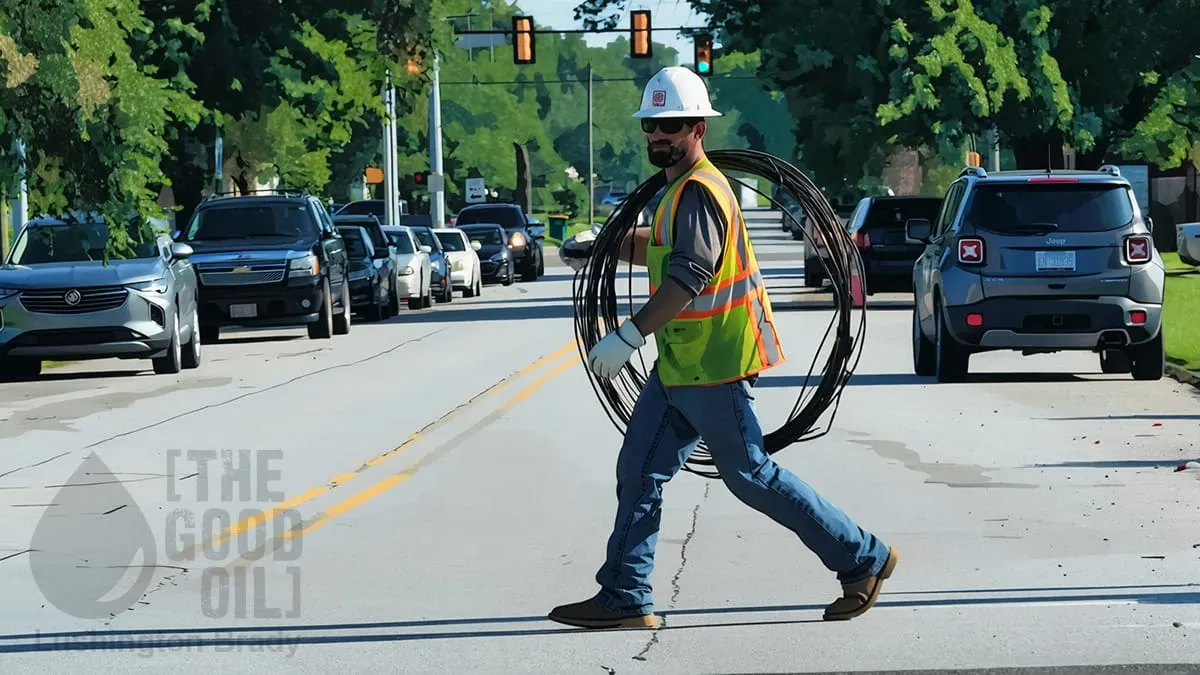
A NIPSCO vehicle was struck by gunfire on Friday night while utility crews worked to restore power in Gary, Indiana, prompting restoration efforts in the city to be temporarily paused, officials said.
This is much the same reason for so-called ‘food deserts’ in predominantly black areas: all the shopkeepers got sick of being robbed, stabbed and shot at and moved out. That’s if they even open shop in the first place in neighbourhoods where greengrocers go broke while customers queue up at junk food places (and wait patiently for the obscenely obese women at the counter to stop trying to rip each other’s braids out).
But admitting that is cruising dangerously close to shouldering responsibility. It is far easier to blame ‘environmental racism’ and ‘redlining’ – which was abolished more than half a century ago. Long ago enough that entire neighbourhoods in other cities have gone through cycles of gentrification, rebirth and re-decline.
‘Racism’ is also a pretty bizarre scapegoat in a city that is almost entirely populated by, and solely run by, blacks. Where the entire executive of the power company is black. And, of course, where the people shooting at power workers are also black.
Gary, Indiana, in fact looks like nothing so much as Johannesburg. More than three decades after the ANC were handed a first-world economy with nascent space and nuclear programs, the city runs out of water and power because the residents steal the copper transmission wires, cut metal from the transmission towers till they fall over and smash open water pipes for free water.
As Steve Sailer would say: maybe it’s time to wonder whether it’s a you problem.