Table of Contents
EKO
Artist and bookmaker
I’ve been thinking about what it means to walk away from power.
Power doesn’t corrupt. Power reveals.
Give a man control over others and you’ll see what was always inside him. The mask comes off. The rationalizations begin.
I deserve this. They need me. Only I can fix it.
Every revolution in history has ended the same way. The liberator becomes the tyrant. Cromwell. Napoleon. Lenin. Castro. The man who fights the king becomes the king. Or worse.
Every revolution except one.
The war was over. Washington had won. And his army was about to destroy everything they’d bled for.
Congress hadn’t paid them in years. Promised pensions? Gone. Back pay? Forget about it. The men who had starved at Valley Forge, who had crossed the Delaware in the dark, who had watched friends die in frozen mud... they were being told to go home with nothing.
So the officers wrote a letter. Anonymous. Passed hand to hand through the barracks. The message was simple: We have the guns. Congress has paper. Why are we still asking permission?
A coup. March 1783. The American experiment almost ended before it started. Not from British muskets, but from American impatience.
They wanted to make Washington a king.
He had the military. He had the power. He had the justification.
The system had failed.
Washington called a meeting. He walked into a room full of armed men who loved him. Men who would have followed him through hell. Men who were waiting for him to say the word.
One nod. That’s all it would have taken.
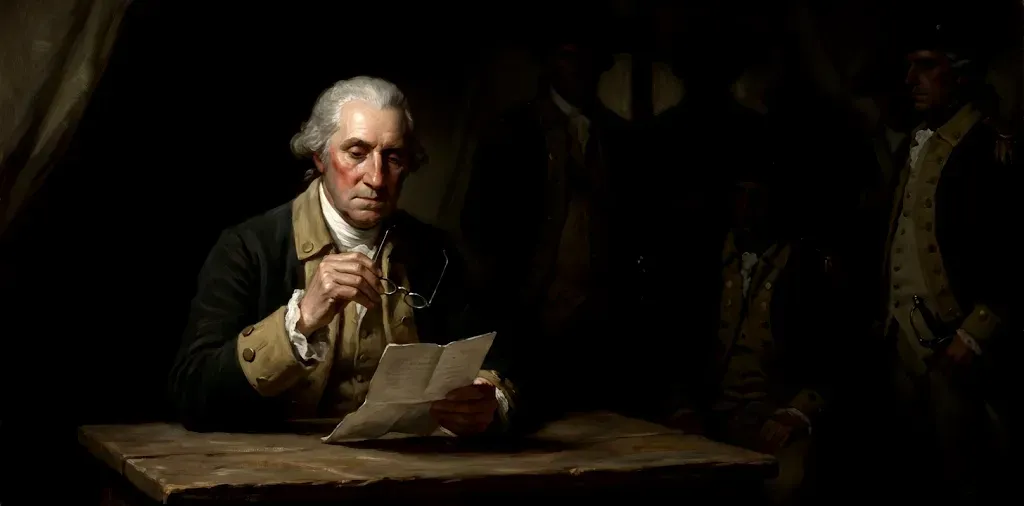
He stood before them. Pulled out a letter from a congressman explaining why the money wasn’t coming. Started to read. Stumbled. Squinted at the page.
Then reached into his coat and pulled out something none of them had ever seen him wear.
Spectacles.
Gentlemen, you will permit me to put on my spectacles, for I have not only grown gray but almost blind in the service of my country.
The room collapsed. Hardened soldiers wept. The conspiracy evaporated. Not through force or threat, but through the single most disarming act a powerful man can perform.
He showed them his weakness.
The man they thought was invincible, the man who had ridden through a storm of lead at the Monongahela with four bullets through his coat and not a scratch on his body, that man was going blind. Tired. Human.
And he was asking them. Not ordering. Asking.
The coup died. The republic lived.
Washington refused absolute power twice. First at Newburgh in 1783, when he talked down the coup. Then in 1797, when he walked away from the presidency after two terms. He could have ruled for life. No one would have stopped him. Instead, he went home. Mount Vernon. Farming. Silence.
Two times this man held the entire nation in his hands. Two times he opened his hands and let it go.
Name another figure in history who did this. Cincinnatus. Once.
That’s it.
So what made Washington different?
He was ambitious. He wanted glory, legacy, fame. He kept that coat with four bullet holes in a trunk for 44 years. He knew exactly what he’d survived. Read his letters. The man had an ego the size of Virginia.
He understood something most powerful men never grasp: Legitimacy doesn’t come from winning. It comes from what you do after you win.
Any general can take a crown. Only one kind of man can refuse it.
And that refusal, that single act of walking away, creates more authority than a thousand victories.
The power you surrender is worth more than the power you keep.
Washington understood that power is a loan, not a possession. You hold it in trust. And the moment you start to believe it belongs to you, you become the thing you fought to destroy.
The pattern doesn’t repeat exactly. But it rhymes.
You can feel it. The same tension. The same question hanging in the air: What happens when a man with the military holds power that everyone says he’s earned. And then refuses to keep it?
History says it never happens. Power always wins. The general always becomes the tyrant.
But history has been wrong before.
This article was originally published by EKO Loves You.