Table of Contents
David Leyonhjelm
David Leyonhjelm was elected to the Senate in 2013 and 2016, resigning in 2019. He has degrees in veterinary science, law and business.
In 1829 the proposal to create the Metropolitan Police in London prompted considerable resistance. To many people it sounded like another standing army which, ever since the Romans, have had a history of suppressing dissent. Moreover France, with which Britain had been at war since 1793, was known for its secret and political police force.
Opposition ran deep. In Blackstone’s 1768 Commentaries on the Laws of England, Henry St George Tucker wrote:
Wherever standing armies are kept up, and when the right of the people to keep and bear arms is, under any colour or pretext whatsoever, prohibited, liberty, if not already annihilated, is on the brink of destruction.
In newly independent America, the founding fathers, having freed themselves from British military tyranny, were in no hurry to suffer the same fate at the hands of their own government. Alexander Hamilton thought Congress should vote every two years “upon the propriety of keeping a military force on foot”, while Thomas Jefferson suggested the Greeks and Romans were wise “to put into the hands of their rulers no such engine of oppression as a standing army”.
James Madison wrote: “Throughout all Europe, the armies kept up under the pretext of defending, have enslaved the people.”
Sir Robert Peel, who was responsible for the Metropolitan Police proposal, recognised this concern. He ensured police uniforms were different from the military, avoided military ranks, and armed officers with just a wooden truncheon and rattle (later a whistle) to signal the need for assistance. Every officer was issued a warrant card with a unique identification number to assure accountability for his actions.
Australia not only has police which fail to respect human rights, but a standing army that facilitates them to do that.
He also established nine principles of policing, known as Peelian Principles, which defined the ethical standards that police officers must follow to be effective. These are based on the concept of policing by consent, the most well-known being “the police are the public and the public are the police”.
In the 20th century, standing armies did nothing to redeem themselves. Every single dictatorship – fascist, communist or merely obnoxious – used its permanent military to retain power.
Despite misgivings, the democracies have found it necessary to establish a full-time professional military, particularly because of the increasing role of technology. Some, like Switzerland, limit this to a small full-time professional core supported by a much larger citizen militia. Others have placed limits on the use of the military for anything other than national defence.
The Australian Defence Force is at least notionally focused on national defence, although it occasionally gets involved in such things as delivering relief supplies, erecting field hospitals or evacuating those affected by natural disasters. This is reinforced by the constitution, which nominates the Governor-General as commander in chief, not the prime minister or defence minister.
But things changed in 2020. At the beginning of the year, during the NSW bushfires, the ADF not only provided logistics support but also engaged in traffic control with state police.
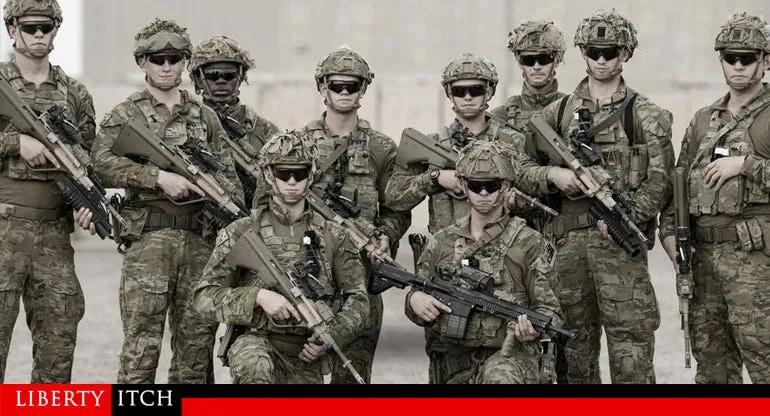
Then when the Covid pandemic hit, it was brought in to work beside state police to enforce border closures, hotel and home quarantine and, in Victoria, a second lockdown. A very important line was crossed – the ADF was helping enforce laws.
Assisting Victoria Police to enforce lockdown rules had another effect – it freed up the police to do what so many standing armies have done – suppress freedom. Under a state of emergency, the police were given extremely wide powers, including entering premises without a warrant and enforcing rules on exercise, working from home, wearing a mask, home quarantine, leaving home and essential work.
Despite misgivings, the democracies have found it necessary to establish a full-time professional military, particularly because of the increasing role of technology.
They used these powers to attack people who questioned Covid rules and the loss of freedom, selectively arresting those who protested. Moreover, much of this was done with a degree of thuggish enthusiasm that would be familiar to any of the last century’s dictators. Peelian Principles were nowhere to be found.
By any measure this was intended to suppress dissent. And the only reason it was possible was that the ADF provided assistance.
This also occurred in the context of the steady militarisation of the police. This includes the wearing of military camouflage, the use of military weapons, the acquisition of equipment such as armoured personnel carriers, references to the public as civilians, and the ridiculous claim that the police place their lives on the line every day.
When they see themselves as soldiers in a war, it is not surprising that police see no problem with suppressing dissent. Clearly, they do not see themselves as part of the public.
We cannot pretend the lessons of history do not apply in Australia; indeed, failing to learn from them makes it more likely they will be repeated. As they were two hundred years ago, standing armies continue to be a threat to freedom. And that includes police which emulate the military.
In 2025, Australia not only has police which fail to respect human rights, but a standing army that facilitates them to do that.
This article was originally published by Liberty Itch.