Table of Contents
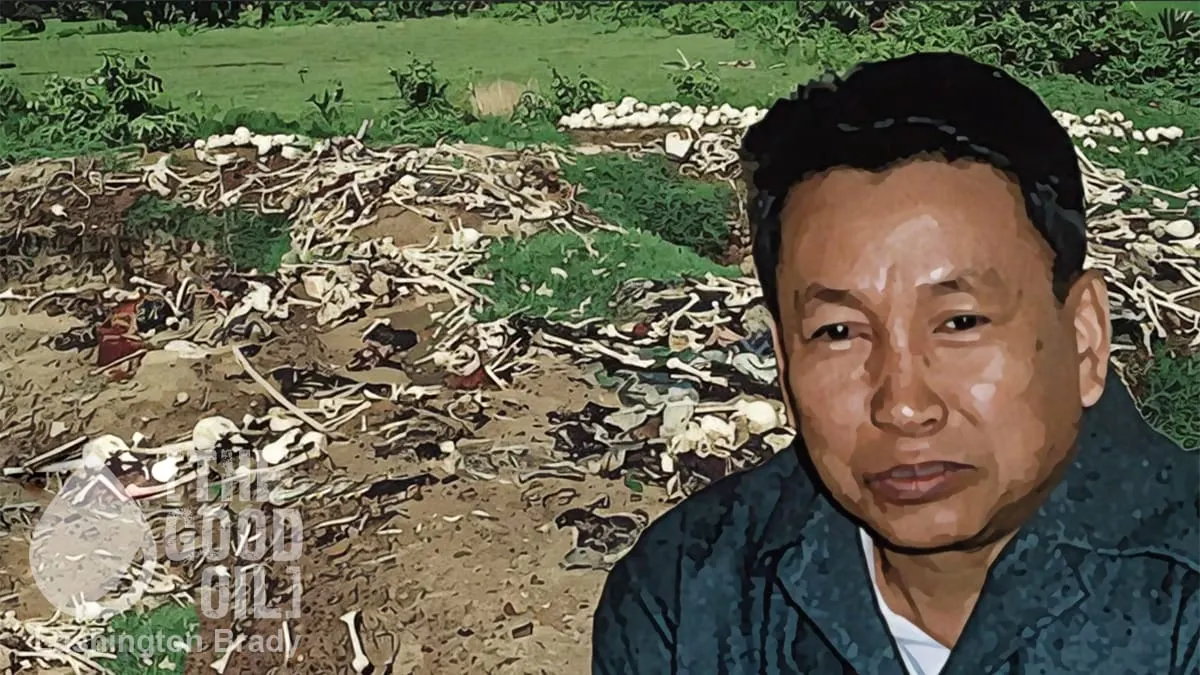
Pol Pot… Pol Pot… Pollll POT…! The very name conveys ominous dread, repeated like a mantra in the Dead Kennedy’s “Holiday Cambodia”. But if Pol Pot has largely faded into the background of the horrors of communism, it’s not for want of trying. While Stalin and Mao stand atop the heap of tens of millions of bodies, Pol Pot only looks like a minor player because Cambodia in the 1970s was such a small place.
If the sheer scale of Pol Pot’s murderous was replicated across the same-sized populations as the Soviet Union in the 1930s, or China in the 1950s, his death count would stand between 40 and 150 million. More than the death toll of the other communist dictators combined with the Nazis. But the population of Cambodia in 1974 was just around eight million, so Pol Pot’s murders were ‘only’ 1.5–2 million. A mere footnote in the history of communist bloodletting. A rounding error in a Stalinist or Maoist purge.
But for the people of Cambodia, the haemoclysm unleashed by Pol Pot and his Khmer Rouge fanatics was anything but a footnote. A full quarter of the entire population was shot, beaten, bludgeoned, or worked to death from 1975 to 1979. The holocaust of the Khmer Rouge was so astonishingly extreme that eventually its own communist neighbour, Vietnam, invaded Cambodia and overthrew Pol Pot’s regime.
Who was this bloodthirsty monster? Where did he come from and how did he fall from power and eventually die?
Like most of the world’s bloodthirstiest dictators, Pol Pot was the academic son of a prosperous bourgeois family.
Pol Pot was born Saloth Sar – “Sar” loosely translating to “white” or “pale,” a reflection of his lighter complexion – on May 19, 1925, in the small farming village of Prek Sbauv in central Cambodia. His family lived modestly but comfortably, with enough land to employ laborers and maintain status within their community. As a child, he grew up studying the fundamental principles of Buddhism, and even spent a year at a Buddhist monastery.
Like many future murderous revolutionaries – the Ayatollah Khomeini, Frantz Fanon, Hồ Chi Minh, Laurent-Désiré Kabila – Saloth Sar was sent to Paris on a scholarship. There, he wallowed in the milieu of comfortably radical French intellectual theorists – and prepared to put their cozy Marxist mental masturbations into brutally real communist practice.
In 1951, the Khmer People’s Revolutionary Party (KPRP) was founded in Cambodia. Revolution was brewing on multiple fronts, as the Cambodians also fought for the independence from France.
And after Saloth Sar returned to Cambodia in 1953, he soon took advantage of the dramatic changes taking place across his country.
By November 1953, Cambodia had achieved its independence from France. Meanwhile, Saloth Sar worked as a teacher while simultaneously plotting a communist revolution with the KPRP.
Throughout the next decade, Sar rose through the ranks of the organization, which was renamed Communist Party of Kampuchea (CPK) and would eventually become known as the Khmer Rouge. Sar also began identifying himself with a nom de guerre, Pol Pot.
Pol Pot assumed the leadership of the Khmer Rouge in 1963 as the movement set up guerrilla bases in the Cambodian countryside, recruiting ranks of poorly educated teenage boys. Just across the border, Vietnam was descending into the maelstrom of communist insurgency and civil war. The violence spread across the border, as the US ‘Secret War’ bombing campaign tried to eliminate Viet Cong bases in the Cambodian jungle.
In 1970, the movement gained an unexpected ally: Prince Norodom Sihanouk. The prince had lost power after General Lon Nol staged a coup – possibly with the support of the United States. Sihanouk, furious, then allied himself with Pol Pot’s guerrillas, lending them legitimacy in the eyes of many peasants […]
Then, on April 17, 1975, the Khmer Rouge captured the capital, Phnom Penh. The civil war was over, and they had won.
Pol Pot promised the people a fresh start. He claimed to envision a classless system, an alternative to the corrupt autocracy that had been in place, and a prosperous future for Cambodia’s people.
Those were the promises, just as had been made to the people of the Soviet Union and China. What Cambodia got was the reality of communism, but on a scale to make the enormities of Stalin and Mao look like a garden party.
Immediately upon assuming power, [his orders] included the evacuation of all cities and towns, forcing millions into the countryside to work in the fields. The Khmer Rouge also ordered the abolition of money, markets, schools, and religion, and the establishment of agricultural communes where people labored under brutal conditions.
Anyone considered an “enemy of the revolution” was imprisoned, tortured, or executed. This included intellectuals, merchants, government officials, soldiers, ethnic minorities (especially Cham Muslims, Vietnamese, and Chinese Cambodians), Buddhist monks, and even suspected dissenters within the party. Many of these people were sent to the notorious prison Tuol Sleng in Phnom Penh. According to the Association for Asian Studies, the prison became known as a place where people “entered but never returned.”
Even wearing spectacles was enough to condemn you as an ‘intellectual’ and therefore an “enemy of the revolution”. Hospitals were evacuated, mid-surgery, with the patients, some limping, some crawling, forced to join the exodus from the city. Black-clad Khmer Rouge soldiers forced evacuees to walk on as they witnessed friends and neighbours’ deaths by gunshot or beheading.
In the ‘Killing Fields’ of Pol Pot’s ‘agrarian utopia’, an even more brutal killer was ever-present: starvation. Two times a day, a small tin of rice would be split up to feed 10 people. People ate leaves, rats, insects or snakes to stay alive, even though to be caught ‘stealing food’ was an instant death sentence. “Life is like a battery. It just slowly drains,” says survivor Seang M Seng. “When the battery ran out, you’d just die abruptly.”
A 2017 study by Katherine Gruspier and Michael S Pollanen entitled “Forensic Legacy of the Khmer Rouge: The Cambodian Genocide,” found that over the course of just four years between 1975 and 1979, Pol Pot’s regime resulted in the deaths of between 1.67 and 2.18 million people – roughly a quarter of the population.
Then, in 1979, Vietnam invaded Cambodia. The Vietnamese toppled the Khmer Rouge and installed a new government, once again forcing Pol Pot and his followers to retreat into the jungles along the Thai border and wage a low-level guerrilla war.
Although they held out for another two decades, Pol Pot was eventually arrested by Khmer Rouge defectors in 1997. He was placed under house arrest to await trial for genocide.
But before the dictator could face justice, Pol Pot died suddenly from heart failure on April 15, 1998, at the age of 73. However, not everyone believed this official explanation of Pol Pot’s cause of death.
In January 1999, the Hong Kong-based Far Eastern Economic Review reported Pol Pot’s death was not from natural causes, but that the dictator had actually committed suicide upon learning that he might be extradited to the United States to stand trial. (Though it was likewise reported that the US declined to take Pol Pot because it was not prepared to try him.)
The Khmer Rouge who’d held him prisoner refused to allow an autopsy, in defiance of both the US and Cambodian governments. His body was hastily cremated, though Thai officials reportedly took samples of his hair and skin. Far Eastern Economic Review reported that he died after taking a “lethal dose of a combination of Valium and chloroquine”.