Table of Contents
Ani O’Brien
Like good faith disagreements and principled people. Dislike disingenuousness and Foucault. Care especially about women’s rights, justice, and democracy.
Every election cycle, like clockwork, Opportunity (TOP) reappears. It refreshes its branding, gets a new leader, rolls out a new slate of candidates, and the media, just as predictably, froths over them. Since Gareth Morgan founded the party in 2016, this has become a familiar ritual in New Zealand politics.
TOP is treated less like the minor party polling at less than one per cent and fighting for relevance, and more like a recurring idea of the sensible alternative, the one that might break through this time, the one that represents politics done properly. There is always a tone of enthusiasm in the media coverage, a sense that perhaps this time the ignorant voters will finally recognise its value. And sitting underneath that optimism is the same false central claim that TOP exists outside the tired binary of left and right, guided not by ideology but by evidence.
It is a compelling story, particularly for a certain kind of politically engaged voter who is frustrated with the major parties and attracted to the idea that there might be a ‘more rational’ way of doing things. But it is also, of course, a total fiction. “Evidence-based” is not a political position: it is a rhetorical device. Ask Chloe Swarbrick, who has been repeating it ad nauseum all term, but taken seriously by very few people.
In any case, all parties claim to rely on evidence. The real dividing lines in politics are not about whether you use data, but about what you prioritise, what trade-offs you are willing to make, and what outcomes you consider desirable. Those are inherently value-laden judgements and they are, in other words, ideological.
The language TOP uses, the issues it elevates, and the solutions it proposes sit squarely within the world view of the contemporary left. Climate transition, inequality, child poverty, biodiversity, housing equity, “regenerative” economic systems, co-governance, and a persistent critique of “short-term politics”. This is a standard issue framework of modern leftist politics, but delivered in a tone designed to sound above it all. There is a moral narrative underpinning it that systems are failing, outcomes are unjust, the current model is unsustainable, and the answer lies in structural reform guided by experts to produce fairer and more equitable results.
None of this is inherently illegitimate. But it is not ideologically neutral. It is a more polished, less confrontational version of the same arguments that animate Labour and the Greens. TOP’s point of difference is not in what it believes, but in how it presents those beliefs. It strips out the activist rhetoric, softens the edges, and wraps the whole thing in the language of rationality and competence. It is left-wing politics for people who do not like the current aesthetic of left-wing politics.
If you have any doubt about that, it should disappear the moment you look at the party’s people. Political parties can say whatever they like about themselves, but their candidate lists reveal instincts, networks, and priorities in a way that branding cannot. And TOP’s roster is consistent in what it signals.
Party leader Qiulae Wong’s career spans human rights, ethical fashion, purpose-driven business, B Corp advocacy, and climate consulting. She has worked with global brands to shift toward sustainability and social impact frameworks. It is a profile deeply embedded in the ecosystem of modern progressive thought, corporate social responsibility, climate transition, and “values-led” capitalism. It is not the background of someone steeped in free market liberalism or centre-right economics. It is the background of someone who is obviously from the hard-left.

Canadian-born candidate Dr Kayla Kingdon-Bebb’s academic and professional focus is on indigenous rights, environmental governance, and Treaty-based constitutional change. In her writing, she says “whether you’re in Zambia or New Zealand, you cannot begin to grapple with any conservation or environmental issue without first countenancing the matter of indigenous rights”.
She advocates for a framework that places indigenous authority at the centre of governance, including over land, water, and natural resources. That perspective directly aligns with the intellectual foundation of He Puapua, the report she helped develop as part of the government-appointed working group tasked with designing New Zealand’s implementation of the UN Declaration on the Rights of Indigenous Peoples.
The report itself outlines a pathway toward expanded rangatiratanga, including models of autonomous separatist decision making structures. Whatever language is used to describe it (co-governance, partnership, or constitutional transformation) the underlying project is a rebalancing of political authority.
I first came across repeat candidate Jessica Hammond several years ago on the site formerly known as Twitter. She initiated a pile-on attack on me because I am a ‘TERF’, a label that tends to function less as a descriptor and more as a permission slip for hostility. At least back then, she was an aggressive trans-rights activist. She has also been a guest writer for the Spinoff, a playwright, and blogger, though her blog appears to have been taken down.
Tukituki candidate Rachel Ward has been explicit that her motivation for joining TOP is dissatisfaction with the current government’s environmental direction. Her critiques reflect a clear alignment with the left side of the political divide. Meanwhile, David Bainbridge-Zafar is the spokesperson for Gore District Council and currently berating ratepayers for their opposition to a district plan that requires resource consents to be measured against Ngāi Tahu’s cultural values. Building a shed in your back garden must comply with iwi beliefs. Young candidate Finn Liley organised the School Strike for Climate locally while at high school in 2021.
Beyond that, the party’s list includes environmental campaigners, public servants, conservation strategists, Treaty law specialists, indigenous development practitioners, union delegates, a paramedic, a teacher, and local government expertise. Notably absent is any meaningful representation of candidates whose experience suggests a comfort with centre-right policy settings, deregulation, or a more restrained view of the state.
The party’s board and organisational leadership tell a similar story to its candidate list. They are competent, credentialed, and overwhelmingly drawn from the same professional-managerial ecosystem. Chair Penny Fairbrother is a senior advisor in regional government with a background in science-led policy and environmental issues, while other board members span public health programme management, intellectual property law, environmental NGOs, and entrepreneurship support organisations. Even where there is private sector experience, such as Alan Wilderland’s success with Serato, it sits comfortably alongside that same emphasis on systems thinking, long-term planning, and social impact.
It is not at all a balanced roster designed to operate across political blocs. It is a roster that reflects a particular set of assumptions about how the world works and what should be done about it and that is absolutely fine. The problem is in the clear attempts to deceive voters into believing they would be willing and able to work with the current government parties.
And, we are constantly told, particularly by parties operating in this ideological space, that diverse representation is not just important but foundational to legitimacy. It is worth noting that for a party that places such emphasis on equity, inclusion, and Treaty partnership, it appears, at least from its candidate line up and public-facing team, to be one of the least ethnically and racially diverse offerings that will be on the ballot. Their list is overwhelmingly white and 18 of its 26 candidates (on its website) are male. Shrug.
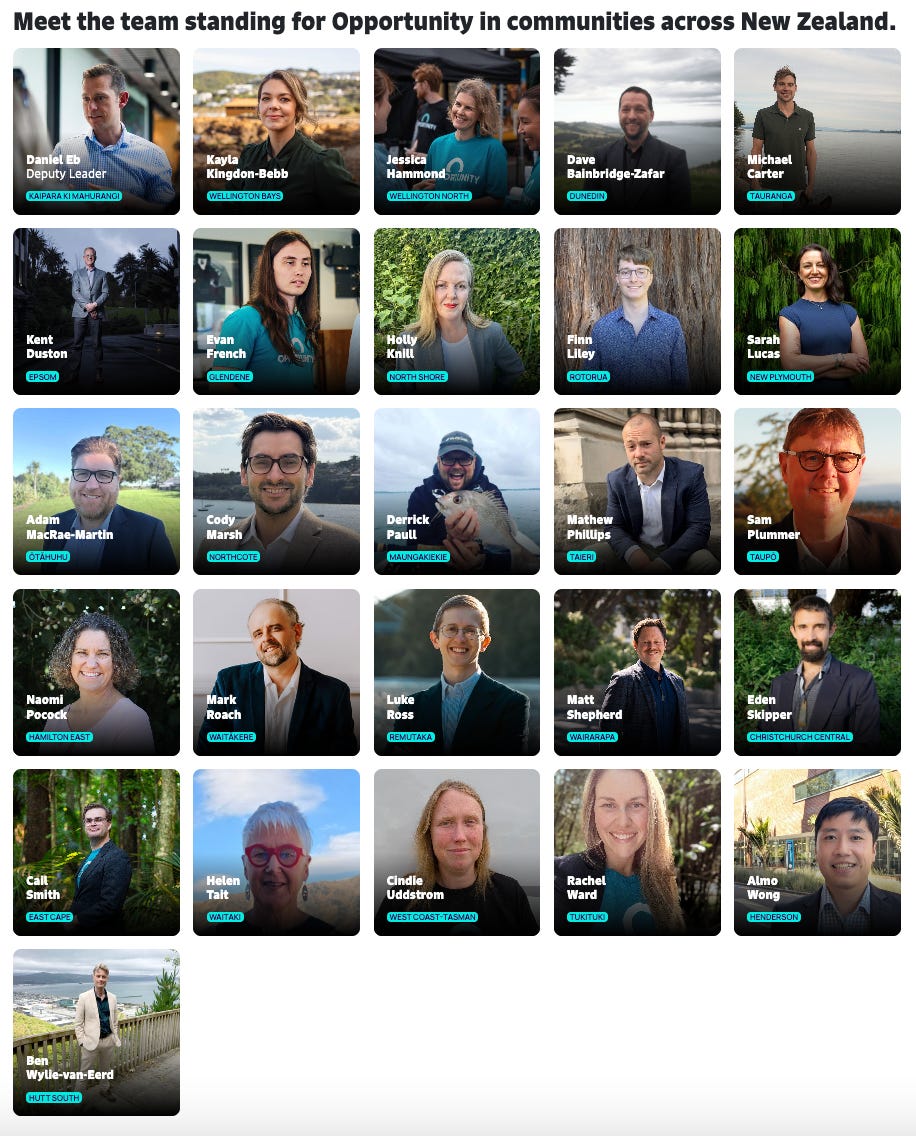
Despite failing to get a single candidate elected in its entire history, TOP does have support and is capable of mobilising a reasonably large number of small donors. Disclosed donations over the past few years show a mix of one-off larger backers and a heavy reliance on small donors. In 2023, individual donations from David Mahon ($5,278.46) and Ben Wylie-van Eerd ($6,098.20) sit alongside $277,034.37 raised from 6,436 donors under the $1,500 threshold, plus $11,935.74 from five donors in the $1,500–$5,000 range, and just $720 from anonymous donors. In 2024, Alan Wilderland made a $10,000 donation and $72,648.09 was raised from 2,865 donors each giving less than $1,500. A classic minor-party funding model with broad but shallow support, rather than concentrated backing. There are, however, occasional spikes that deviate from that pattern, like Brian Cartmell’s $100,000 donation and Phillip Mills’ $50,000.
Where TOP does become genuinely interesting is not in its claim to transcend the left-right divide, but in the space it should be attempting to occupy within the left. The Greens have spent the past term making themselves politically vulnerable in a way that creates an obvious opening. This is not simply a matter of isolated scandals, although those have undoubtedly eroded public confidence. It is their broader drift in focus from a party that built its brand on environmental stewardship but has increasingly found itself consumed by identity politics, internal controversies, and international causes that feel distant from the day-to-day concerns of New Zealand voters.
For many voters, particularly those who came to the Greens primarily through environmental issues, this creates a tension. They still care deeply about climate, conservation, and sustainability, but they are less comfortable with the wider ideological package that now accompanies those priorities. At the same time, the Greens’ economic agenda has become more overtly redistributive in ways that raise legitimate concerns about cost, incentives, and impact on working households. The combination of cultural drift and economic radicalism narrows the party’s appeal and leaves a segment of its traditional base looking for an alternative.
That is the gap TOP could realistically fill, and it is where its strategy should be focused. Because what TOP offers is, in effect, the original Green proposition of environmental focus, concern about inequality, long-term thinking, but without the baggage. It offers a more controlled, more professional, and more disciplined version of the same core appeal.
For disenchanted Green voters, that is an attractive proposition. The same is true for some Labour voters, particularly those who feel the party has lost direction but are not willing to cross the aisle to National. In that sense, TOP is more realistically competing within a specific slice of the left, offering a refinement rather than a departure from principle.
When you look at TOP’s policy platform in detail, the top-line priorities are carefully branded: healthy oceans, abundant energy, productivity unleashed, citizens’ voice, and a tax reset. They sound almost managerial, like a strategy document rather than a political manifesto. But “healthy oceans” is not just conservation, it’s a sweeping restructuring of marine governance, banning practices like bottom trawling, massively expanding protected areas, and embedding Treaty-based co-governance. “Abundant energy” is a state-led transformation of the energy system with large-scale investment, market restructuring, and electrification programmes designed to push the economy toward a fully renewable model. And “productivity unleashed”, which sounds like it might lean toward market-friendly, is really built around redirecting capital away from property via a land-value tax, expanding R&D spending, tightening regulation on “monopolies”, and actively utilising the state to weight the scale in shaping which sectors grow.
The “tax reset” is one of the most radical proposals in New Zealand politics: with a universal citizens’ income replacing much of the welfare system (and even superannuation), funded by a land value tax and paired with compulsory, high-contribution KiwiSaver. “Citizens’ voice” introduces citizens’ assemblies and a new layer of institutional oversight into democratic decision making. “Clean up politics” adds donation caps, lobbying regulation, and an anti-corruption commission. The party’s website says “Democracy works when everyone – rich or poor – is represented equally.” But they appear comfortable with ancestry-based political representation. “Honouring Te Tiriti” explicitly backs devolution of services and embedding Treaty principles across the state.

From there, the rest of the platform is a comprehensive centre-left programme of heavy environmental regulation (“healthy land”, “climate action”), expanded public investment and long-term planning (“intergenerational infrastructure”, including free public transport), active state intervention in housing markets to drive down prices, a prevention-focused and expanded public health system, and a justice model built around decriminalisation, rehabilitation, and raising the youth court age to 25.
Individually, many of these policies are defensible and, in some cases, thoughtfully constructed. They reflect a coherent world view that prioritises environmental limits, redistribution, state coordination, and structural reform of both the economy and governance systems. Everything about TOP’s candidate base and policy platform suggests a party that would feel far more at home negotiating with Labour, the Greens, and Te Pāti Māori. The idea that TOP is some kind of swing player, equally comfortable on either side of the aisle, does not survive contact with reality.
That’s why I baulked when the NZ Herald reported this week that “[Kayla Kingdon-Bebb] envisions TOP as the party disaffected National Party voters can rely on for a consistently centrist view and a strong interest in environmental protection.” This is dishonest campaigning, in my view. Because the way TOP is framing itself has real implications in an MMP system. If a party is widely perceived as genuinely centrist or ideologically flexible, it gains leverage and can position itself as a kingmaker, capable of working with either side. But if that perception is based on a misrepresentation of its underlying alignment, it distorts voter expectations. Voters who believe they are supporting a neutral, technocratic corrective are in reality reinforcing the left side of the ledger. Commentators who treat TOP as a potential partner for both blocs are overstating its credible range of options.
There is a predictable theme to all of this. Every few years, a version of the same project re-emerges, promising to rise above politics. Every few years, it is aggressively promoted by media in a way that no other party who has never been elected enjoys. And every few years, it turns out to be less novel than advertised.
The difference this time is that if TOP correct their strategy and pursue the left vote, the conditions are actually in their favour. The Greens are vulnerable, Labour is searching for direction, and voters are fragmented. If they do this the party may well perform better than it has in the past.
This article was originally published by Thought Crimes.