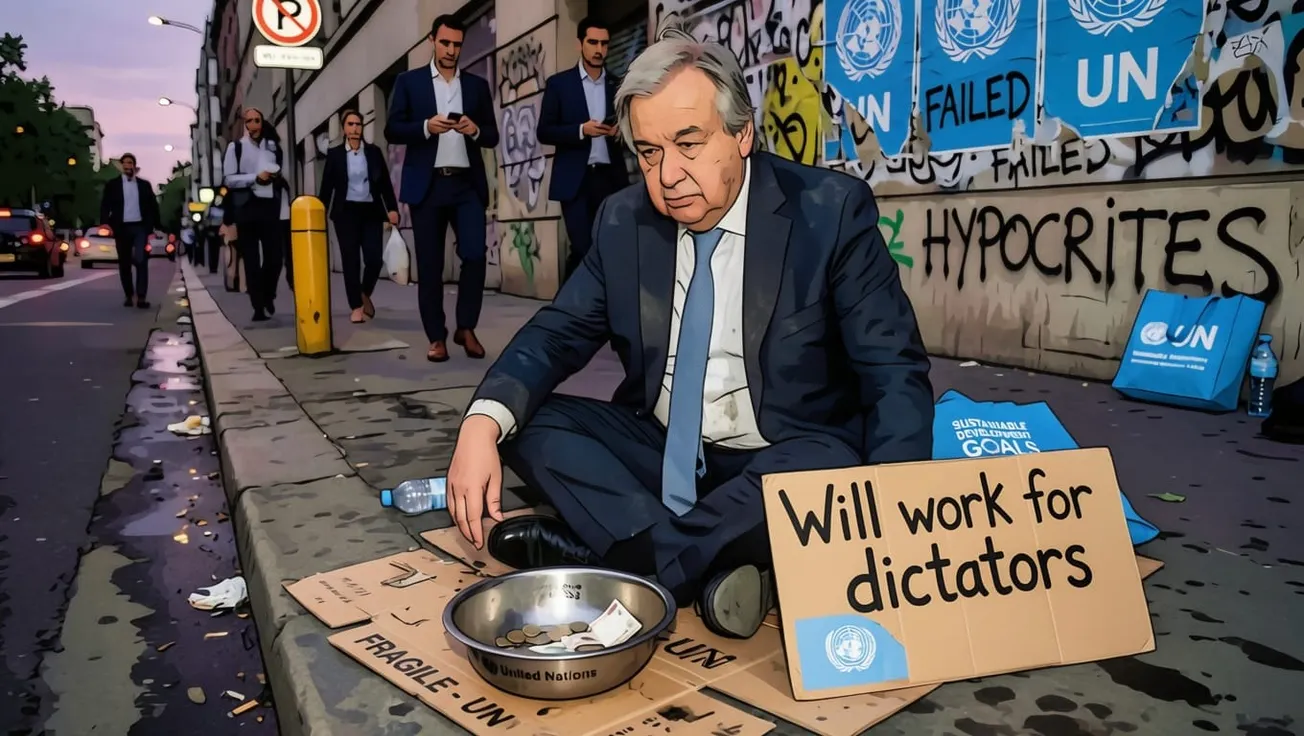
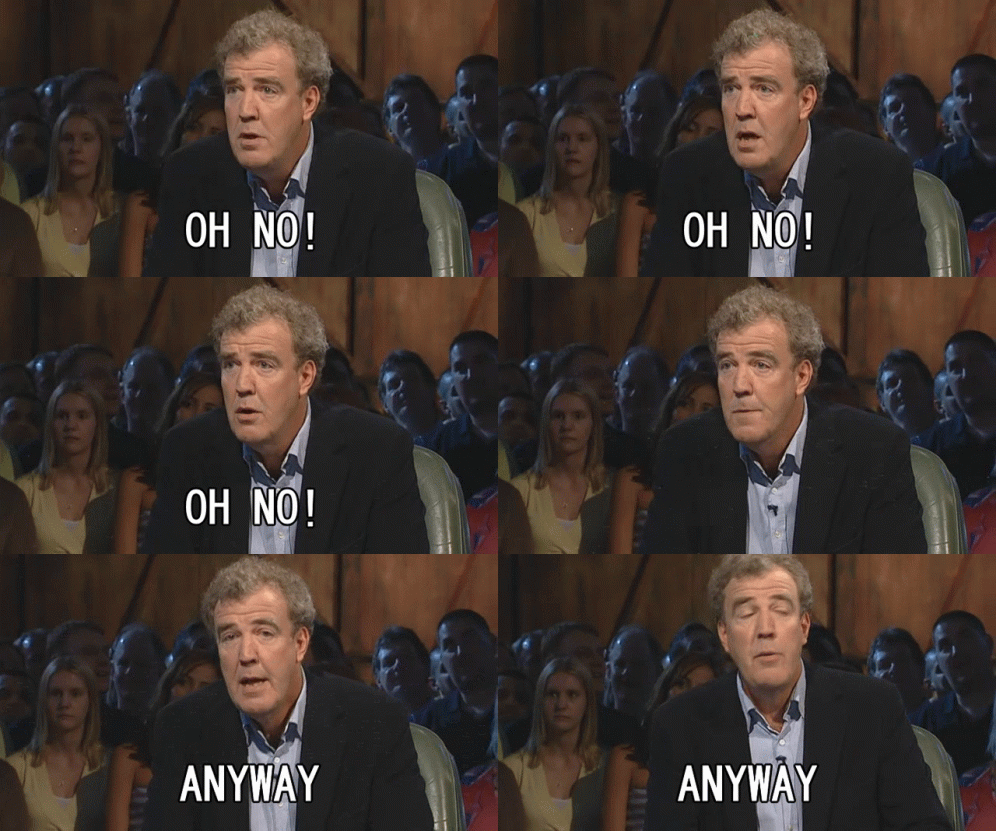
Here’s one for the “Oh no… Anyway…” files: the UN is about to run out of money.
It is now being reported that the United Nations is on track to run out of money by mid August as they are in an imminent financial crisis.
The UN is facing a severe liquidity crisis for their operating budget and that their available cash balance is only enough to pay for staff salaries etc. until the middle of August this year.
They have implemented energy conservation measures to try and save as much money as possible.
That raises even more questions, such as: why is the world’s leading climate alarmism peddler not already trying to slash their energy use? Isn’t shutting down elevators, dimming lights in corridors and turning down the heating and air conditioning in New York and Geneva exactly what they should have been doing for the last decade at least? But, no, as always, it’s been one rule for us peasants: another for the global elite.
“The crisis is deepening, threatening programme delivery and risking financial collapse... I cannot overstate the urgency of the situation we now face” said UN Secretary General António Guterres already in January.
In other words, the UN is on track for a complete financial collapse. And it is imminent.
Well, that’s one bright spot in an otherwise darkening world.
The UN was a noble idea in 1945. After the bloodiest war in history, the victors tried to build something better than the toothless League of Nations. Sovereign states would sit down, talk and prevent another global slaughter. That was the theory. Eighty years later the theory has curdled into something actively hostile to the very principles it was meant to uphold.
The UN’s own charter begins with respect for the sovereign equality of nations. Yet it later invented the doctrine of ‘Responsibility to Protect’: a bureaucratic euphemism for ignoring that sovereignty whenever the great powers feel like it. The results speak for themselves. In the Balkans, the UN’s dithering and safe-area charades helped produce Srebrenica. In Libya a UN-backed intervention sold as humanitarian protection turned a dysfunctional state into a failed one, complete with open slave markets and a decade of civil war. Sovereignty, it turns out, is only sacred when it protects the right people.
Then there are the peacekeeping missions. Decades of documented cases show UN troops and civilian staff sexually exploiting and trafficking children in the very countries they were sent to protect. Congo, Haiti, the Central African Republic: the pattern repeats. The organisation’s response has usually been internal reports, wrist-slaps and the occasional repatriation that changes nothing on the ground.
More recently the mask has slipped entirely on antisemitism. UN agencies and personnel have promoted anti-Israel propaganda so crude it would embarrass a third-rate activist group. UNRWA staff participated in the October 7 atrocities and used UN facilities to hold hostages. The organisation’s Special Rapporteur on the occupied Palestinian territories, Francesca Albanese, has been sanctioned by the United States. Secretary of State Marco Rubio put it plainly: she has “spewed unabashed antisemitism, expressed support for terrorism and open contempt for the United States, Israel and the West”. This is not fringe behaviour inside the UN system. It is rewarded with senior positions.
This is, after all, the same body that preaches human rights but routinely elevates regimes with some of the worst records on earth to its Human Rights Council and related panels. China, Cuba, Venezuela and sundry dictatorships rotate through with depressing regularity. The message is clear: if you have enough votes in the General Assembly, your atrocities are someone else’s problem.
Even the World Health Organization, a UN specialised agency, spent the early months of Covid parroting Chinese talking points and suppressing discussion of the lab-leak hypothesis. Officials with close ties to Beijing helped shape a global response that treated an authoritarian cover-up as authoritative science. The cost in lives and trust is still being counted.
The current funding squeeze is not an accident, but possibly one of the most significant foreign policy achievements of the Trump administration. The largest contributor, the United States, has been deliberately slow-walking payments, roughly $4 billion normally due, with only about $160 million handed over so far this year. The Trump administration has also announced withdrawal from more than 30 UN agencies and bodies, including the WHO, citing “radical climate policies, global governance and ideological programs that conflict with US sovereignty and economic strength”. Other nations are following the logic, if not the pace. One Nation, currently storming up the polls in Australia, is also advocating policies, such as withdrawing from the WHO and the United Nations Refugee Convention.
Like the League of Nations before it, the UN has outlived whatever usefulness it once possessed. It has become a lavish talking shop for authoritarian regimes, a jobs programme for international bureaucrats, and a vehicle for doctrines that undermine the nation-state system it was supposed to stabilise. It intervenes where it shouldn’t, fails where it should act and protects its own institutional interests above all else.
Running out of money by August would be embarrassing for any serious organisation. For the UN it would be a well-deserved comeuppance. The world managed without it for most of history. It is increasingly obvious that it could manage without it again.