Table of Contents
In Australia and New Zealand we remember the fallen on two solemn days: Remembrance Day, November 11, which is rapidly taking second-place to Anzac Day, April 25. Both commemorate events from WWI: the first landing of Australian and New Zealand troops at Gallipoli (Anzac Day) and the signing of the Armistice to end the war, at ‘the 11th hour of the 11th day of the 11th month’.
The United States also observes 11 November, but there it is known as Veterans Day and honours all veterans, living and dead. Americans specifically honour the fallen on Memorial Day, observed on the last Monday in May.
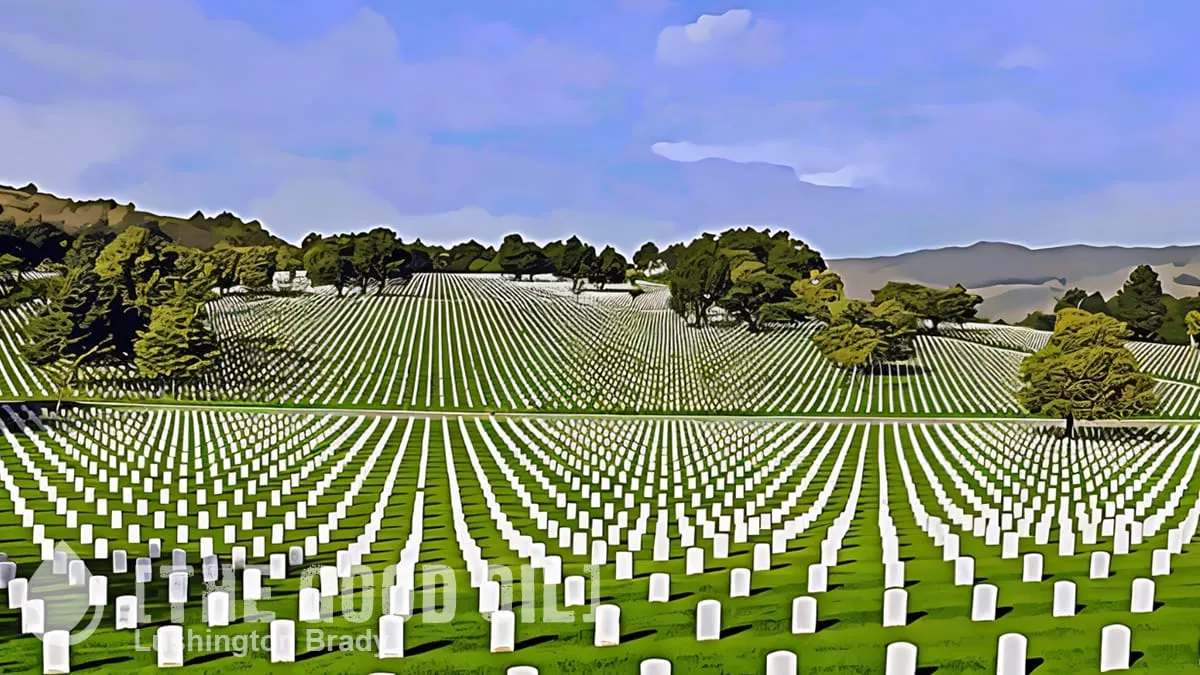
Memorial Day entered the American calendar shortly after the end of the Civil War, when Mary Ann Williams, who is credited with originating the “idea of strewing the graves of Civil War soldiers – Union and Confederate – with flowers”. Many of those graves are at the Arlington National Cemetery, nearly 260 hectares of hallowed ground in Virginia, just across the Potomac from the National Mall. More than 400,000 US service members and their family members, from every war and conflict fought by Americans since the Revolutionary War, lie buried beneath its sprawling lawns.
The site was established by George Washington Parke Custis, the step-grandson of the first president. In 1831 Custis’ daughter Mary married a first lieutenant in the US Army, named Robert E Lee.
The Lees abandoned the property as the Civil War broke out, and the US Army seized the site to defend Washington, DC. Three forts were built on the strategically important site, as was a refugee camp for freed and escaped enslaved people, Freedman’s Village.
The first person buried at the site that would become the National Cemetery was not a soldier.
It was George Washington Parke Custis’ cousin Mary Randolph, who died in 1828. Randolph drew on her experience running a plantation when she wrote “The Virginia House-Wife,” published in 1824 and considered the first American regional cookbook. Her recipes drew on African, Native American and European culinary traditions, and helped define what came to be known as Southern cuisine.
The first serviceman buried at the site was Private William Christman, 13 May, 1864.
Brigadier General Montgomery Meigs, the Army’s Quartermaster General, ordered the site be used as a cemetery, as the existing national cemeteries in the area – Soldiers’ Home (now called Soldiers’ and Airmen’s Home) and Alexandria National Cemeteries – were running out of space.
The idea of a national cemetery was not at first conceived as a means of generally honoring war dead. It was instead seen as a way to ensure that service members whose families could not afford to bring them home for a funeral were given a proper burial.
Still, there were 74 national cemeteries established in the wake of the Civil War. But as what was initially called ‘Decoration Day’, because of the tradition of laying flowers, caught on, Arlington became a particularly popular spot. By 1873, an amphitheatre was built to accommodate ceremonies. Over time, the originally 80-hectare site grew and grew.
As Allison Finkelstein, senior historian at Arlington National Cemetery, says, “You can explore every aspect of American history at Arlington.” One of the most obvious aspects of American history to be seen at Arlington is the end of segregation.
Like many cemeteries, and all national cemeteries at the time, Arlington was initially segregated by race. Section 27 had been the area for Black soldiers and free Black people, and more than 1,500 Black soldiers and 3,800 free Black people are buried there. Arlington remained segregated by race and by rank until 1948, when President Harry S Truman desegregated the military.
Initially, too, widows and wives of servicemen were the only women buried at the site. But, late in the 19th century, women who’d served as nurses during the Civil War won the right to be buried there. As more women served in the military, they also gained the right to be buried in Arlington.
It’s not just fallen soldiers or nurses buried there, either. Medal of Honor recipients are also eligible, regardless of their service status. Former presidents and certain high-ranking government officials may be buried there, as well. Civilians who died in service to the US military may be eligible, often due to their service in a military capacity or for reasons of national honor or public service.
Individuals who served on active duty, regardless of their subsequent military status, may be eligible. Hence, the cemetery is the final resting-place of the Apollo I astronauts, as well as five crew from the Space Shuttles Challenger and Columbia.
Child star Jackie Cooper Jr (Navy), actors Charles During (Army), Lee Marvin (Marines), Audie Murphy (Army), Maureen O’Hara (whose husband was an Air Force general), and Arctic explorer Robert Byrd (Navy) are also in Arlington.
Civil Rights activist Medgar Evers (Army), early baseball pioneer Abner Doubleday (Army), boxer Joe Louis Barrow (Army) and several Supreme Court Justices are also among those buried at Arlington.
There are two former presidents, John F Kennedy and William Taft, buried at Arlington. Although Abraham Lincoln is buried in Springfield, Illinois, his oldest son, Robert Todd Lincoln (a captain in the Union army), is buried at Arlington. Robert F Kennedy, Joseph P Kennedy Jr, Edward (Ted) Kennedy and Jacqueline Kennedy Onassis are buried there, too, as well as Secretaries of State, including Colin Powell, John Dulles, Alexander Haig and George Marshall.