Table of Contents
Back in WWI, anti-German hysteria reached fever-pitch. Streets and suburbs were re-named. Even the Royal Family changed their names: “Saxe-Coburg-Gotha” became “Windsor”, and “Battenburg” became “Mountbatten”.
Not even food escaped the madness: sauerkraut was, however temporarily, re-dubbed “liberty lettuce” in the US.
Even during the first Gulf War, demented prejudice saw French fries renamed “Freedom Fries”.
Of course, the sophisticates of modern culture sneer down their noses at such ludicrous displays of xenophobia.
Even as we do the same.
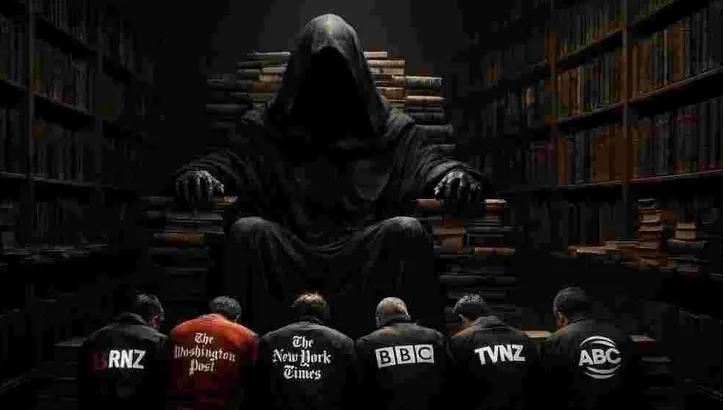
RNZ chief executive Paul Thompson has apologised for the “pro-Kremlin garbage” published on the broadcaster’s website and announced a review of processes for editing online stories.
This process of continuous alteration was applied not only to newspapers, but to… every kind of literature or documentation which might conceivably hold any political or ideological significance. Day by day and almost minute by minute the past was brought up to date
George Orwell, “1984”.
What “pro-Kremlin garbage”, exactly?
The journalist in question admitted that he had been changing wire stories from the Reuters news agency for at least five years.
“I subbed several stories that way over the past number of years, in fact, since I started [at] Radio New Zealand,” they said in a statement. “And I have done that for five years and no one has tapped me on the shoulder and no body told me I was doing anything wrong,” he said.
Because he wasn’t? There’s nothing in journalism ethics that says a journalist can’t use a wire story as just another source, and add their own colour or background info. Indeed, journalists uncritically running wire stories without even fact-checking it is regarded as a poor standard.
So, there’s nothing wrong at all with a journalist adding contextual information to a wire story.
All that was “wrong” in this case was that the context didn’t fit the mainstream media narrative.
In one example, a story about the Ukraine war was changed to describe Ukraine’s 2014 Maidan revolution that toppled a pro-Russian president as “violent” and to claim Russia’s annexation of Crimea came “after a referendum.”
“Russia annexed Crimea after a referendum, as the new pro-Western government suppressed ethnic Russians in eastern and southern Ukraine, sending in its armed forces to the Donbas,” the copy read.
Another on the destruction of the Nova Kakhovka dam described the Maidan revolution as a “coup”
The Australian
Each of those is true. Maidan was violent: hundreds were killed and the president was forced to flee the country. Whether it was a “revolution” or a “coup” comes down to the old adage of one man’s “freedom fighter” being another’s “terrorist” (in the case of, say, the Mujahideen, the difference between “freedom fighter” and “terrorist” was merely a matter of years and shifting US foreign policy). The new government in Ukraine did suppress ethnic Russians in the Donbas. There was a Crimean referendum: whether it was “legitimate” or not depends very much on your “side”, but it happened.
All of those were facts — so what was the problem?
The real complaint from RNZ’s editor is not that the changes were false, but that they were supposedly “pro-Russian”. Which is as good a concession as any that the mainstream media are cheerleading a side, not reporting the news.
But the anti-Russian hysteria doesn’t end there. Just as nobody could have a German name during WWII, no-one is even allowed to set a fictional story in Russia, now.
Penguin Random House is withdrawing a new novel by Eat, Pray, Love author Elizabeth Gilbert at her request after critics objected that it was set in Russia, according to a person familiar with the situation.
Gilbert said in a video she posted on Twitter Monday that she won’t publish the new book, The Snow Forest, after receiving objections from fans.
The author said she received “an enormous, massive outpouring of reactions and responses from my Ukrainian readers, expressing anger, sorrow, disappointment and pain” about her plans to release a book set in Russia.
I wonder what disgusting pro-Kremlin propaganda she was planning to unleash?
Set in Siberia in the 20th century, the new book tells the stories of people who removed themselves from society to “resist the Soviet government, and to try to defend nature against industrialization,” Gilbert said in the video.
The Australian
Well, we can’t have that, now, can we?

![[The Good Oil] Stuff Up of the Day](/content/images/size/w1304/format/webp/2024/09/Stuff-up-image-1.webp)