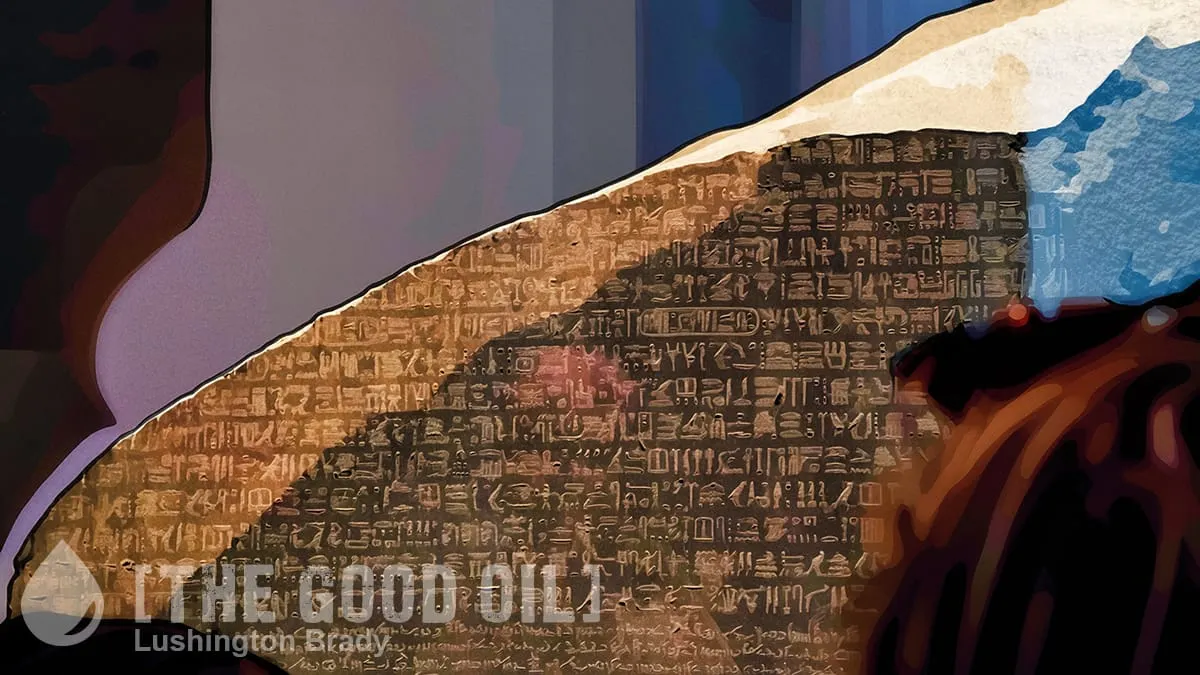
As Carl Benjamin has said, if we had to dig it up, you never really wanted it in the first place. Benjamin was responding, of course, to the endless, whining accusation from Third World grifters that Britain ‘stole’ this or that artefact. The harsh truth is that Britain either acquired them perfectly legally by the law of the day (such as the Koh-i-Noor diamond) or dug them out of rubbish heaps.
That includes the Rosetta Stone, which had been so little regarded by North Africans that they treated it as little more than rubble, using it to build a wall in a fort. It took a French officer to recognise its value.
Of course, once its value was recognised, the same people who had treated it as just another piece of rubbish suddenly started clamouring that it was their treasure. They’re still at it.
The latest grifter to try his luck is Chidi Nwaubani, a Nigerian-British artist who decided the Rosetta Stone belonged back in Egypt. So he and a mate wandered into the British Museum with an iPad, took a LiDAR scan – all without legal permission – and used augmented reality to plonk a digital version back in its original spot in Rashid. Of course they dress it up with a bit of oogabooga: the “soul” of the artefact has been “stolen back”, they say.
“The Rosetta Stone is the symbol of cultural imperialism and cultural violence,” says Dr Monica Hanna, the Egyptian Egyptologist who helped out. It’s almost impressive how many layers of hypocrisy she packs into one sentence.
Nwaubani isn’t even Egyptian. He’s Nigerian, from sub-Saharan Africa. His claim on the Rosetta Stone is as credible as Donald Trump calling dibs on the Crown Jewels because his ancestors once visited London. Ancient Egypt was a North African civilisation with its own distinct history, language and culture. A Nigerian has no more ancestral stake in it than a Swede has in the pyramids. Yet here he is, lecturing the world about ‘reclaiming’ something that was never his to begin with.
“As Africans, for the most part, our history has been written and taken over by people from the outside,” Nwaubani whines. The irony is thick enough to stand a spoon in. He is the outsider culturally appropriating Egyptian history for his own art project while finger-wagging at the British for doing the same thing two centuries ago.
As for Hanna, her support makes the hypocrisy complete. For as start, Egyptians spent the last few thousand years looting all the treasures of the pharaohs they could get their claws on. Maybe the British couldn’t relocate the Great Pyramid, but Egyptians long ago gave it the old college try, stealing the once-magnificent limestone outer facing and massive electrum cap. Secondly, an Egyptian academic cheering on a Nigerian to ‘return’ Egyptian heritage is cultural imperialism in reverse. If the West did this, it would be denounced as neo-colonial theft of someone else’s story. When it suits the narrative, though, suddenly it’s all about “global stories of conquest”.
The Benin Bronzes offer a perfect case study in why these artefacts are safer in Western museums. Some were ‘returned’ to Nigeria. They promptly vanished into a private collection after being looted by Nigerian officials. The same pattern repeats across Africa and the Middle East. Artefacts ‘repatriated’ disappear into the pockets of corrupt elites or get destroyed in the next round of tribal warfare. The priceless relics of Nineveh, for instance, or the ancient Buddhas of Bamiyan.
They’ve worked with artists in Sudan, where artefacts have been destroyed by war.
Yes, destroyed by Africans killing each other in endless civil conflicts. Had those pieces been ‘stolen’ by the British instead, they would still be intact in a climate-controlled gallery rather than reduced to rubble by the latest warlord with a grudge.
Nwaubani insists the physical return isn’t the point. It’s about “the return of agency, the return of power, the return of story”. Well, it’s about power, all right. The power to hypocritically shame Western institutions while the actual descendants of the people who built these things loot, sell or smash whatever is left. Only recently, an artefact from an Egyptian museum was stolen by one of the Egyptian curators and melted down for the gold.
The Rosetta Stone was rubble when the French found it. The Benin Bronzes were seized as legitimate spoils of war after a brutal local regime was toppled. Countless other pieces across the developing world have been smashed, melted down or buried in rubbish heaps because the people living there no longer cared. The West preserved them, studied them and made their knowledge available to everyone.
We’ll start taking finger-wagging lectures from Third World grifters about ‘cultural imperialism’ when they stop the looting and destruction. Until then, the stuff is safest in a Western museum, where it won’t be used as a doorstop or melted for scrap the moment the next strongman needs cash.