In Sean McMullin’s excellent post-apocalyptic Greatwinter Trilogy novels, thousands of years in the future there is no more electricity. Ancient battle satellites still circling the skies will automatically lay waste to any area where they detect electromagnetic activity. So, all technology is wind and human-powered. Trains run on sails and treadmills — and passengers can reduce their fare by contributing their own efforts, courtesy of a treadmill in every compartment.
Wellington’s ferry operators might want to consider such an option in the future.
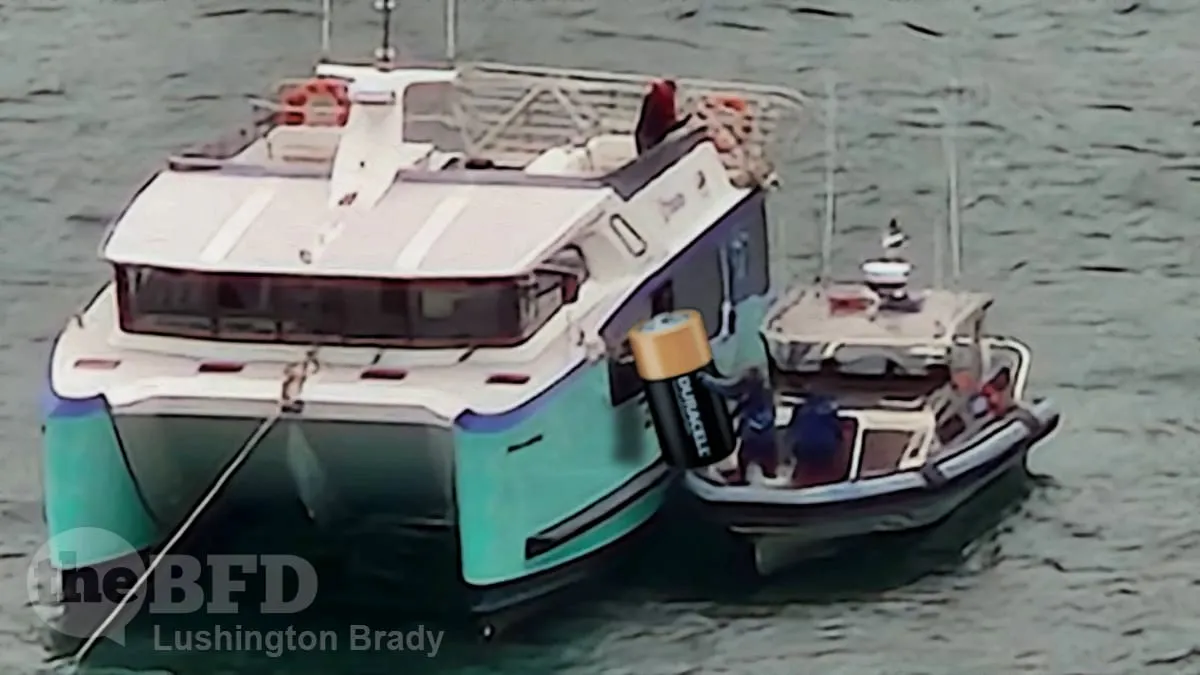
Passengers on Wellington’s new electric ferry were rescued by a police boat after the ferry lost power.
A police spokesperson confirmed to the Herald the Ika Rere had run out of battery in the harbour and all passengers on board were transferred to the police boat.
They were then escorted back to Queen’s Wharf, and the police boat went back out to help tug the ferry back to port.
Was the boat electric, too? A waka with paddles? Or, a good, old-fashioned, diesel motor?
Harbourmaster Grant Nalder said the boat was on its way back to Queen’s Wharf from Days Bay when the power issue began.
“The skipper got it to a safe spot and put the anchor down.”
NZ Herald
The only problem was that it was out of reach of the extension cord.
Wellington’s ferries are far from the only electric vehicles to prove not up to the task in a workplace setting.
Electric police cars in rural areas are leaving officers struggling to reach crime scenes when they ‘run out of puff’, according to one police chief.
Gloucestershire’s Police and Crime Commissioner Chris Nelson says that his police officers have difficulties reaching far flung emergencies in electric vehicles.
The force boasts the largest fleet of electric cars by percentage size, but when they run out of power officers struggle to locate charging points out in the sticks.
As a result officers are having to change vehicles without even reaching emergency sites, he claims.
Daily Mail
Of course, petrol cars can run out of fuel, too. But these incidents with police vehicles and ferries highlight the inherent issues with electric vehicles that petrol ones do not have, in an operational setting.
It’s all very well for Primrose of Grey Lynn to leave her Leaf on charge all night so she can do a bit of shopping tomorrow. Even the most efficient chargers take up to 40 minutes — and that’s just to 80% charge. A full charge will take more than an hour. Policemen and ferry operators don’t have the luxury of sitting around, sipping an almond latte, while their smugmobile recharges.
Even letting an EV run low on charge will damage the battery and reduce its efficiency and lifespan. Battery performance is also heavily affected by the ambient temperature.
Of course, given New Zealand officialdom’s fetish for all things Maori, perhaps they ought to swap the electric ferry for a paddle-powered waka.


![[The Good Oil] Stuff Up of the Day](https://storage.ghost.io/c/31/f4/31f4e20a-0315-499e-83ff-139e8eab53bf/content/images/size/w1304/format/webp/2024/09/Stuff-up-image-1.webp)