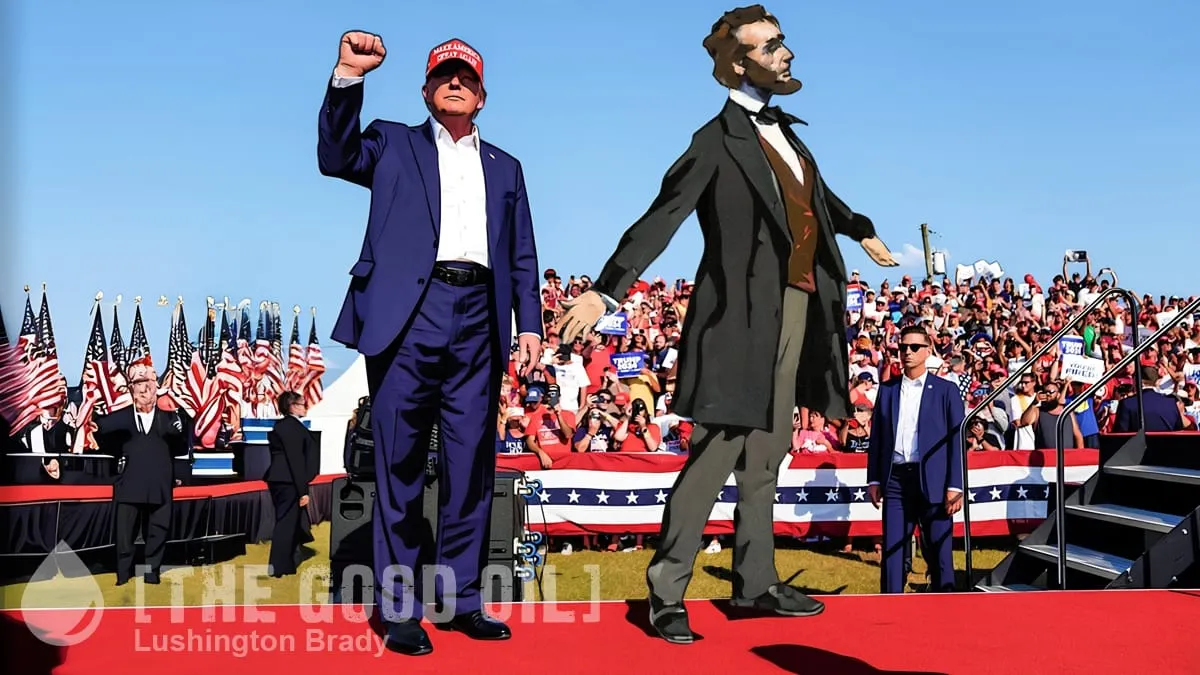
What do Donald Trump and Abe Lincoln have in common? A lot, as it turns out. Both Republicans and both the best thing to happen for black Americans in decades – and both made their political careers via a grand American tradition: the stump speech.
Lincoln was early dubbed ‘the Giant Killer’, when he made his political career in an 1858 series of debates with Stephen Douglas. Douglas was dubbed “the Little Giant”, as double-edged tribute to both his short stature and his domineering ability in political debates. Lincoln wiped the floor with Douglas, failing to win the Senate seat on offer, but achieving national fame.
When Donald Trump launched his political career in 2015, he eschewed the ‘clever’ digital campaigning of Barack Obama, who bought space in video games for instance, and instead revived the great American stump speech. It was a brilliant move that infuriated the legacy media and coastal elites as much it mystified them. Completely failing to see their own glaring hypocrisy, they screeched about “threats to democracy” even as crowds packed stadiums across the country – almost always spilling out to surrounding seats.
Trump may not be as mellifluous as Obama, but he doesn’t need a teleprompter, either. He simply shows up, steps to the podium, and lets rip – often for 90 minutes or more – in front of tens of thousands who’ve queued for hours to hear him. It’s raw, unfiltered, occasionally rambling, frequently hilarious and always unmistakably American. It’s electrifying and nothing less than a roaring revival of one of the republic’s great traditions: the soapbox orator, the stump speaker, the man (or woman) who climbs atop whatever is handy and holds forth.
From the 1890s to the mid-1960s, [Chicago’s ‘Bughouse Square’] was a hotspot for soapbox speakers: radicals, evangelists, cranks, poets, philosophers, and eccentrics. Anyone with a perspective outside the mainstream gathered there nightly to declaim from their improvised podiums. The ethos, as one newspaper put it, was ‘free speech and the louder the better.’ People actually came to listen, too, in crowds.
Bughouse Square – properly Washington Square Park – was merely the most famous site of American speechifyin’. From New York’s Union Square to street corners across the country, the early 20th century was the golden age of the American soapbox. Hubert Harrison, the ‘Black Socrates’, tore into capitalism outside the Stock Exchange. Suffragettes drew massive crowds. Anarchists, socialists, prohibitionists and salvationists all had their turn. Like Trump rallies, it was as much pure theatre as debate: Lowlife McCormick escaped a straitjacket as a metaphor for wage slavery. Another would yell “I’ve been robbed!” before revealing the culprit: the capitalist system. Good speakers could stop traffic. Great ones built movements.
It was messy, chaotic and gloriously democratic.
As Mary Anne Trasciatti writes in “Athens or Anarchy? Soapbox Oratory and the Early Twentieth-Century American City,” the soapbox was a particularly democratic mode of public address. Even if you couldn’t get your cause into a meeting hall or a newspaper column, you could still hop on a box, lift your head a few inches above the crowd, and start talking. But that doesn’t mean just anyone could be a successful soapboxer. You had to be a good speaker to keep the crowds listening.
These are exactly the same qualities that made Trump the most electrifying political performer of the modern era. Americans, as Stephen Jay Gould once wrote, love speechifyin’ and they know when it’s good.
The left, of course, hates it. They prefer their politics sanitised, stage-managed and delivered through approved channels by polished professionals who never say anything off-script. Democrat national conventions literally script “spontaneous applause”.
Trump’s rallies, by contrast, terrify the left because they bypass the political priesthood entirely. No focus groups. No teleprompter grovelling. Just the man, the crowd and unvarnished connection. It’s the 21st-century equivalent of the Wobblies overwhelming San Diego with free-speech fighters, except this time the ‘radicals’ are working-class Americans demanding secure borders, cheap energy and an end to endless foreign wars.
And like the old soapboxers, Trump draws the inevitable establishment backlash. They call his rallies ‘threats to democracy’ while ignoring that the crowds are there voluntarily, often paying their own way, because they finally feel heard. The same elites who cheered Occupy Wall Street or BLM street theatre suddenly discover that large, boisterous public gatherings are dangerous when they’re full of plumbers, truck drivers and small business owners rather than trust-fund radicals.
The genius of Trump’s approach is that it restores something the professional political class thought they’d killed: genuine, unmediated connection between leader and people. In an age of algorithmic curation and legacy media gatekeeping, the rally is the new soapbox. Bigger, louder and, thanks to modern technology, reaching millions more. It proves that the hunger for authentic public oratory never died: it was simply starved by a system that preferred managed messaging to messy democracy.
The old Bughouse Square is long gone, sanitised into just another polite urban park. But its spirit lives every time Trump takes the stage. The crowds still come. They still listen. And they still leave energised, not by polished pablum, but by a man willing to say out loud what millions are thinking.
That, more than any policy speech or carefully worded op-ed, explains why the institutional left cannot stand him. He has revived a tradition they thought safely buried: the American citizen standing up, speaking his mind and daring the crowd to follow. Long may the rallies continue. The republic needs its soapboxers now more than ever.