Table of Contents
James Hickman
James Hickman (aka Simon Black) is an international investor, entrepreneur, and founder of Sovereign Man.
A new Gallup poll finds that 29 per cent of Americans now say government itself is the country’s biggest problem.
That’s a higher percentage than people who think America’s biggest problem is the economy. Or immigration. Or inflation.
Think about that for a moment. The institution whose entire job is to solve problems has become, in the eyes of the public, the single biggest problem of all.
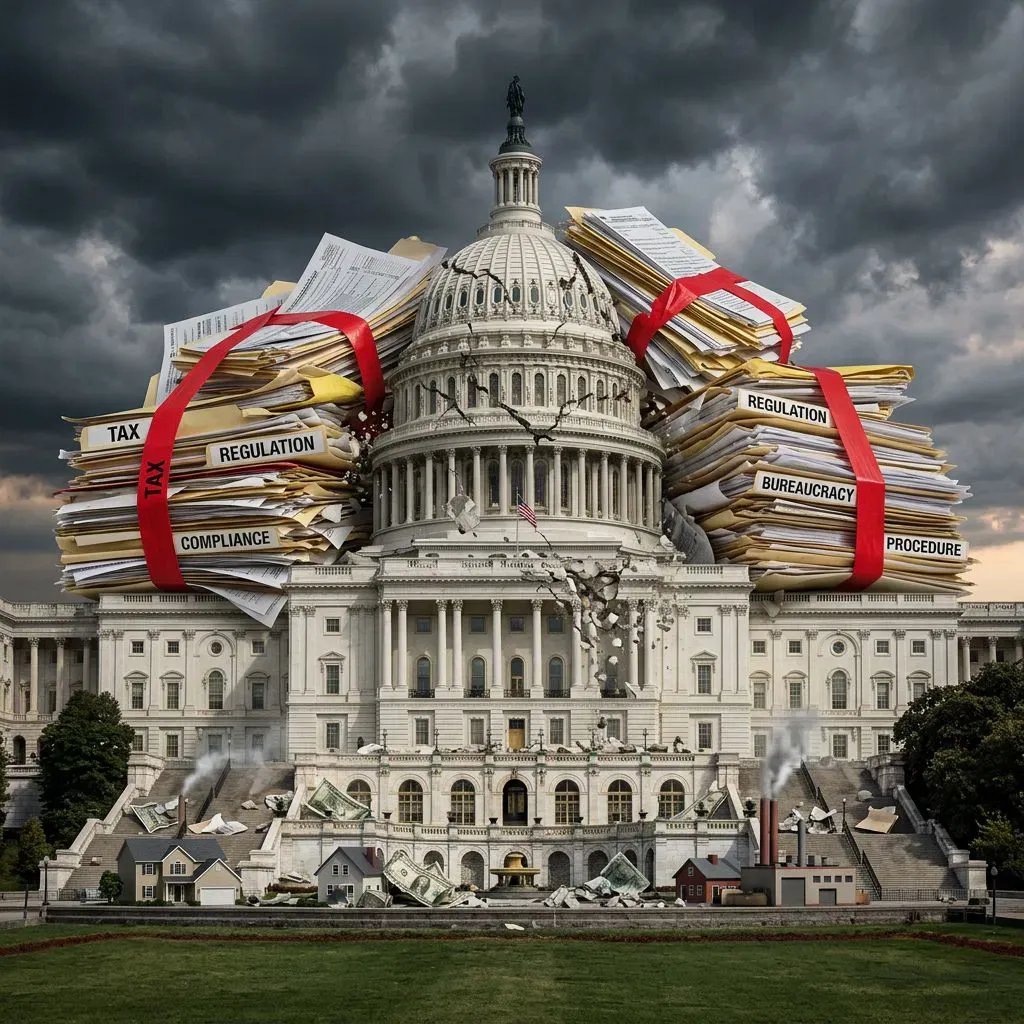
Joseph Tainter described exactly this phenomenon in his 1988 book, The Collapse of Complex Societies. Tainter studied empires from Rome to the Maya and found the same pattern every time: as societies grow, they create layers of bureaucracy and complexity to solve problems.
Eventually the bureaucracy becomes so bloated and expensive that it stops solving anything – and starts generating new problems instead.
And you can see it playing out in real time. Rather than address why it is failing to solve problems with the $5 trillion plus it already collects, a growing number of politicians simply want to extract more wealth from the people who create it.
Senator Bernie Sanders and Representative Ro Khanna just introduced the “Make Billionaires Pay Their Fair Share Act” – a five per cent annual wealth tax on America’s roughly 938 billionaires, which they optimistically estimate would raise $4.4 trillion over 10 years. That’s about $440 billion a year.
Sounds like a lot. Until you remember the federal government is running $2 trillion deficits every single year. Sanders’ grand plan wouldn’t cover a quarter of the annual shortfall.
And that’s the best case – which assumes no billionaire leaves the country, no assets decline in value, no capital flees to friendlier jurisdictions.
Britain tried something similar when the Labour government abolished its 110-year-old “non-dom” tax regime. The result? Over 10,000 millionaires left the country, and tax revenue actually fell.
But even setting aside the question of whether it would ‘work,’ a five per cent annual tax on existing wealth – compounding every year – is an extraordinarily destructive idea.
It’s not a tax on income. It’s a tax on assets – on the factories, businesses, and investments that employ people and produce things.
If you tax at five per cent annually, within 15 years you’ve confiscated more than half the wealth. You haven’t funded the government. You’ve just driven capital, talent, and entire companies to friendlier places.
Then what? America is poorer. There are fewer businesses, fewer jobs, fewer wealthy people left to tax. Growth slows. Tax revenue declines. The deficit gets worse, not better.
The federal government already collects $5.2 trillion a year in tax revenue. The problem was never insufficient taxation. It’s a spending addiction that no amount of taxation can feed.
And we know that’s true because the entire federal budget in 2019 was $4.4 trillion.
If Congress had simply held spending at that level, the government would have posted an $800 billion surplus last year. Even adjusted for inflation, they would have roughly broken even – without making a single spending cut.
Instead, spending surged 59 per cent to over $7 trillion.
And what did Americans get for it? Roads and bridges are still crumbling. Social Security is still barreling toward insolvency. Is America safer? Is inflation down? Do we receive more government services?
No.
The only people it’s working out for are the Somali immigrant fraudsters who are part of the network that steals $600 billion from taxpayers every year.
And the bureaucrats in California, where the legal graft funnels $100 billion in government grants to DEI initiatives, intersectionality programs, and non-binary construction apprenticeships.
Of course this dysfunction is not just at the federal level.
In Los Angeles, fire victims who lost their homes in the devastating Palisades fires have been receiving citations from the city’s fire department – for failing to clear brush on properties that already burned to the ground.
In Baltimore, where the Francis Scott Key bridge collapsed in March 2024, the city initially said that reconstruction would cost $1.7 billion and be complete in 2028. Nine months later they revised their cost estimate to $5.2 billion, and completion to 2030.
These people just cannot execute.
This is what late-stage institutional decay looks like. Not a dramatic collapse, but a slow, grinding loss of competence and legitimacy – where the government’s primary function shifts from solving problems to perpetuating itself.
But here’s the thing – history shows that this kind of decay is less “end of the world” and more forest fire. Painful, yes. Destructive, absolutely.
But forest fires clear out the deadwood, return nutrients to the soil, and make way for new growth. It’s happened to every overgrown empire in history, and what comes after is almost always better than what came before.
The sensible course of action is to make sure, one, you have fire insurance, and two, you’re positioned for the new growth.
This article was originally published by Sovereign Man.