Table of Contents
As I’ve written several times, official data from China must be treated with a grain of salt bigger than all of Qinghai’s Chaerhan Salt Lake. Always, always remember that official data is strictly whatever the Chinese Communist Party wants the world to see.
And we all know just how reliably truthful the CCP is.
Sometimes, the oddest things slip through the cracks. For instance, despite the assiduous data-scrubbing the CCP undertook when Covid broke, a few little things got missed. Job ads for the Wuhan laboratory, or the online bio of a key scientist who subsequently disappeared from the face of the Earth.
Outside China-watchers also sometimes resort to proxies to try and guess the truth. The scale of lighting in cities at night, for instance, which is a proxy for economic activity. In another case, shortly after Covid, one watcher noticed that a mobile telco suddenly removed millions of subscriptions from its services.
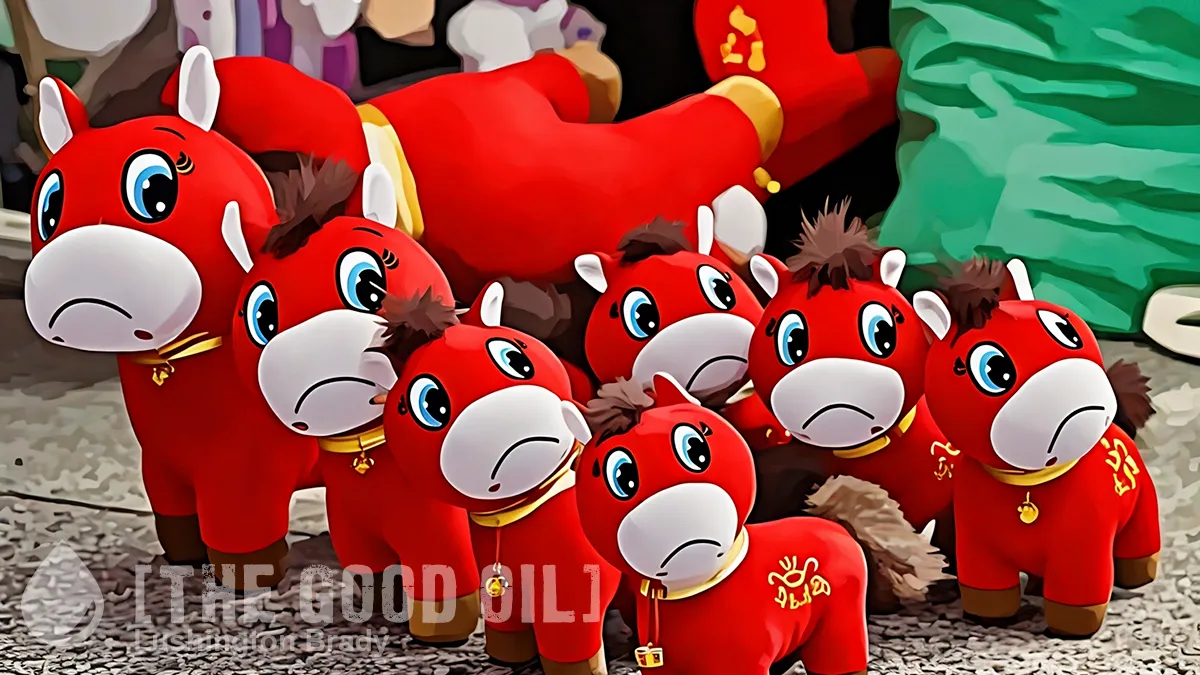
Sometimes, the oddest little things can shine a light through China’s great firewall. Such as a toy horse featured in viral social media posts.
The posts took off. The hashtag #YiwuCryCry-HorseGoneViral had garnered about 100 million views on the social media platform Sina Weibo by Jan 11, according to the Straits Times.
Now, “crying horse” – sometimes referred to online as “cry-cry horse” – is being upheld as a symbol of the overworked and undervalued.
The toy was originally intended to be a cheerful plush mascot for the Chinese Year of the Horse. Instead of stitching its smile, though, a factory worker accidentally turned that smile upside-down on one toy. Zhang Huoqing, owner of the Yiwu-based shop Happy Sister, offered the purchasing customer a refund, when she noticed the flaw. She never heard back.
Instead, shortly after, she found photos of it circulating online, after a Hangzhou user posted a photo to China’s social network, Sino Weibo.
The posts went viral, with the hashtag #YiwuCryCry-HorseGoneViral garnering 100 million views in days. Demand for the ‘flawed’ toy exploded, with orders soon reaching 15,000 a day, faster than the factory could keep up. Over a dozen production lines running at full capacity still can’t keep up. Orders are backlogged well into next year.
This seemingly trivial fad potentially tells us a lot about contemporary China. Most especially, that the CCP’s much-vaunted ‘harmonious society’ ain’t exactly feeling the harmony.
Wang Bin, a professor of social media communication at Renmin University of China, told China Daily he interprets the trend as a psychological response to widespread social fatigue.
“This little horse looks so sad and pitiful, just like the way I feel at work,” a buyer named Tuan Tuan Mami said online, according to the South China Morning Post.
Like the short satirical animation banned by the CCP, shortly after the tainted milk scandal, the viral sad toy is yet more evidence of a declining social moral in China.
As the South China Morning Post points out, many young people in China call themselves niu ma, a term that means “cattle and horse.” Chinese news site Sixth Tone explains that niu ma has “become a popular online shorthand for China’s overworked, undervalued employees.”
Many Chinese employees are expected to work a 72-hour week under the country’s “996” culture: 9 am to 9 pm, six days a week. Despite attempts to change that culture, intense overtime has remained a common practice in China.
Enter crying horse, which, according to Business Insider, costs about 25 Chinese yuan, or just under $5. Online, young workers are turning it into memes, posting photos of the horse with captions like, “me when my proposal gets rejected,” says Business Insider.
“People joked that the crying horse is how you look at work, while the smiling one is how you look after work,” Zhang told Reuters.
How long before, like Winnie-the-Pooh, the meme is banned from Chinese social media?
The CCP is desperate to maintain the face of a happy communist society, united under the red banner of Mao and Xi. And nothing escapes their notice. The popular dating game show, If You Are the One, was ordered to tone things down after its first season, because it gave off an impression of modern Chinese society very much at odds with the image the CPP wishes to project.
As the viral toy shows, though, the reality appears far different. This is far from trivial. Much of the legitimacy of China’s communist dictatorship rests on its claim that Chinese have never had it better. Like Animal Farm’s Squealer, Chinese media relentlessly peddles a message of hyper-optimism.
Still, just as in Animal Farm, some of the animals can remember a time when there was more food and less work.