Table of Contents
As the horror of the Bondi anti-Semitic terror attack sinks in, one of the more grotesque outcomes is that Jewish-Australians are being advised to be ‘less identifiably Jewish’ in public, and calls for the curtailment of Jewish events and celebrations. It’s only just satire that the Babylon Bee carried the headline, “To Halt Violence Against Jews, Australia Bans Hanukkah”.
Even worse is the likelihood that many Jewish-Australians will flee this country for the sanctuary of Israel. When even a country in a multi-front war is safer for Jews than Australia, we really ought to hang our heads in shame. We should also worry, because of the tremendous loss to Australia that the loss of a Jewish Australia would represent. The profound influence of Jewish Australians to the nation’s public life ranges from science and the military, to the arts and culture, with a strong emphasis on philanthropy.
The history of Jews in Australia is as old as European settlement itself. There were as many as a dozen Jewish convicts on the First Fleet, making Jews one of the earliest non-Christian groups present in Australia. Many of these convicts were transported for minor property crimes, reflecting the restricted social and economic opportunities Jews faced in 18th-century Britain.
Contrary to what we might expect a penal colony to be, the settlement at Sydney Cove proved to be an opportunity as much as punishment. The small society of Jewish convicts, and later free settlers, were quick to embrace the opportunities of the colony, becoming merchants, traders and publicans, integrating rapidly into colonial society.
Jews benefitted from the relative religious tolerance of the colonies, where civil disabilities that existed in Britain were largely absent. As a result, Jewish Australians were able to participate fully in economic and civic life from an early stage. Within 30 years of British settlement, a dedicated Jewish cemetery was established and Jewish worship commenced. The first Jewish wedding, between Moses Joseph and Rosetta Nathan, took place in either 1830 or 1832. By the 1840s, the first synagogue was established in Sydney (although Australia’s surviving synagogue today is in Hobart, built 1845).
Jewish Australians were prominent in commerce and finance throughout the colonial and Federation eras. Families such as the Cohens, Levys and Goldsbroughs played key roles in retail, pastoral finance and international trade. Sir Saul Samuel, a prominent merchant and politician, became the first Jewish member of the New South Wales parliament and later served as Agent-General in London.
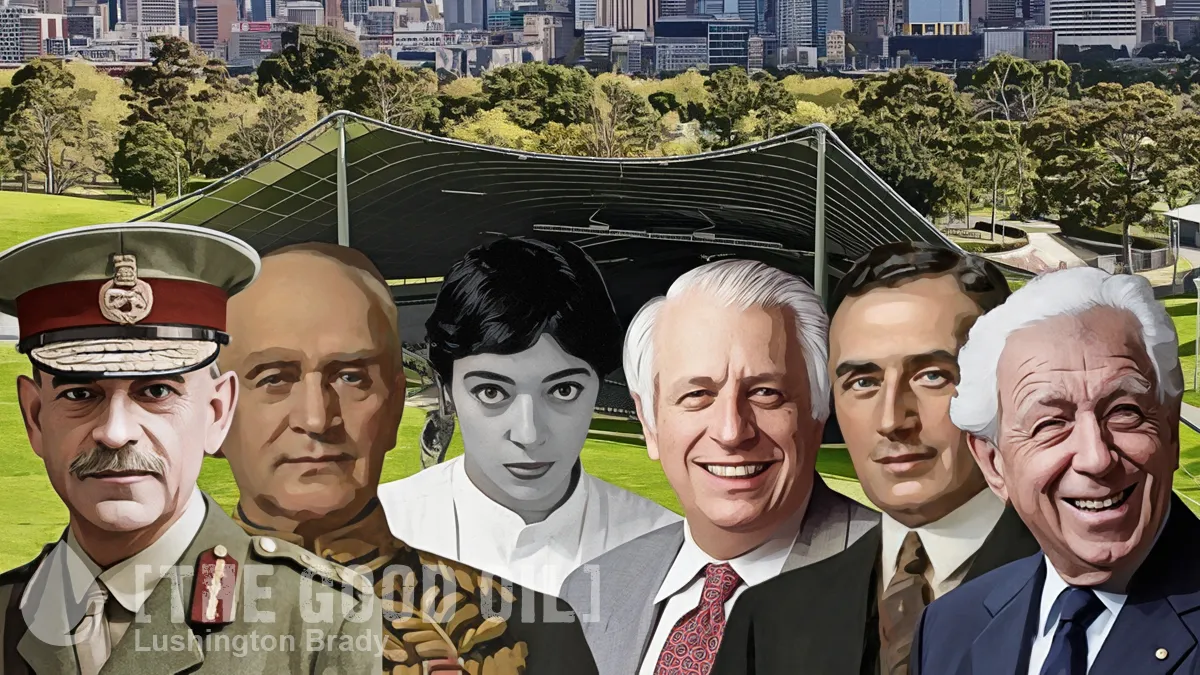
Jewish entrepreneurs helped build Australia’s retail sector, including the development of department stores and wholesale trading firms. Their success was often reinvested into Australian society through philanthropy, education and public institutions, establishing a pattern of civic contribution that continues today. For instance, the foundation started by businessman and philanthropist Sidney Myer, himself a violinist, built Melbourne’s iconic Sydney Myer Music Bowl, inspired by the Hollywood Bowl. Myer had long funded free open-air concerts with the Melbourne Symphony Orchestra, a tradition which continues to this day in the open-air venue that bears his name.
Few people, though, better symbolise Jewish contributions to Australia than its most celebrated soldier, and significant figure in global military history, General Sir John Monash. Born in Melbourne in 1865 to German-Jewish parents, Monash rose to become one of Australia’s most celebrated military leaders. As commander of the Australian Corps during the First World War, Monash pioneered modern combined-arms warfare, integrating infantry, artillery, tanks, and aircraft with meticulous planning.
Monash’s leadership was instrumental in the Allied victories of 1918, particularly at the Battle of Hamel. Despite facing antisemitism during his career, Monash was appointed commander-in-chief of Australian forces and later became one of the nation’s most respected public figures. After the war, he served as vice-chancellor of the University of Melbourne and led major infrastructure projects, including the State Electricity Commission of Victoria.
A measure of Monash’s greatness is best exemplified by Sir Robert Menzies’ recollection of an august gathering when those around Monash instinctively knew that he was a greater man than they would ever be. Opening the university named after Monash (my alma mater, as it happens), Menzies dubbed him, “one of the greatest of Australians of all time – wonderful engineer, a famous and tremendous soldier, a scholar in his own right, a great expert in many fields of life and an advocate, not only an advocate of good causes, but… one of the greatest advocates I ever listened to in my life”.
A few decades after the Great War, with the second looming, Australia was finally permitted to appoint its first Australian-born governor-general. The man chosen for the honour was Sir Isaac Isaacs. The son of Jewish Gold-Rush-era immigrants from Poland, Isaacs served as attorney-general in the epochal early federal government of Alfred Deakin, and later as Chief Justice of the High Court. Despite opposition from King George V, Isaacs was appointed governor-general in 1931. The first governor-general to live full time at the official residence, Yarralumla, Isaacs earned the respect of Depression-era Australians for his frugality in office.
The rise of Nazism and the Holocaust transformed Australian Jewry. During the 1930s and 1940s, Australia accepted Jewish refugees fleeing persecution in Europe, although immigration quotas were limited. After the war, Holocaust survivors arrived in significant numbers, particularly in Melbourne and Sydney. These new Australians rebuilt their lives with remarkable resilience, contributing to industry, medicine, academia and the arts.
The postwar Jewish community helped shape Australia’s multicultural identity. Jewish Australians were among the strongest advocates for refugee resettlement, human rights, and remembrance of historical injustice, contributing to broader conversations about tolerance and diversity in Australian society.
Jewish Australians have also been prominent in science, medicine and scholarship. Sir Gustav Nossal, an immunologist of international renown, made foundational contributions to medical research and public health. Other Jewish scientists and academics have been leaders in physics, law, economics and philosophy, reflecting the strong Jewish cultural emphasis on education and intellectual inquiry.
Universities, research institutes and hospitals across Australia have benefitted from Jewish leadership, endowments and mentorship, helping to position Australia as a centre of scientific and medical excellence.
Jewish Australians have made enduring contributions to Australian cultural life. In literature, writers such as Judah Waten, Arnold Zable and Lily Brett explored themes of migration, memory, and identity. In visual arts, figures such as Judy Cassab, Sali Hermann, Mirka Mora, and others, brought international influences into Australian modernism. Georges Mora (husband of Mirka and father of actor Tiriel Mora, best known as ‘Dennis Denuto’ of The Castle) established the Tolarno Gallery in Melbourne’s St Kilda, helping establish the bayside suburb as a long-running bohemian enclave.
In film, theatre and music, Jewish Australians have been prominent as performers, producers and patrons. The establishment and support of cultural institutions, festivals, and galleries by Jewish benefactors has enriched Australia’s artistic landscape far beyond the Jewish community itself. A 1930’s Polish-Jewish refugee, Joseph Brown, made the largest single gifts of works of art ever to a public gallery in Australia, when he donated his collection of 20th century Australian art to the National Gallery of Victoria.
Indeed, philanthropy has long been a defining feature of Jewish-Australian life. Jewish business leaders have supported hospitals, universities, welfare organisations and the arts. Figures such as Sir Isaac Isaacs, and later business leaders including Frank Lowy, co-founder of Westfield, exemplify the tradition of combining commercial success with public service.
Jewish philanthropic organisations have also played a major role in social welfare, aged care, education and refugee support, often serving the broader community regardless of religious background. This commitment reflects Jewish ethical traditions emphasising tzedakah (charitable justice) and communal responsibility.
Today, Jewish Australians continue to contribute across all fields of national life, including law, politics, technology, media and education. Jewish voices are prominent in public debate, while Jewish institutions remain active partners in Australia’s multicultural fabric. Though antisemitism has not disappeared, Jewish Australians remain deeply engaged in strengthening democratic values, interfaith dialogue and social cohesion.
From the First Fleet convicts to General Sir John Monash and the diverse Jewish-Australian community of today, Jews have made contributions far exceeding their numbers. Through commerce, leadership, culture, science and philanthropy, Jewish Australians have helped build the nation’s institutions and values. Their story is inseparable from Australia’s broader history – a testament to resilience, civic participation and the enduring belief that newcomers can help shape a shared national future. Their exit would be an immeasurable loss to all Australians.