Table of Contents
In brief
- Headlines shape how readers classify events, and many people never read beyond them.
- Mass shootings are overwhelmingly committed by biological males, a consistent criminological finding.
- Leading with “woman suspect” signals a rare female-perpetrated crime.
- If biological sex changes how the event is understood, it belongs in the headline, particularly when the wording suggests something statistically unusual.
- Clarity and consistency build trust; buried context erodes it.
Clarity first, nuance second
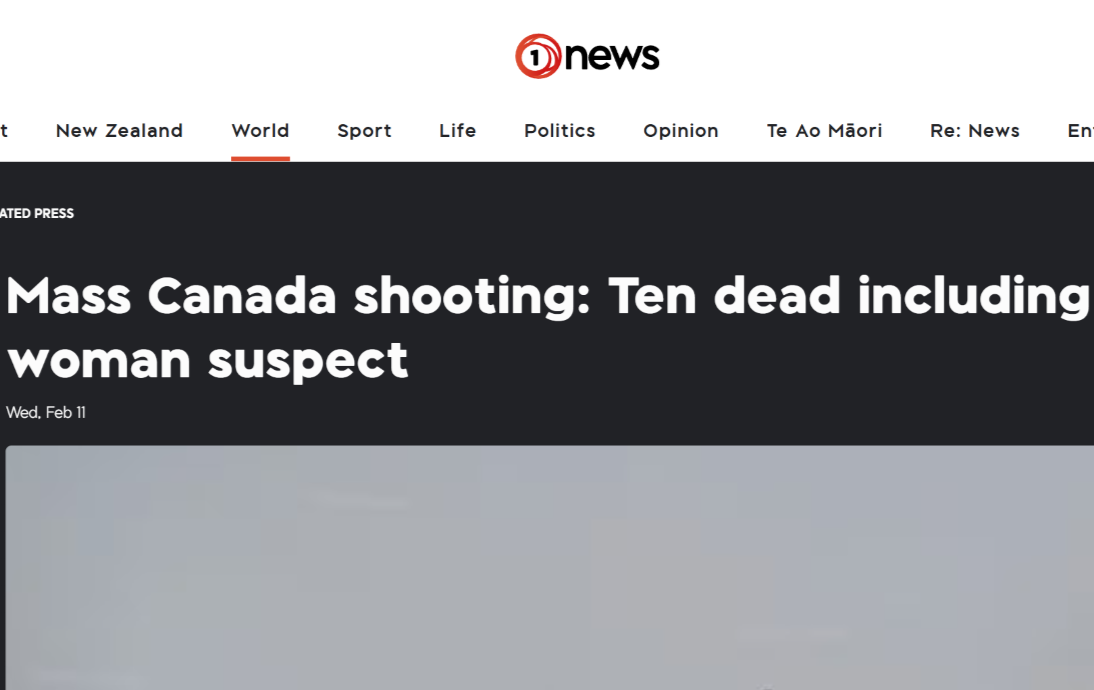
In the tragic school shooting in the Canadian town of Tumbler Ridge, police identified the suspect as a woman. The story garnered worldwide attention. In New Zealand, RNZ described the shooter in its headline as a “woman with mental health issues”. 1News ran with “woman suspect”.
Only later in the articles did readers learn that the suspect was born male and had only begun identifying as female years earlier.
To be fair, RNZ and 1News were not inventing the wording. They were reflecting how Canadian police and international wire services such as Reuters and the Associated Press described the suspect.
While the wording originated with the police, the l issue we wish to focus on is how editorial standards determine the order of facts.
Headlines are signposts. The signpost should match the terrain.
In everyday language, most people hear “woman” and think adult female. That is how most people understand the word. They are not analysing terminology through a gender lens when scanning the news. They read the headline and move on.
If readers must reach paragraph six to discover the biological reality, something has been ordered backwards.
First impressions stick
Mass shootings are overwhelmingly committed by biological males. That pattern has held for decades.
Yet a plain reading of the headline suggests something extraordinarily rare: a female-perpetrated mass shooting. First impressions tend to stick.
If readers continue and discover the suspect is biologically male, tragic as it is, the Tumbler Ridge shooting fits the established statistical profile of this type of offence.
But that clarity only emerges if readers keep reading.
The concern is that most readers never do.
If the anchor is “woman school shooter,” the clarification later does not fully undo it. Once an event is mentally filed under “rare female mass killer,” it tends to stay there.
If you call it a female-perpetrated mass shooting, you are signalling something rare. Rare things usually need explaining.
If it fits the established male pattern, it does not. When it comes to violent crime, biology still matters.
Clarity requires that key facts and details not be buried.
A clearer formulation would be simple and precise: the suspect identified as female but was born male.
That preserves dignity and accuracy. It also reflects the simple fact that almost all mass shootings are committed by males.
An 18-year-old biological male who identified as female committed a horrific act. That sentence is precise. It respects identity. It preserves biological reality. It maintains statistical coherence.
Why make it harder than that?
Consistency builds trust
Standards change. But they only build trust if they are applied evenly.
If a biological female who identified as male committed a crime overwhelmingly committed by males, would the headline lead with “man suspect”?
If the rule is not applied consistently, readers will assume preference over principle. And when language begins to feel managed rather than natural, people disengage.
None of this requires hostility toward transgender people. It is about coherence. In fact, incoherent messaging can have negative consequences for transgender people themselves.
If media lead with identity in a way that seems to sidestep biological sex, some readers will feel something is being filtered. They may assume something is being hidden, even if it isn’t.
That reaction is most likely among those who already distrust the media or are sceptical of transgender politics. Once suspicion takes hold, motive gets inferred. The wording then reinforces what they already believe.