Table of Contents
Alapasita Pomelile
Family First
The Salvation Army’s annual State of the Nation (SOTN) report offers a grim overview of the reality faced by many of our nation’s vulnerable families and communities. While we appreciate the Salvation Army’s effort to include diverse viewpoints through the Te Ora o Te Whānau framework, the report still neglects the significant role of stable family structures in addressing social issues affecting children and families. Highlighting the significance of stable families, traditional marriage, and two-parent households in policy discussions is crucial for developing effective solutions. Ultimately, the report’s statistics speak for themselves, regardless of the framework used. Some of the key findings in relation to children and families were:
Child Abuse and Neglect
- A 44% increase in reports of concern for child abuse or neglect, reaching almost 108,000 cases in 2025
- 11,798 children were substantiated victims of abuse and neglect
- Emotional abuse findings increased 11.3%, and neglect findings surged 21.5%
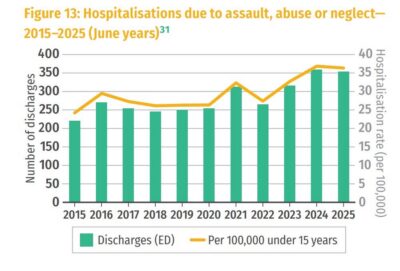
Violence Against Children
- Over 9,000 children under 15 were victims of violent crime reported to police
- Serious assaults against children increased 49% over five years
- 10,448 violent offences against children recorded in 2025
- Sustained high levels of violence with no sign of reduction
Child Poverty
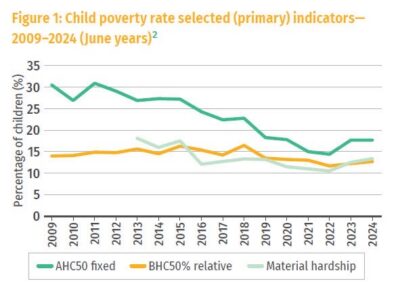
- Child poverty rates increased in 2024 after previous gains were reversed
- 156,600 children (13.4%) are in material hardship, higher than the 2018 baseline
- 234,000 children live in benefit-dependent households, the highest since 2010
- Children with disabilities face double the hardship rate (21%) compared to non-disabled children (12.3%)
These statistics are deeply concerning, yet they align with trends our research has documented. According to our 2023 “Value of Family” report:
- Marriage rates have plummeted from 46 per 1,000 in 1971 to just 7.7 per 1,000 in 2021
- Only 50.8% of births are now registered to married or civil union parents
- 30% of families with children are sole-parent families – among the highest rates in the OECD
- Children in sole-parent households face a 49% poverty rate – five times higher than the 9% rate for children in couple households
- 46% of all children in material hardship live in benefit-dependent households, where 39% of children experience material hardship compared to only 8% in working households
We found the fiscal cost of family breakdown has doubled since 2008, from $1 billion annually, underscoring how family instability directly impacts government spending and child outcomes, making it a key area for policy reform.
Now research on families and their impact on children and society at large consistently demonstrates that stable two-parent families provide:
- Economic advantages through dual earning potential
- Economies of scale in household costs
- Better educational outcomes for children
- Lower rates of involvement in crime and substance abuse
- Improved mental and physical health outcomes
- Greater family resilience during difficulties
Despite this evidence, family structure is rarely considered in social policy discussions. For example, the Children’s Commissioner’s August 2022 report to the UN Committee on the Rights of the Child – a 104-page document focused on child wellbeing – contained no reference to marriage, divorce, or parents’ separation. Current policies often work against family stability, such as marriage penalties in the tax-benefit system, which can cause some couples to have a higher combined income when separated than when together. Poverty traps lessen incentives to work more, while the interplay of welfare programs creates complex deterrents for family formation and stability.
Simply increasing government spending has proven ineffective. Despite billions invested through Working for Families and benefit increases, child poverty has increased rather than decreased since 2022. Material hardship among children is higher in 2024 than at the 2018 baseline, and the number of children in benefit households (in which a large majority are single-parent households) has reached its highest level since 2010.
The Real Human Cost
Behind these statistics are real children suffering real harm and families experiencing pain and dysfunction. Family breakdown doesn’t just cost taxpayers $2 billion annually – it costs our children their wellbeing, their education, their safety, and sadly sometimes their lives.
The SOTN reported a 44 per cent increase in reports of child abuse, the 49 per cent increase in serious assaults against children over five years, and the 156,600 children in material hardship are not just numbers. They represent New Zealand’s failure to prioritise what we have always known and what research consistently shows matters most: stable, committed marriages and families with both parents present and engaged.
International research demonstrates that family breakdown increases risks of poverty, mental illness, educational failure, juvenile delinquency, substance abuse, and family violence. New Zealand’s data confirms these patterns.
The report’s findings reaffirm what we have always known: the state cannot replace the family, yet policies often neglect this, despite evidence that strengthening marriages and supporting parents could reduce child poverty and abuse effectively.
This isn’t a critique of sole parents either – we empathise and understand that many do an exceptional job in difficult circumstances. Rather, we seek honest acknowledgement that family structure matters for child and family outcomes, and that public policy should support family stability rather than inadvertently undermining it and, I would argue, neglecting it.
When research consistently shows that stable two-parent households, particularly having a father in the home, provide protective factors against abuse, poverty, and poor quality of life outcomes, why are they not part of the solution? Perhaps it’s time to start considering policies that help enable family stability, like:
- Removing marriage penalties from the tax-benefit system
- Develop support services to help struggling couples stay together where safe to do so
- Consider tax relief for married couples and two-parent families, as implemented in other OECD countries
- Support second earners in families (often mothers) to enter or remain in the workforce without sacrificing the desire to stay at home with children
- More community-based and faith-based family strengthening programs
- Parenting education and support services
The evidence is clear: we cannot solve social issues affecting children and families through systemic changes and increased government spending alone, while ignoring the family breakdown crisis. After years of increasing social expenditure alongside increasing family fragmentation, New Zealand has both the highest child poverty rates and the highest costs to taxpayers.
It’s time for policy makers to recognize that strong, stable families are not just a private good but a public necessity. While we wait for them to muster the courage to do so, we will continue to advocate for and promote strong marriages and strong and resilient families make for a strong nation.
Check out the full SOTN report here.
This article was originally published by Family First New Zealand.