Table of Contents
We often talk about ‘the Stone Age’, possibly because we seem to be importing a great many of its inhabitants lately, but what was the Stone Age? It was, in fact, the longest period of human history. It predates even modern humans by over two million years. Our species is about 300,000 years old, but our predecessors were banging rocks together for at least 2.3 million years before that.
Of course, some humans were still at it until as recently as 200 years ago, but, generally, the Stone Age is reckoned as lasting from 2.6 million years ago until about 5000 years ago. Until then, very little changed in the daily lives of humans and our hominid ancestors, but the changes that did, very slowly, take place were among the most profound in human history.
The Stone Age was first defined in the 19th century by Christian Jurgensen Thomsen as the earliest period of human history. C J Thomsen considered the Stone Age to be a time when most technology and tools were made of stone. The Stone Age was part of the three-age system which divides the human story into the Stone Age, the Bronze Age, and the Iron Age.
The Bronze Age is the period directly succeeding the Stone Age. The beginning of the Bronze Age and the end of the Stone Age vary from region to region, but the earliest date for the beginning of the Bronze Age is around 3000 BC when the use of bronze became widespread in ancient southwest Asia.
The Iron Age begins sometime in the first or second millennia BC and marks the time when iron replaced bronze as the most commonly used metal. The date of the beginning of the Iron Age also varies, but the Iron Age in southwest Asia began around 1500 BC.
In some parts of the world, the Bronze and Iron Ages simply never happened. At least, not until they were foisted on cultures still using stone tools over the last few centuries.
The Stone Age itself, as most commonly represented, is divided into the Paleolithic (‘Old Stone Age’) and Neolithic (‘New Stone Age’). The term Mesolithic (‘Middle Stone Age’) is also applied in Europe, where such Neolithic characteristics as agriculture did not emerge immediately after the commonly accepted end of the Paleolithic, 12,000 years ago.
Indeed, the picture is far more complicated than even that in some parts of the world. The Mesoamerican civilisations developed agriculture and large, complex social systems with sometimes huge cities, but without metallurgy. Aboriginal Australia remained locked in to Paleolithic technologies, even after they had been exposed, via connection with New Guinea, to such Neolithic innovations as farming and bow-and-arrow hunting.
But, given its pride of place as the longest-running phase of human history, let’s look closer at the Paleolithic.
The Palaeolithic represents most of human history, about 2.5 million years, and involves multiple human species . The technology of the Palaeolithic developed very slowly, changing very little until about the past 50,000-100,000 years when technological innovation began to accelerate.
The Palaeolithic is generally divided into the Lower Palaeolithic, lasting from about 2.5 million years ago to about 200,000 BC, the Middle Palaeolithic, lasting from 200,000 BC to about 40,000 BC, and the Upper Palaeolithic, starting about 40,000 BC and lasting until 10,000 BC.
The Lower Paleolithic is the longest of the three subdivisions of the Paleolithic and entirely excludes modern humans. It began with the appearance of the first species of our genus, Homo.
Characteristics of genus Homo include an upright bipedal posture and a large brain. The earliest member of our genus is Homo habilis .
H habilis still had ape-like body proportions with long arms compared to their legs, but their brains were larger than the australopithecines and other bipedal apes that preceded them. They were also responsible for making some of the first stone tools, though archaeologists now know that stone tools pre-date the appearance of H habilis .
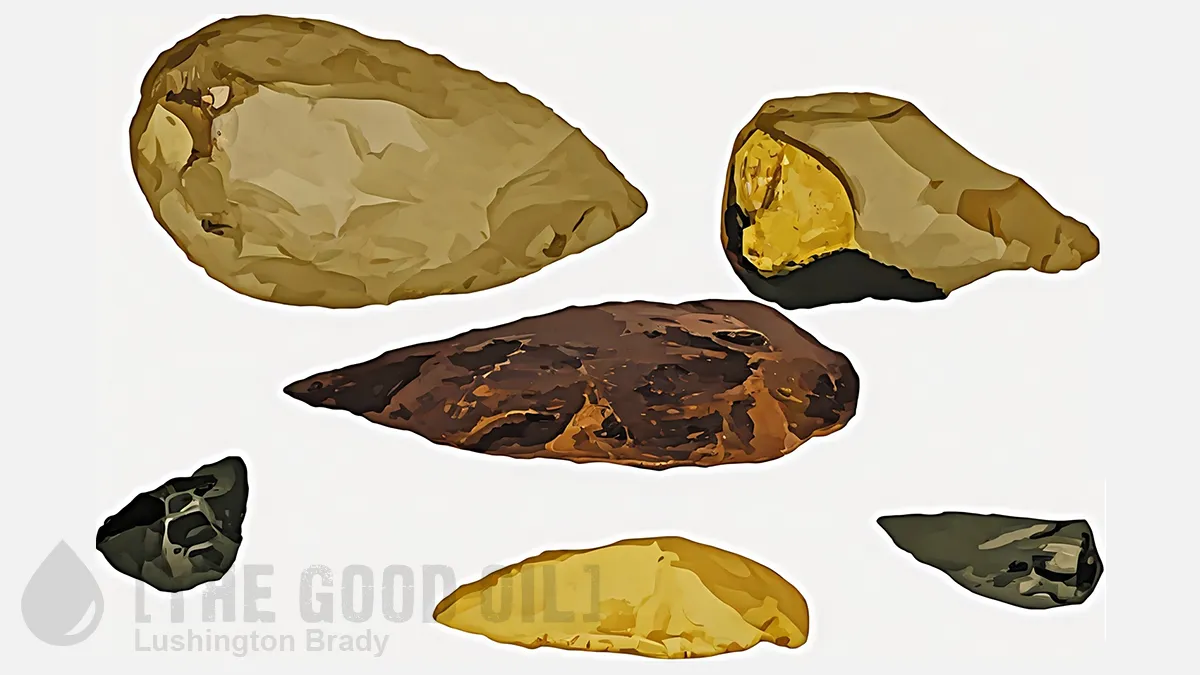
The earliest stone tools were made by taking a cobble, or hammerstone, and striking it against a larger rock, or core, to get sharp flakes that could be used as cutting tools. These early tools are primitive, but they represent the earliest recognizable tools used by humans. These sharp flakes were most likely used to help cut meat from bone.
These stone tools, dating to the earliest part of the Lower Palaeolithic, are referred to as the Oldowan toolkit. H habilis probably never left Africa and their ape-like body proportions suggest that they still spent at least some of their lives in trees.
All this time, our species was still stuck in Africa and still likely spent most of their time in the trees. Their stone tools are profoundly different from later human ones. They might almost have been made by instinct. It wasn’t until hominids like H ergaster became the first to leave Africa and the first to intentionally use fire that human cognitive abilities appear to have advanced to the making of stone tools that required planned intention.
This evolutionary advance in cognition led to the next phase, the Middle Paleolithic. We Homo sapiens still weren’t on the scene yet, though.
Around 400,000 years ago, early humans began developing the ‘prepared-core technique’, a technique in which tools could be made by splitting off flakes of a pre-determined size and shape. This control over the end-result of the process allowed for diversification and standardization of the sorts of tools that could be made.
This development probably represents another advance in cognition because such an elaborate stone-tool making technique requires even greater skill and deliberation than previous tool-making traditions. Hafted tools, tools that are placed on wooden handles, also first appear during this period. It is also during the Middle Palaeolithic that the first spears with stone spearpoints were probably made.
It is debated whether another species that appeared at this time, H Heidelbergensis, is actually another species, or in fact a primitive iteration of our own species.
Regardless of the exact taxonomic configuration, the humans of the Middle Palaeolithic appear to have had more advanced cognition than earlier humans, allowing for more advanced tools. There is evidence that they may have been the first to bury their dead and the first to have true spoken language. The rise of language would definitely have made it easier to develop complex tool traditions that could be taught and passed down from generation to generation.
Another revolutionary change during the Middle Paleolithic is that our human ancestors went from scavenging meat to actually hunting it for ourselves.
As time went on, and human populations became more separated, the early humans of the Middle Palaeolithic appear to have separated into three distinct species, Neanderthals in Europe, H sapiens in Africa, and the Denisovans in Asia. These distinct species probably evolved around 200,000 to 300,000 years ago.
Neanderthals and H sapiens both had advanced tools compared to earlier humans and both appear to have had language. Although H sapiens would later develop evidence of slightly more advanced cognitive abilities than Neanderthals, for most of the Middle Palaeolithic, they appear to show about the same cognitive abilities as other contemporary human species.
With ‘us’ on the evolutionary scene at last, the next big change was in the offing. Some 200,000 years after H sapiens evolved, the Upper Paleolithic arrived, bringing with it cultural changes that are generally considered unique to our species: art and religion.
By 40,000 years ago, anatomically modern humans had entered Eurasia and displaced the Neanderthals, Denisovans, and remnant populations of H erectus that still lived in Island Southeast Asia. This displacement appears to have been a gradual process, however, and there is evidence of H sapiens co-existing and even interbreeding with other human species for long periods of time.
It is also during the Upper Palaeolithic that humans arrived in Australia and the Americas for the first time in prehistory. H sapiens were the first and only known human species to colonize these regions.
The Upper Palaeolithic is known for the widespread appearance and use of stone blades, harpoons, and artwork for the first time in human prehistory. Traditionally, these examples of technology and artwork have all been attributed to the rise and spread of H sapiens , but recent archaeological evidence suggests that the same cognitive revolution may have also been happening in Neanderthals.
Currently there is no way of knowing whether the Denisovans had a similar cognitive revolution, since they have no archaeological record. Nonetheless, they were related closely enough to modern humans that the two populations were able to interbreed which makes it likely that the Denisovans were similarly advanced in terms of cognition.
By about 10,000 BC, the human stage had been cleared of our brother and sister species, and H sapiens had the world to ourselves – and the Neolithic Revolution began.
Around this time, the earliest farming communities began to emerge, initially in the ancient Near East and then elsewhere independently.
By about 9,000 BC, agricultural settlements had emerged all over Southwestern Asia and elsewhere. Farming eventually resulted in a food surplus so that not everyone needed to farm or gather food fulltime. This allowed for craft specialization and a division of labor for the first time in human history.
The Neolithic Revolution brought with it the rise of large settlements and new innovations in social organisations, such as chiefdoms and the earliest states.
The rest, as they say, is history.