Table of Contents
When America entered the Great War, it hadn’t fought a truly major war, with mass casualties, since the Civil War 50 years earlier. Consequently, most of its troops entering the Great Sausage Grinder of the Western Front had never seen combat before. Nor were their commanders much more experienced in anything besides fighting poorly armed guerillas or the last dogged remnants of Indian resistance.
Now, they were coming up against battle-hardened German soldiers, reinforced with masses of troops newly released from the Eastern Front and morale-boosted by the devastating success of the Spring Offensive. Throwing inexperienced American soldiers and commanders into such a battlefield was an obvious recipe for disaster.
So, for the first time in American history, American soldiers fought under a foreign command. They couldn’t have asked for better, both in commander and veteran comrades-in-arms.
General John Monash distinguished himself as one of the great commanders in history on the Western Front, pioneering combined arms and precisely planned battles designed to make the most of technological advancements like aeroplanes and tanks. Most importantly from the soldiers’ point of view, Monash was determined not to needlessly squander lives.
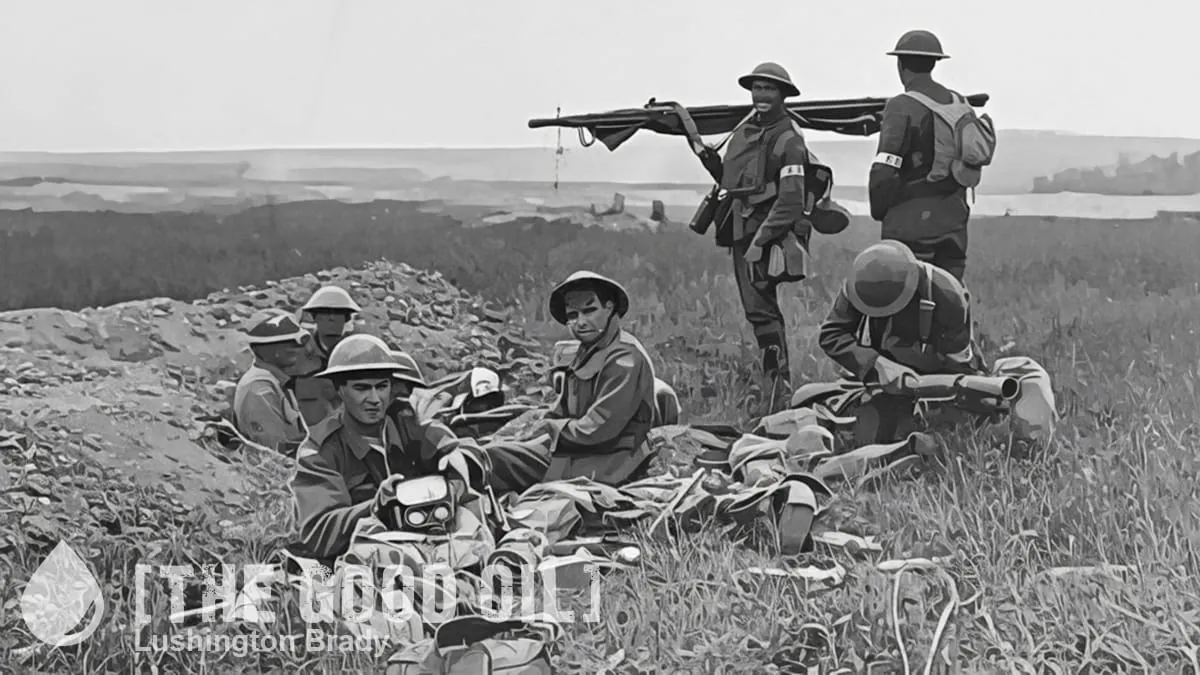
In the Battle of Hamel, green doughboys fought under Monash’s command and alongside battle-hardened Anzacs.
In 93 minutes, they would help win what military historians call the first modern battle and forge a relationship with Australia that has lasted ever since.
The Battle of Hamel was an important learning curve for the inexperienced American forces and a turning point in World War I tactics. Roughly 1,000 American doughboys from the 33rd Division joined Australian and British troops in a meticulously planned assault that integrated infantry, tanks, artillery and aircraft in ways never before attempted. Together, they proved combined arms warfare could break the deadlock of trench warfare.
It almost didn’t happen. American Expeditionary Force commander General John J Pershing was adamant that American troops would only fight under American command.
When he learned that 10 companies of his soldiers were ordered to join Australian Lieutenant General John Monash at Hamel, he ordered their immediate withdrawal.
On July 3, the day before the scheduled attack, six American companies received orders to pull back. Some obeyed, but many refused. Two Americans in the 42nd Battalion switched into Australian uniforms and stayed.
The sudden changes played havoc with Monash’s carefully coordinated plans. Field Marshal Douglas Haig intervened and ordered the remaining American companies to stay. Pershing fumed, but his troops later praised the valuable experience they gained.
Captain Gale spoke for many when he said that “more real good was done by this small operation with the Australians than could have been accomplished in months of training behind the lines.”
Monash had planned the Hamel operation with extraordinary precision.
“A perfected modern battle plan is like nothing so much as a score for an orchestral composition,” he wrote, “where the various arms and units are the instruments, and the tasks they perform are their respective musical phrases.”
He calculated the attack would take 90 minutes.
In the end, it took precisely 93.
And Americans and Australians forged a relationship that would long continue.
The inexperienced Americans joined the Australian units just days before the attack.
Australian Lieutenant Edgar Rule described their arrival, “Twelve were put in each platoon, and believe me they were some men. This was the first time that they had been in the line, and they were dead keen; and apart from that it bucked our lads up wonderfully.”
The enthusiasm was mutual. The Australian veterans were grizzled and hardened. But the Americans arrived eager for information.
“Everyone was smiling or laughing,” Rule wrote. “The Yanks were out for information and our boys were very willing teachers, and it speaks well for the future to see one set so eager to learn and the other so willing to teach.”
When the infantry assault began, the Americans were sometimes rather more keen than was prudent. But their sheer courage impressed their new mates.
Some ran into the shellfire. Australian Corporal Mick Roach was killed while turning back an American platoon that had pushed too far forward into the barrage. But the Americans’ aggressiveness impressed the Australians.
One observer noted their “excessive keenness” but praised their “dash.”
Two VCs, a Distinguished Conduct Medal, and America’s first Medal of Honor in World War I were awarded at Hamel. In all, 14 Americans received British decorations. Eight Americans also received the Distinguished Service Cross. Monash, long a junior commander in the junior partner of the Allies, proved that his innovations were the way to win the war.
The tactics employed at Hamel changed how the British and Allied forces fought for the rest of the war. The integration of infantry, tanks, artillery and aircraft demonstrated that combined arms warfare could achieve decisive results with relatively low casualties.
Previous battles over similar positions had lasted weeks or months with massive losses. Hamel proved that meticulous planning, surprise and coordination could break entrenched defenses in minutes.
The lessons of Hamel were applied on a larger scale at the Battle of Amiens on August 8, 1918. That attack became what German commander Erich Ludendorff called “the black day of the German Army.” The tactics continued through the Hundred Days Offensive that ended the war in November 1918.
In 2018, Australian and American forces conducted joint training exercises to commemorate the 100th anniversary of the battle that began an enduring relationship. Today, the Australian Corps Memorial overlooks the battlefield.