Table of Contents
Charlotte Gill
Charlotte Gill regularly publishes about the use of taxpayers’ money to fund left-wing causes and left-wing researchers.
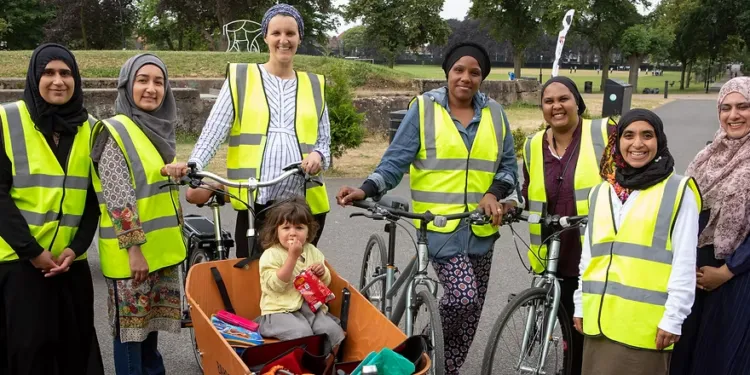
Last week, Will Norman, London’s Walking and Cycling Commissioner, was photographed trying “the excellent new cycle lanes on Lambeth Bridge”. He was joined by two cycling groups, the London Cycling Campaign and Cycle Sisters UK. In this piece I am going to delve into the latter as an example of how ridiculous identity politics has become, so much so that there are now exercise charities only open to minorities.
Case in point: Cycle Sisters UK describes itself as “award-winning charity which creates accessible and empowering spaces for Muslim and ethnically diverse women to cycle and become more healthy, confident and connected”. It’s not obvious what’s stopping them from doing this in the first place, nor why hobbies and socials are increasingly being turned into registered charities (a trend I have noticed a lot while researching the charity sector). That’s before we get to the fact that Cycling Sisters was awarded £103,346 from taxpayers between 2021–2025.
Although Cycle Sisters is technically open to “ethnically diverse women”, it’s ultimately centred around Islam, with teachings from the Quran on its website:

On another page it writes: “Our rides aim to meet the specific needs of Muslim women such as halal café stops, timings around prayers and providing advice and support on how to cycle while wearing modest clothing.”
On social media it posts about Ramadan…

…Eid…

…and Muslim climate action week:

The charity maintains that it helps women overcome barriers such as “Negative cultural attitudes” and “Racism and Islamophobia”. Its website is packed with resources, such as an article on how to cycle in modest clothing:

The length of the article – covering everything from how to secure your hijab or niqab to “modest” activewear – might suggest that this clothing isn’t all that suitable for sports.
When it’s not providing resources on “Cycling for Diverse Communities” or running “regular women-only rides”, Cycle Sisters is also fairly political. In August last year it took part in a “Big Ride for Palestine”, posting: “Our sisters rode to remember every life taken and to stand against the genocide and ongoing oppression and denial of human rights faced by the Palestinian people.”

It’s clear from the website that Cycle Sisters provides free bikes and helmets:

It partners and receives funding from an enormous number and range of organisations, including Brompton, Hackney Council, Islamic Relief, Lime Bikes, the London Marathon Foundation, Muslim Aid, Palmers Green Mosque, Sustrans, Transport for London, UCL and Raleigh, which provides the charity with “high-quality bikes”:

Quite why Muslim and “ethnically diverse women” are apparently less able to buy a bike compared to the rest of the population, according to Cycle Sisters, is a mystery.
Unfortunately, this is just the beginning of identity-based cycling groups, as you can see in this section of Cycle Sisters’ report, which lists more Muslim and “Community Cycling” groups:

Examples include Evolve, “The Cycling Network for Muslim Women”, and Fasted 500, “an annual cycling challenge encouraging Muslims to keep active during the month of Ramadan by pledging to ride 500 kilometres”.
I suppose it would be far right to ask why people can’t just cycle with whomever they want and without a whole charity being set up?
This article was originally published by the Daily Sceptic.