
Table of Contents
Almost every day, Australia’s university sector just hands over another reason to justify my call to abolish them entirely and start again from scratch.
If it’s not ripping off local students by charging them a king’s ransom for more and more worthless degrees, more and more often studied entirely online, it’s turning themselves into diploma mills in hate studies. If it’s not openly coddling violent anti-Semites within their ranks, it’s selling their souls – and the nation’s interests – to the Chinese Communist Party.
It just got worse.
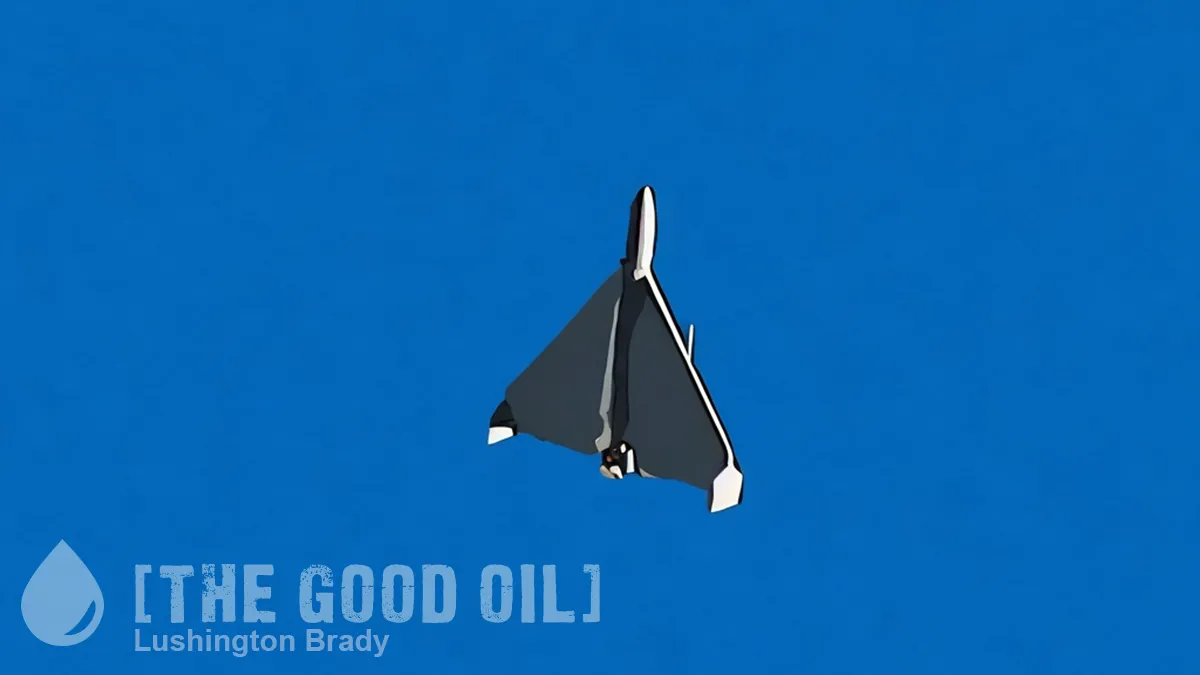
As Iran rains exploding drones on hotels and airports across the Middle East, their victims might wonder where a backwards theocratic regime got its hands on such technology. They should ask some local vice chancellors.
After Tehran launched at least 1000 unmanned delta-wing “kamikaze drones” to bomb Gulf states this week, killing civilians in airports and hotels and hitting an air base used by Australian soldiers near Dubai, the Australian has identified research collaborations between at least three universities and Iranian scientists relating to drone technology in recent years.
Foreign Minister Penny Wong ordered vice-chancellors to immediately cease all collaborations with Iranian institutions in February 2023.
Yet, still these academic quislings continue to find new ways betray their country.
Despite the ban on collaborations with Iran, Australian universities are continuing to work with researchers in China, and have made public sensitive research relating to spy drones.
UNSW recently collaborated with Chinese researchers on artificial intelligence for drones, in a paper published this year. Two UNSW researchers worked with Fudan University scientists in China, along with a Cambridge University researcher, to develop spy drones. Using AI, they devised a “dual-mode intelligent control system’’ for drones.
“For overt surveillance scenarios, the framework enables fixed-wing UAVs to maintain optimal eavesdropping positions while respecting aerodynamic restraints, resulting in a 37 per cent improvement in detection success rate,’’ their research paper concluded. “In anti-jamming operations, the system demonstrates 59 per cent throughput enhancement compared to conventional … approaches.’’
The Australian Research Council has funded UNSW research into ways to camouflage drones and prevent them crashing. The researcher, electrical engineering expert Talal Almuzaini, designed drone flight paths to “minimise the risk of collision while ensuring a high level of camouflage’’.
In other words, they’re enabling the enemies of the West to spy and attack without detection.
What is wrong with these people?
Conference papers published after the ban reveal Australian researchers from the University of Sydney, the University of NSW and Adelaide University have worked with Iranians to improve the efficiency of unmanned aerial vehicles (UAVs), better known as drones.
The research collaborations involve the Sharif University of Technology in Iran, which has been sanctioned by the European Union on the grounds that it “has a number of co-operation agreements with Iranian government organisations which … operate in military or military-related fields, particularly in the field of ballistic missile production and procurement’’.
The Australian is not suggesting they worked on military uses for drones, only that they were involved in drone research collaborations.
Well, what did they think they were going to be used for? Temu deliveries?
At the University of NSW, a researcher collaborated with two Sharif University scientists […] “Advancements in integrated cameras and sensors have greatly improved the surveillance and tracking capabilities of UAVs, especially when it comes to monitoring ground-based targets,’’ he wrote in his research paper, presented to a conference in 2024 […]
The same researcher also investigated ways to prevent multiple drones crashing during “covert military surveillance of a moving target’’, in research presented to the International Conference on Computer and Automation Engineering in 2024.
The name of the researcher? Talal Almuzaini.
But, of course, there’s no reason to be suspicious about any of this.



![[The Good Oil] Stuff Up of the Day](/content/images/size/w1304/format/webp/2024/09/Stuff-up-image-1.webp)
