Zephyr
Zephyr works for a train operating company in England.
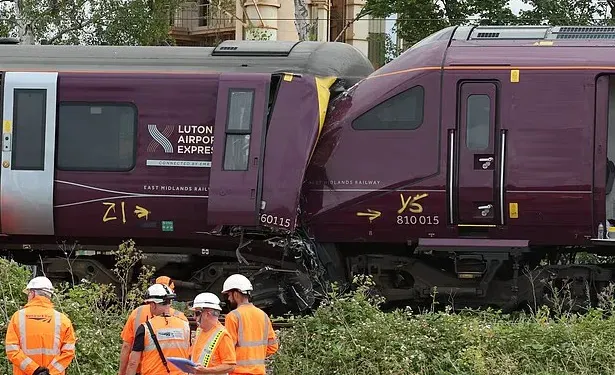
On Friday, two trains collided. A driver lost his life. Dozens of people were injured, among them a friend of mine, who suffered multiple broken bones and was taken to hospital. I work on the railway, though not for the company involved, and I wasn’t there. I don’t know what caused the collision – human error, technical failure, procedural failure, some combination – and like everyone else I’m waiting for the investigation to tell me. None of that has stopped me thinking about it. If anything, the seriousness of it is exactly why I can’t stop.
Modern-day black armband
Within hours, social media was awash with tributes. Railway colleagues changed their profile pictures to a black background with the British Rail double-arrow and the headcodes of the trains involved. Others posted stock photographs of tracks vanishing into the distance. There were messages about the ‘railway family’, expressions of solidarity, declarations of grief... I know many of the people posting these things. Some are decent, honourable, compassionate – several are friends – and I don’t doubt their sincerity for a moment. And yet I found the whole spectacle faintly irritating.
That reaction puzzled even me, because I’m not short of empathy. A man had died. My friend was lying in a hospital bed with multiple fractures. Other staff had been through something that will likely stay with them for years. I cared about all of it. What I felt no urge to do was change my profile picture, and the longer I sat with that, the clearer it became that my objection wasn’t to grief – it was to the increasingly performative way grief now gets expressed. For a lot of people, changing a profile picture has become the modern equivalent of lowering a flag to half-mast: a visible public gesture that says I care. Perhaps that’s enough for most people. It isn’t enough for me.
My instinct is always to ask what a gesture actually achieves. Does it help the injured? Support the bereaved? Uncover the truth? Prevent it happening again? Changing a profile picture does none of that. Its real function seems to be making the person who changes it feel better – which isn’t a damning observation in itself. Human beings have always relied on symbols: we lay flowers, wear black armbands, observe silences. But social media does something different to that instinct. It turns a private feeling into a public performance, so that what would once have been a quiet expression of sympathy becomes a signal broadcast to hundreds or thousands of people.
Some of that is sincere. Some of it, I suspect, is virtue-signalling – an overused phrase nowadays, but a useful one. We’re social creatures who like to demonstrate that we hold the approved views of our tribe, and social media rewards exactly that behaviour. One person changes their picture, then another, then another, and before long a visible consensus has formed. Nobody phones you up demanding compliance. Nobody issues a memo. But there’s a quiet expectation that decent people will join in, and I’ve never had much patience for that – possibly a character flaw, but I’ve never been especially interested in doing something purely because everyone else is doing it. When large numbers of people all start behaving identically, my first instinct is to ask why. It makes me awkward. It probably makes me unfashionable. But I think it also keeps me clear of a good deal of noise.
The railway has its own version of this in the well-worn phrase ‘the railway family’. I understand the sentiment – we deal with fatalities, assaults, disruption, public anger, difficult conditions in a closed system that few outside fully understand, and there’s a real camaraderie that comes from that. But there’s also a tendency to romanticise the industry well past the point of accuracy. Most railway employees don’t actually know one another. A conductor in Leeds has probably never met a driver in London; a signaller in York knows nothing of a dispatcher in Bedford. Yet when something serious happens, people who’ve never met those involved start talking as though a close relative has died. I understand it. I also find it faintly irritating, which might sound cold, but I think it’s the opposite. I was far more concerned about my friend in that hospital bed than I was about crafting a suitable tribute. I cared more about the welfare of the staff involved than about displaying my own emotional response to the wider world. That distinction matters to me because life increasingly seems obsessed with demonstrating that we care, rather than simply caring – and the two are not always the same thing. This is something I hope many other Daily Sceptic readers can appreciate.
Don’t speculate
Close behind the tributes comes the other ritual that always follows a serious incident: someone in authority steps in front of a camera and delivers the familiar line: please do not speculate. Police say it, railway executives say it, politicians say it. Every major incident now comes with a paternal appeal for the public to stop thinking out loud, and I find this almost as irritating as the profile pictures, mostly because it’s futile. Human beings speculate. It’s one of the defining things we do. We meet an unexplained event and immediately start building possible explanations for it – children do it, scientists do it, detectives do it, historians do it, accident investigators do it. So do railway enthusiasts. So does everyone. Understanding starts with speculation; every formal investigation begins life as a set of hypotheses, generated and then tested against evidence, not arrived at through silent contemplation.
There’s obviously a difference between considering possibilities and claiming certainty. ‘I wonder whether a signal was passed at danger’ is not the same statement as ‘I know exactly what happened’ – but public authorities seem increasingly unable or unwilling to make that distinction. Instead we’re simply told not to speculate at all, and I’m never quite sure what that’s supposed to mean in practice. Should people stop asking questions? Suppress curiosity? Switch off the very faculties that make investigation possible in the first place? What I suspect officials actually mean is that people shouldn’t present guesses as established fact, which is a perfectly reasonable request – it’s just rarely what they say. What they say sounds much more like an instruction to suspend independent thought until the approved explanation is handed down. Maybe that’s unfair to them. Maybe it isn’t their intention. But it’s certainly how it lands.
A more sceptical approach
I’ll admit I come at this from a particular angle. I’m a sceptic by temperament, I think free speech is one of the more important principles a civilised society can hold onto, and I’m deeply suspicious of attempts to limit discussion for supposedly benevolent reasons. History isn’t kind to the authorities who insisted certain questions shouldn’t be asked. None of that means all speech is wise – people say foolish things constantly, myself included – but I don’t regard being wrong as a moral offence. Increasingly, though, society seems to have lost the ability to tell error apart from malice. If someone looks at the available information after a major incident and reaches the wrong conclusion, I struggle to see the actual problem. The problem is when people knowingly lie. Those are not the same act. An honest mistake is not deliberate deception; a misguided theory is not a malicious falsehood. Modern discourse treats them as though they were interchangeable, but if someone proposes a theory about a railway collision and later turns out to be wrong, the obvious consequence is that they look foolish. That seems like punishment enough to me. The idea that this should trigger police involvement or some official intervention simply because somebody held an incorrect opinion strikes me as bizarre.
Maybe this is another quirk of mine: I have a very high threshold for what counts as harm, and an equally high one for what counts as recklessness. It puts me at odds with a lot of contemporary thinking, which talks as though words possess near-magical power – dangerous narratives, harmful language, the need to be endlessly mindful of impact. Sometimes that concern is justified, often it isn’t. At times it feels as though we’ve simply forgotten that adults have agency. People hear things, weigh them, accept some and reject others. The idea that ordinary citizens can’t be trusted to hear a few competing theories without some kind of psychological collapse strikes me as patronising. There are obviously limits: falsely naming individuals, deliberately spreading lies, encouraging harassment, those are different matters entirely – but most speculation comes nowhere near that line. Most of it is just ordinary people trying to make sense of an extraordinary event. That process is human, not sinister.
Which brings me back to where I started. A railway driver is dead. A friend of mine is recovering from multiple broken bones. Other staff have been through something that may stay with them for years. These are the things that matter to me. The colour of a profile picture doesn’t. Neither does the performance of grief on social media, nor the inevitable lectures about the approved way to discuss a tragedy. The truth matters: finding out what actually happened and making sure it doesn’t happen again. Everything else is largely theatre. Some people find genuine comfort in that theatre: changing their pictures, posting their symbols, repeating the lines about the railway family. And that’s their choice. I don’t begrudge them it. Mine is different. I’d rather ask questions, weigh up possibilities and wait for the evidence. And when the investigation finally reports, I’d rather go back and check its conclusions against the theories people were throwing around in the immediate aftermath, and see which ones actually survived contact with reality.
That approach may make me look awkward. It may make me unpopular, possibly even cold. But I’d argue it shows more respect – for the truth, and for people’s intelligence – than the increasingly fashionable alternative. Because if a tragedy can’t prompt honest inquiry, I’m not sure what can.
This article was originally published by the Daily Sceptic.