Table of Contents
What most people take to be the ‘natural’ Australian landscape, especially on the populous east and south coasts, is in fact the product of not just 200 years, but 45,000 years of human influence. What we see today is not what the first European explorers saw and that, in turn, was not what greeted the first Aboriginal settlers tens of thousands of years ago. Each wave of human settlement on this staggeringly ancient continent has exercised a profound influence on the ecosystem as they shaped it to their particular needs.
For the Aborigines, that meant repeatedly burning what were then dense, wet forests in order to create the sort of open landscape that favoured hunting. This repeated burning cleared the forests, dried the soils and encouraged the proliferation of fire-loving plant species. Fire bred more fire, ultimately creating one of the most fire-prone landscapes in the world.
Consequently, when Europeans first explored Australia, their overwhelming impressions were of an open landscape, ‘like an English park’, and fire. Smoke everywhere, as their journals constantly record. Captain Cook dubbed Australia ‘the land of smokes’, while Tobias Furneaux, sailing along the east coast of Tasmania by night, bestowed the name that persists to this day: the Bay of Fires.
The 1830 journals of missionary and ‘protector of Aborigines’ (his official role), George Augustus Robinson describe a very different landscape on Tasmania’s wild west coast than we see today – and indicate why fire is such a peril there today.
Most of his routes (72 per cent) went across treeless areas such as buttongrass plains or sedge and shrub-covered moorlands, or followed what Robinson called “native roads” – pathways through forests created through intentional burning.
This burning made those treeless areas highly fire-prone. After the collapse of Aboriginal society, alpine graziers maintained their patterns of burning. In the last half-century, though, those were stopped. About a third of the treeless areas haven’t burned for 50 years, with obvious consequences for any bushwalker who’s ever followed in Robinson’s path.
Over time, these long-unburned treeless areas become denser and denser. Tasmanian bushwalkers describe walking here as “scrub-bashing”, as it involves fighting through thickets of vines, shrubs and dense undergrowth.
A striking feature of Robinson’s journeys was how quickly he moved across landscapes now notoriously difficult for modern-day bushwalkers. Retracing Robinson’s west coast routes is a challenge even for well-equipped bushwalking groups. The distance Robinson travelled in one day would now take two or three days.
The result of the latest wave of human activity has inevitable consequences for the fire regime in the area.
Visitors are often struck with how western Tasmania’s wild, remote landscapes mix large treeless areas with forests and alpine plants. This diversity of vegetation brings with it a complex fire ecology. Ancient trees such as southern beech (Nothofagus) and pencil pines (Athrotaxis) dating back to the Gondwanan era are often surrounded by flammable eucalypt forests and sedgelands.
These areas are often wet. Rainfall is high and many soils are saturated. Plant communities here grow on peaty soils with organic surface layers. When these organic layers dry out, the soil itself can burn, triggering a cascade of degradation through soil loss, erosion and slower plant growth.
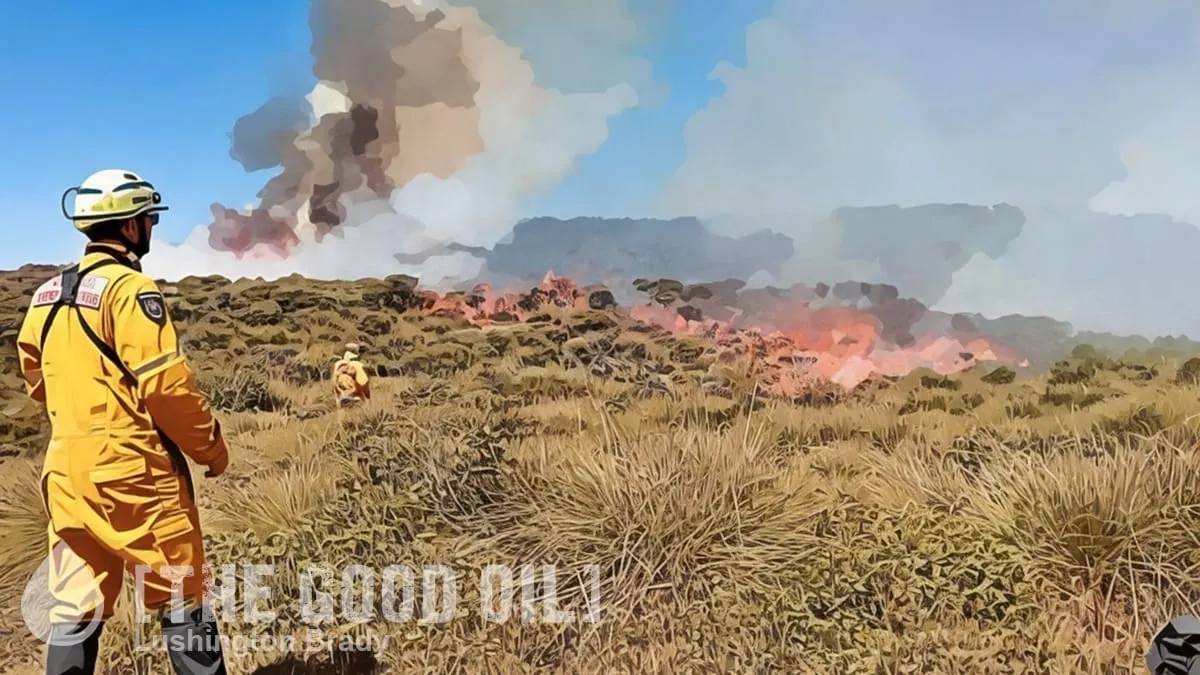
Lightning is a major cause of bushfires, as treeless regions are particularly prone to igniting after a strike.
The natural question, then, is: should we return to the patterns of deliberate burning that prevailed up to the latter half of last century?
The fires started by dry lightning storms can grow very fast, as lightning can strike in several places in quick succession, far from human settlements. It’s practically impossible for land managers to detect these fires and put them out while small. This year, a huge 100,000 hectare fire began when over 1,200 lightning strikes started dozens of individual fires.
Fuel reduction burns on treeless areas can reduce the risk of lightning starting a fire and make any ignitions easier to fight.
The irony, though, is that much of the powerful environmental lobby passionately opposes fuel reduction burns. Increasing populations of ‘tree-changers’ from the Mainland, and policies set from afar by, in Bob Katter’s words, people “whose shoe leather has never set foot off concrete pavement” also regard fuel reduction burns with horror.
And yet, the landscape wants to burn and will.