Table of Contents
John McLean
Citizen typist. Enthusiastic amateur.
On 28 January 2026, Prime Minister Christopher Luxon announced that sitting government minister Judith Collins will be appointed president of the New Zealand Law Commission in the first half of 2026. On becoming law commission president, Collins will retire from politics. Collins currently holds a number of cabinet portfolios, including attorney‑general and minister of defence.
Under the Law Commission Act 1985, the commission’s president is also its chief executive and has an express duty to “supervise and direct the work of the commission”. Under the act, the commission’s principal functions include to:
- take and keep under review in a systematic way the law of New Zealand
- make recommendations for the reform and development of the law of New Zealand
- advise government ministers on ways in which New Zealand law can be made as understandable and accessible as is practicable
In making recommendations, the commission is expressly required to “take into account te ao Māori (the Māori dimension)”. This bizarre requirement has been in force since 1 February 1986. So, for over 40 years now, New Zealand’s Law Commission has been expressly mandated to pretend that individuals with Māori ancestry are a united collective from a different dimension. That’s completely bonkers.
A cursory glance at the commission’s website suggests that some at the commission may indeed dwell in a different world, and that the commission in its current incarnation could really be from outer space. The commission is farcically Māorified.

The commission’s current president is Dr Mark Hickford. Justice Minister Paul Goldsmith appointed Mark for six months until 3 May 2026. According to his bio on the commission’s website:
Mark has extensive experience across the public, academic and private legal sectors and has specialised in iwi–Māori state relations, land and water rights, natural resources and justice.
He has been General Manager & Special Counsel – Māori Crown Relations at Te Puni Kōkiri… [among other things]… and has also worked at Chen Palmer and Partners in Wellington.
Mark was Pro Vice-Chancellor and Dean of Law from May 2015 until October 2021… at Te Herenga Waka|Victoria University of Wellington. ...
He earned his DPhil from the University of Oxford (examining indigenous property rights and questions of empire [WTF?]) and his LLB (Hons) and BA in Political Studies and History from Waipapa Taumata Rau|University of Auckland.

Hickford is therefore a fully paid up member of Lawtearoa’s Wokerati. He succeeded Dr Amokura Kawharu, who was the commission’s president from 2020 (a Labour Government appointee).
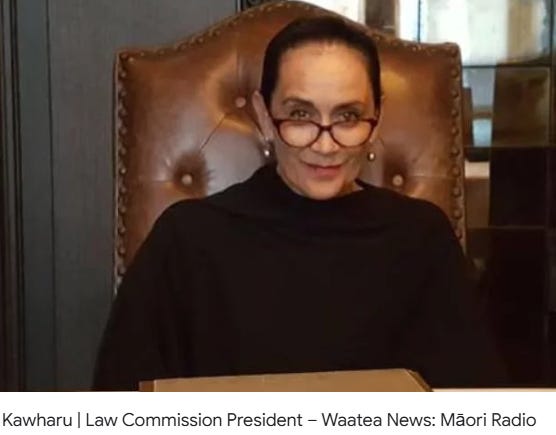
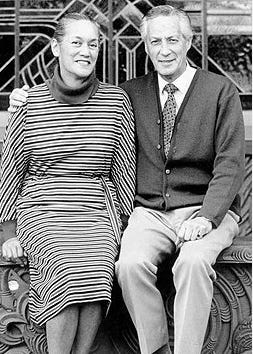
Amokura is the daughter of the late Sir Hugh Kawharu and his wife Lady Freda Kawharu. Hugh Kawharu is perhaps most famous for his 1989 translation into English of the original Māori language version of the Treaty of Waitangi. In particular, Sir Hugh translated kāwanatanga in the Māori version as “government”, meaning that the Māori Treaty signatories supported one government for all New Zealanders. Good on you, Hugh.
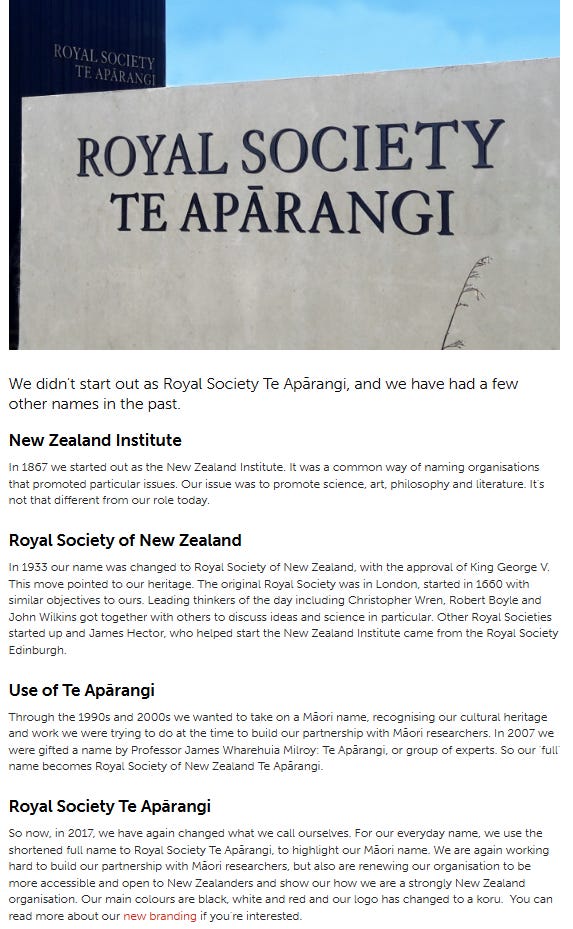
In 2021, a year after starting as president of the Law Commission, Amokura Kawharu was elected to the Royal Society of New Zealand. As with the Law Commission, the Royal Society calls itself by a name that’s not its real name – Royal Society Te Apārangi. The Royal Society claims that “Te Apārangi” was gifted to it in 2007 by someone by the name of Professor James Wharehuia Milroy. Quite why James felt entitled to gift those words to the Royal Society, or why the Royal Society thought James had that entitlement, is anybody’s guess. Madness.
But, in truth, the Royal Society’s connection to objective realities and academic rigour is tenuous at best. In response to seven Auckland University academics signing a 2021 letter objecting to a government proposal to give Māori customary Woo-Woo parity with science in New Zealand’s secondary school curriculum, the Royal Society launched a retaliatory investigation into two of the signatories who were also fellows of the Royal Society – Garth Cooper and Robert Nola. Infantile Woke vindictiveness. Certainly not conduct remotely becoming of a Royal Society.
Just before her departure from the Law Commission, Amokura Kawharu provided her “Ia Tangata” report to the commission’s responsible minister, Paul Goldmsith.
The Ia Tangata tome, which runs to 457 pages, considers whether the anti-discrimination protections in the Human Rights Act 1993 should be extended to “people who are transgender, people who are non-binary and people with innate variations of sex characteristics”. The report recommends that the following should be added as “prohibited grounds of discrimination” under New Zealand’s Human Rights Act:
- “gender expression”
- “the relationship between a person’s gender identity and their sex assigned at birth” [sex isn’t assigned at birth]
- “having an innate variation of sex characteristics”
I won’t get into the weeds of the Ia Tangata report. Suffice it to say that, at the pointy end of the gender debate, the commission recommends a right for biological males who would like to be women to have access to any “single-sex facility… that aligns with their gender identity”.
The essential trickiness with all of this of course lies where rights conflict – a woman insists that she is being discriminated against based on her biological sex when a dude (asserting rights based on gender identity) joins her in the changing room. Ia Tangata fails to address this awkward clash-of-rights reality.
Most women probably don’t care if a guy trying his best to be (and look like) the fairer sex uses the women’s toilet. But to try and deal with these matters by entrenching formal legal rights is problematic. For instance, it remains perfectly legal to discriminate against humans whose head hair is red. Should anti-Blood Nutness be a prohibited ground of discrimination? The law is a blunt instrument in these areas. It’s simply impossible to legislative for civility and decent behaviour.

Current Law Commissioner Professor Claudia Geiringer is also a member of the Royal Society. In March 2024, Minister Paul Goldsmith directed the Law Commission not to continue to look at criminalising “hate speech” i.e., turning people who use hurty words into convicted criminals. But instead of getting Goldsmith’s message to avoid advocating for more criminalization of hurtiness, the commission pivoted.
Claudia Geiringer is now leading a Law Commission investigation into whether New Zealand should create separate (new) “hate crimes”, being distinct crimes allegedly motivated by hate or hostility toward a group of people. Hate can already be taken into account as an aggravating factor in sentencing.
New Zealand therefore has a current Law Commission that’s clearly pursuing its very own out there ideological agendas.

Criticism of the appointment of Collins has focused on the fact that Collins will go straight from the current National Party-led coalition to her new role. The Collins Critic-in-Chief has been Bryce Edwards of his own “Democracy Project”, which Victoria University allows him to run out of Victoria University of Wokeington premises. (I like Bryce’s efforts to promote governmental transparency and have recently become a paying subscriber to his Substack. His work on the Manage My Health debacle has been superb.) You can read Bryce’s criticisms of Collins’ appointment here: https://www.elocal.co.nz/Article/7272.
Edwards’ criticisms fall flat in a number of respects.
Bryce refers to the commission as a “supposedly independent institution”. But the commission is not supposed to be independent. Under its act, the responsible Minister can require the commission to review and report on any aspect of New Zealand law. That’s not independence.
Edwards refers to Collins’ prospective role as a sinecure. But unlike, say, Patsy Reddy’s position as chair of the Climate Change Commission, Law Commission president is not a sinecure. There’s lots of proper work to be done.
Edwards then tries to distinguish Geoffrey Palmer’s appointment as Law Commission president in 2005, by the then Labour government (Palmer’s party), on the basis that he’d been out of politics for 15 years. But of course, Palmer is a Labour Party tragic. You can take a boy out of Labour, but you can’t take Labour out of that boy.
WOE BETIDE US WHEN PARLIAMENT’S WORDS NO LONGER MATTERJohn McLean 19 June 2025
Realising he’s failing to discredit Collins, Edwards goes on to argue that Collins should be ineligible for the Law Commission president role because she once had something to do with blogger Cameron Slater (so what?), had suffered spurious allegations that she’d tried to undermine the head of the Serious Fraud Office and, get this, “led National to one of its worst election defeats in 2020”. Irrelevant.
But the real point that Edwards completely misses is that all law making, and proposals for law reform, are political. Can anyone seriously suggest that the current Law Commission forays into trans human rights and hate crimes are not political and ideological? Of course not. Collins is as suitable to be Law Commission president as anyone else. The Law Commission needs to be put back on track and King’s Counsel Collins is the right person to do that.
This article was originally published on the author’s Substack.