John McLean
Citizen typist. Enthusiastic amateur.
On 20 April, New Zealand First Government Minister Shane Jones warned of a potential “butter chicken tsunami” coming to New Zealand.
Butter chicken curry (murgh makhani) was invented in the 1950s at Delhi’s Moti Mahal restaurant, by a couple of Punjabi chefs. But Matua Jones wasn’t referring a tidal wave carrying curry to New Zealand. Jones was referring to the prospect of a figurative tide of ethnic Indians emigrating from India to New Zealand as a result of the Free Trade Agreement (FTA) about to be entered into between New Zealand and India. The FTA will provide for increased immigration from India.
The FTA will also require New Zealand Governments to push for NZD 33 billion to be invested in the Indian economy in the next 15 years. But that’s another story.
To come into force in New Zealand, the FTA will need to be approved by a majority vote in New Zealand’s Parliament. And the FTA will get that approval as a result of the Labour Party recently announcing it will join the National and ACT parties in supporting the FTA.
It’s currently impossible to know exactly what effect the FTA will have on immigration of ethnic Indians into New Zealand, because the precise content of the FTA has not been made public.
The FTA is expected to be signed today (27 April), with the full text of the FTA to be tabled in New Zealand’s Parliament tomorrow (28 April). At that point, New Zealanders, including MPs, will at last be able to make their own assessments of the effects of the FTA, including on immigration to New Zealand.
In the last three years (2023–25), about 90,000 ethnic Indian individuals emigrated from India to New Zealand. That may not be a tsunami, but it’s not a trickle either. It remains to be seen the extent to which the FTA will increase the number of Indian immigrants to New Zealand. What is abundantly clear is that unrestricted Indian immigration to New Zealand would result in literally millions of Indians shortly shifting to New Zealand with reasonable hopes and expectations of better lives. New Zealand’s demographic composition would be radically and permanently changed.
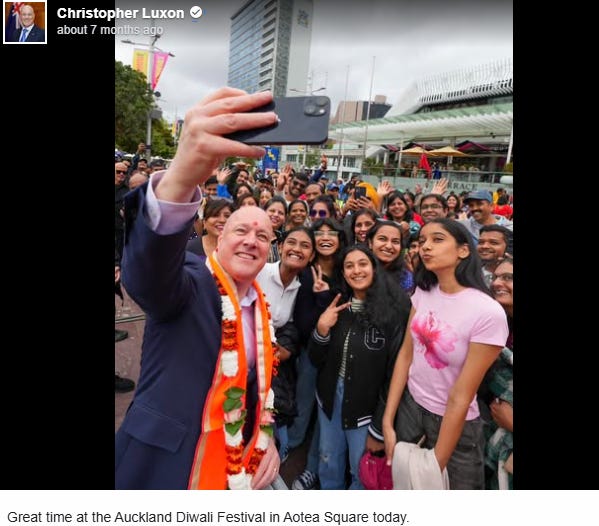
Prime Minister Christopher Luxon’s response to Jones’ spicy “butter chicken tsunami” mixed metaphor was spotty, at best. After describing Jones’ jibe as a “gross misrepresentation”, “scaremongering” and “absolutely false”, Luxon was then pushed on whether he thought Jones’ descriptor was really racist. Luxoflex responded with characteristic evasion (”doesn’t sound right”/“alarmist”/ “unhelpful”), before spluttering “You can call it racist, you know.”
Radio New Zealand, which of course throws RACIST! labels around like confetti, ferreted out a number of Indians to condemn Jones as a racist. Shanti Patel, president of the Auckland Indian Association, announced hyperbolically, “It’s incredibly worrying for everybody.”
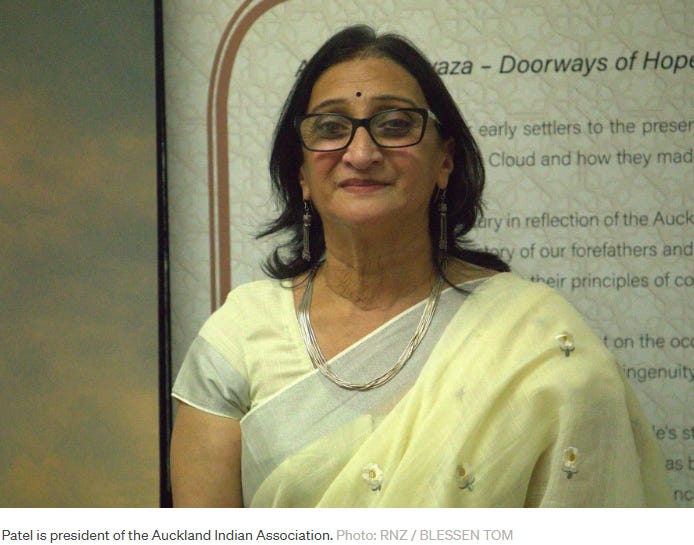
But of course, Jones has no problem with New Zealand’s well established Indian communities. His gripe is with the rising tide of caste system new arrivals.
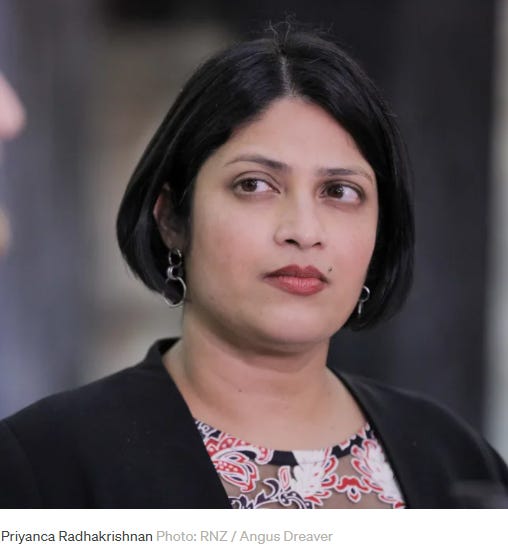
Labour list MP for Maungakiekie Priyanca Radhakrishnan was quick to call Jones’ comments “outright racism”.
One Indian woman who didn’t call Jones a racist is ACT MP Parmjeet Parmar. Parmar herself emigrated to New Zealand from India, where she’d completed a master’s degree in biochemistry before moving to New Zealand in 1995. She then gained a doctorate in biological sciences from Auckland University before working as a scientist. In 2007, Parmar and her arranged husband founded a confectionery business. She went on to work as a radio host and in credible government bodies. Parmar is a polymath.
In 2014, Parmar entered parliament as a National Party list MP. In 2019, she wrote to then Prime Minister Jacinda Ardern complaining about Shane Jones telling members of the Indian community who are disgruntled with immigration policy changes that they should get on the first plane home. But even then, Parmar did not label Jones a racist. Neither did Parmar call Jones a racist when Jones queried Parmar’s arranged marriage, in connection with 2019 changes to immigration policy requiring couples to have lived together for 12 months. Parmar had never lived with (and barely knew) her husband, before she joined him in New Zealand in 1995.
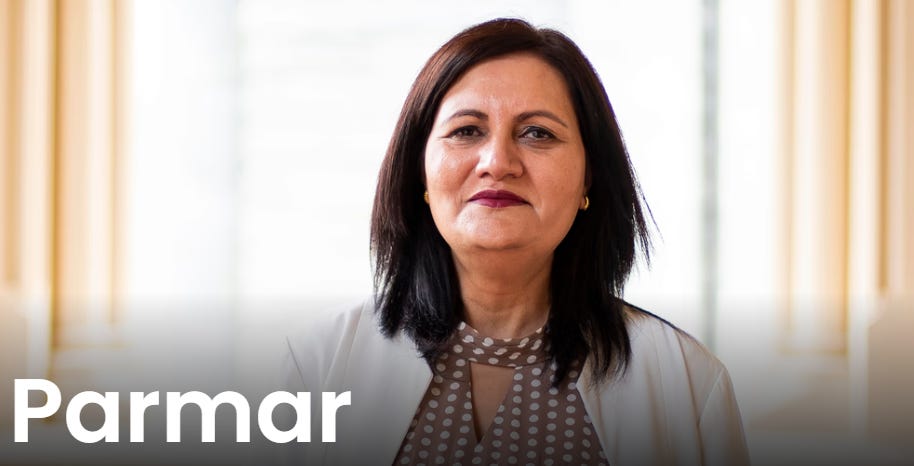
After losing her place in parliament at the 2020 elections, in 2023 Parmar returned to parliament on the ACT Party list.
Parmar is a big fan of equal civil rights for New Zealand citizens, regardless of race. True to her colours, as ACT’s education spokesperson, Parmar objected to Auckland University’s designated safe spaces for Māori and Pasifika students in late March 2024. She argued that the policy is racially discriminatory and divisive.
A year later, Parmar criticised Auckland University’s compulsory course for all first year students forcing them to swallow Māori cultural and Treaty of Waitangi activism. In a supreme example of tertiary institutional race grifting and hustling, Auckland University charged international students almost $6,000 for the course, and local students $1,000 (on a pro rata basis).
Also in March 2025, Parmar introduced legislation seeking to ban universities from offering services based on ethnicity, including scholarships, financial assistance, accommodation, housing and designated university facilities.
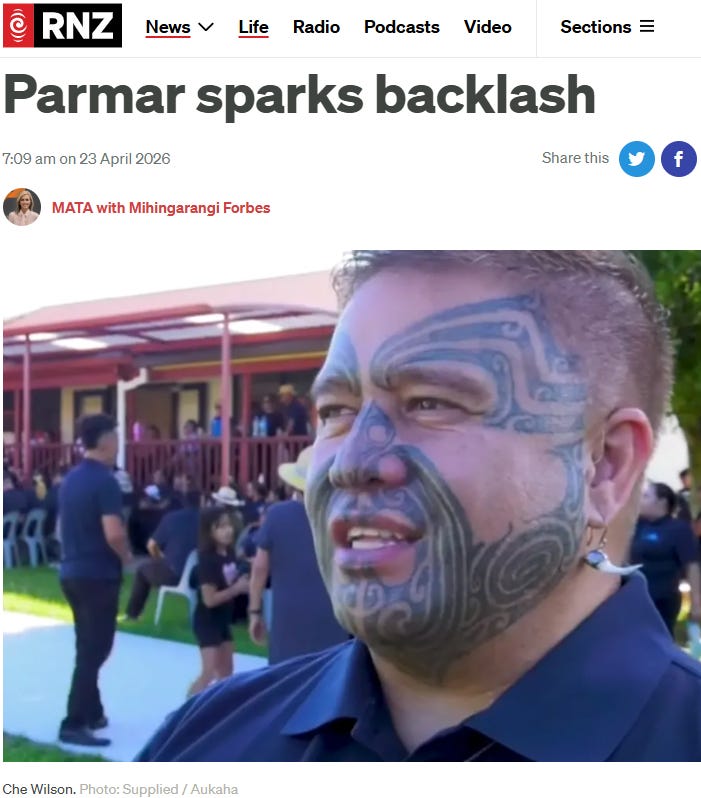
At about the same time as Jones’ butter chicken tsunami, Parmar found herself on the receiving end of overt racism. Former Māori Party president Che Wilson performed a haka at the Tainui Regional Kapa Haka competition.
The haka, specifically targeting Parmar, included the following (translated into English):
For people like Parmjeet who want to instruct or tell us what to do, my message is: Go!
Go back to your own home, to a vast land, to great poverty, to many problems!
Wilson’s crude performance included the phrase “purari karikari iniana”, for which I can find no translation, but which I read is a derogatory reference to ethnic Indians (and perhaps suggesting Parmar is a lady of easy leisure – which she’s clearly not).
Wilson’s haka incorporated gestures mocking and denigrating Indians and their cultural practices, including sitting cross-legged with his hands in a prayer position, mimicking an Indian accent and rocking and rolling his head around.
Responses to Wilson’s haka have been mixed and mangled.
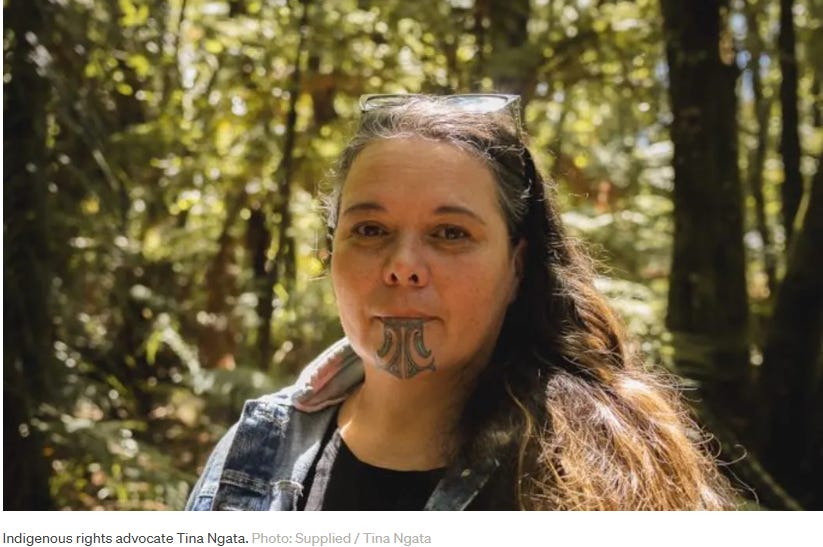
Self-styled “indigenous rights advocate” Tina Ngata, who outwardly appears to have little Māori ancestry, seemed to blame Wilson’s haka on European colonisation. Tina announced, with classic post-modernist obscurantism, “This is a perfect example of how colonial harm turns into lateral racism, and it’s exactly why we, as Māori, need to stop excusing ourselves from anti-racism training.” As far as I’m concerned, all Māori should excuse themselves from any anti-racism training and similar Woke Slop. We can probably assume Tina is herself a well remunerated, self-styled anti-racism trainer.

Carl Ross, the head of state-funded Te Matatini, the national kapa haka (Māori performing arts festival) organisation, assessed that video of Wilson’s haka breached the standards of the Broadcasting Standards Authority (whoop de doo).
Wilson remains unapologetic and unrepentant, which is of course his prerogative.
Red Radio New Zealand reported, “A common sentiment expressed on social media was that political critique should focus on ideas rather than culture.” Which is of course just more low IQ drivel. Everyone should feel (and be) free to criticise other cultures. Lots of ideas are cultural. Check out the absurdly biased heading in the snip of RNZ’s coverage above (Parmar sparks backlash).
All of this noise shouldn’t be allowed to obscure the reality that the incumbent population of New Zealanders (Māori, Indian and Pink Skinners like me and all the rest) should be entitled to choose who can join us, and can legitimately decide that we don’t want mass immigration and drastic changes to New Zealand’s current demographic composition and cultural norms.
Under current and proposed settings (including the NZ/India FTA), the vast majority of new arrivals from India won’t be anywhere near the caliber of Parmjeet Palmer. Anyone for 50,000 Afghani Muhammadans per year?
This article was originally published on the author’s Substack.