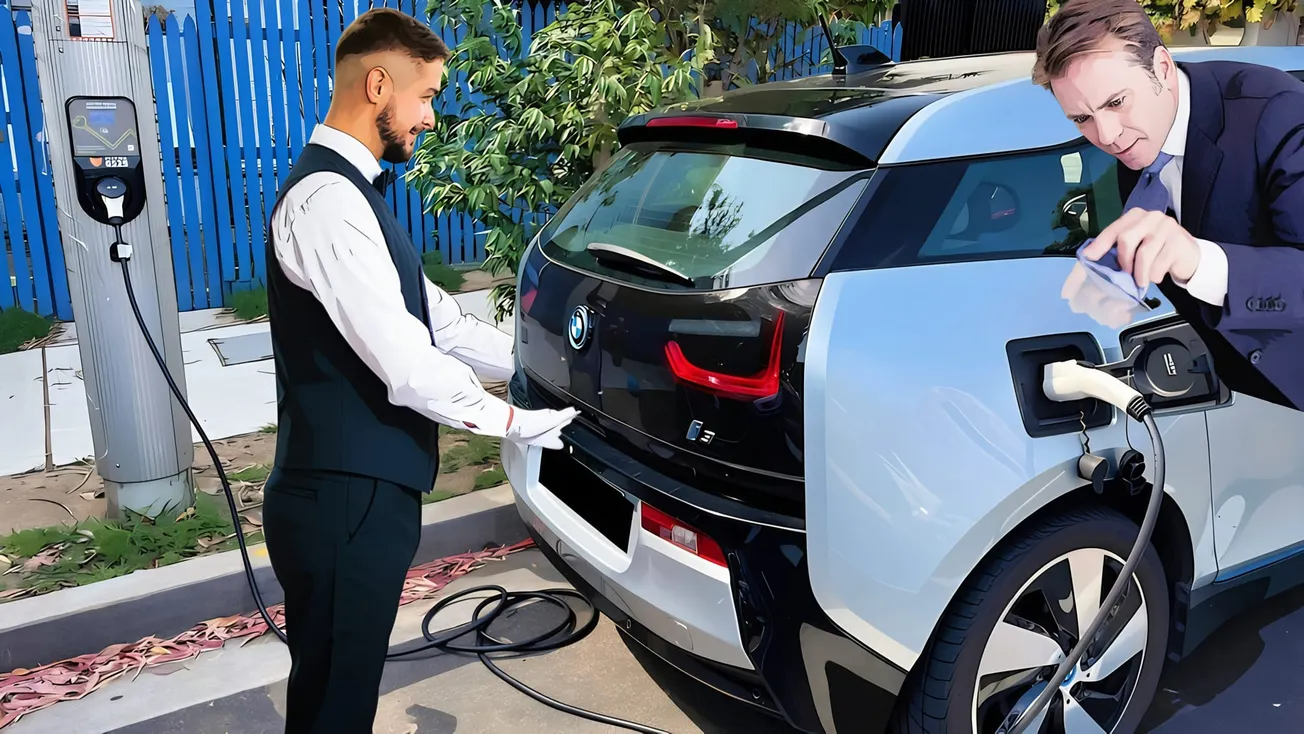
Just how much more taxpayer-funded largesse do the middle-class grifters of the EV set want? They already get their smugmobiles heavily discounted by the federal government, with multiple tax exemptions and discounts on loans. State governments offer more sweets to these greedy bourgeois brats, from cheap loans to discounted registration fees and low interest loans to install charging stations.
What more could this spoiled, indulged class want? Premium parking for them alone?
Turns out, that’s exactly what they want.
The ABC, ever-infatuated with anything that plugs into a wall in the wealthier suburbs, has discovered a tragedy of Dickensian proportions. From 2027, Canberra’s Accelerating EV Charging Program will bolt about 14,000 chargers to power poles in dense inner-city streets. The catch, and it is a ghastly one, is that the program does not oblige anyone to bully councils into reserving the adjacent kerb for EVs alone, which means that petrol cars, those vulgar relics driven by the unenlightened masses, might park there.
The ABC reports the horror in the language of a war crime:
Getting ‘ICEd’ by an internal combustion engine (ICE) car means expensive charging infrastructure goes unused and EV drivers waste time finding the next available plug.
Note that the infrastructure is ‘expensive’ and note who is paying for it. Not the drivers. Under the scheme, energy networks will recover the cost through higher household power bills, up to $1.44 per household per year by the department’s own modelling. That is small change, individually, which is exactly how governments like their pickpocketing: a few coins at a time, from everyone, for the benefit of a privileged few.
And who are the privileged few? Consider Sydney’s eastern suburbs, where more than half of residents live in apartments and EV ownership runs at more than three times the state average. This is not the Australia of the tradie’s ute or the family runabout. This is the ultra-exclusive zone where the median house price tops $3 million – where the Tesla is a form of social signalling and the kerb is a birthright.
Even here, the numbers are damning. Anthony Weinberg, who runs the charging program across the Waverley, Woollahra and Randwick councils, says the undedicated chargers get only five to 10 per cent of the use of the dedicated ones. A reserved charger in North Bondi logged 988 sessions in a year. An undedicated one a kilometre away managed 40. Another, in Curlewis Street, was used four times in 12 months. That is not infrastructure, but a very expensive lamppost for the privileged few.
The Inner West Council found much the same, with its dedicated chargers used four times as often as the others. Its own report recommended converting the lot to reserved spaces. Mr Weinberg is blunter:
We won’t install an EV charger now unless it has dedicated parking.
So the demand is plain enough. The chargers are useless unless a public street is surrendered to the owners of a product that makes up about three per cent of the cars on the road. The other 97 per cent, a quarter of whom have no off-street parking either, can just circle the block and think on their sins.
Now to the part that should interest anyone who still believes in arithmetic. The Department of Climate Change, Energy, the Environment and Water (a title that sounds less like a department than a hostage negotiation) modelled the program on each charger supporting 30 EVs, or 420,000 in total, and promised 9.8 million tonnes of avoided CO2 worth $802 million. Ross de Rango of Vehicle Charging Solutions Australia examined actual electricity delivered by the undedicated chargers in the eastern suburbs and found each supported about three. The model may be out by a factor of 10. Even the Australian Energy Market Commission, hardly a nest of heretics, found ‘limited reliable evidence’ for the uptake the program assumes, and ‘significant uncertainty’ that such chargers would support even four EVs, let alone 30.
The AEMC then backed the scheme anyway, being satisfied that the benefits outweigh the costs to consumers. Only a bureaucrat can stare at a tenfold error and conclude all is well.
Mr Weinberg expects 90 per cent of the chargers to end up undedicated, because the private operators will cherry-pick the best sites and leave the networks, who face no commercial consequence for failure, to plant the rest wherever convenient. The cost lands on your power bill regardless.
This brings us back to the demand. When the program disappoints, as the evidence says it will, expect the cure to be what the EV lobby wanted from the start: reserved kerbside for the chosen few, at the expense of everyone else.
The middle-class welfare comes first. The turbocharged privilege follows. It always does.