Baron
FSB
The murder of Alexander Litvinenko has long been presented as one of the clearest examples of the ruthlessness of Vladimir Putin’s Russia. A former Russian security officer, living in London and openly hostile to the Kremlin, suddenly falls gravely ill and dies after ingesting the highly radioactive substance polonium-210. Two Russian men, Andrei Lugovoy and Dmitry Kovtun, had met him shortly beforehand. The obvious conclusion, we are repeatedly told, is that they were sent by the Russian state to kill him.
Sir Robert Owen’s Litvinenko Inquiry reached that conclusion. It is an important report and runs to hundreds of pages. But a long report is not necessarily a conclusive report, and a judicial conclusion is not the same thing as a criminal conviction. The question worth asking therefore, is whether the evidence and reasoning set out in the report are sufficiently compelling to justify the certainty with which the accepted version of events is now presented.
There is certainly no dispute about the central fact: Litvinenko was poisoned with polonium-210 and died from its effects. The more difficult question is who administered it and, beyond that, who ordered the killing.
The inquiry concluded that Lugovoy and Kovtun deliberately poisoned Litvinenko. Sir Robert Owen stated that he was sure they knew they were using a deadly poison and intended to kill him, although he did not believe they knew precisely what chemical they were handling, or knew of all its properties.
That distinction is important. The report did not establish, by means of a criminal trial, that the two men were guilty. They were not tried in a British criminal court and neither gave oral evidence before the inquiry. The inquiry was an investigation, not a criminal prosecution. Its findings therefore deserve to be examined as findings based upon the evidence available to the inquiry, rather than treated as the equivalent of a jurys verdict.
And here the report becomes rather more interesting.
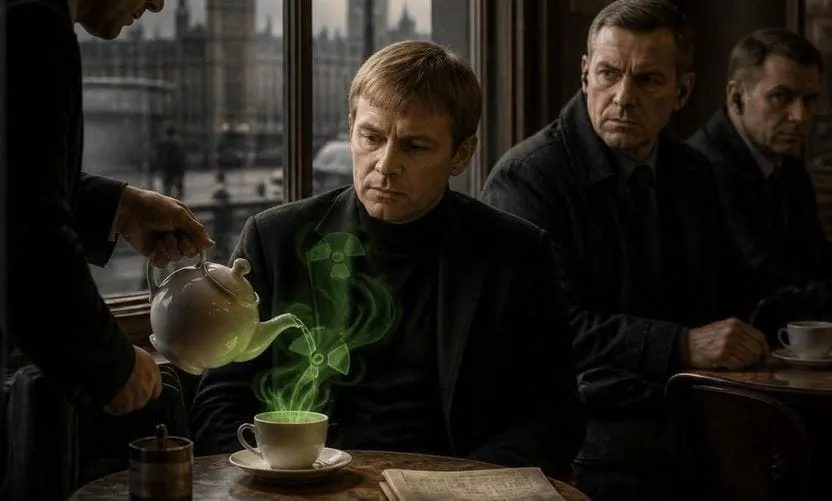
One of the features of the case that deserves greater attention is the meeting at the Pine Bar of the Millennium Hotel. If Lugovoy and Kovtun had been sent to poison Litvinenko, why was the supposed victim not simply induced to drink the poisoned tea?
The circumstances are plainly unusual. Litvinenko was not compelled to drink it. He could have ordered something else or have no drink at all. The report records the circumstances in detail, and the inquiry nevertheless concluded that this did not undermine the case against the two men.
There is an explanation. It was suggested that an excessive insistence that Litvinenko drink the tea could itself have aroused suspicion. Litvinenko was keen to meet Lugovoy and there were opportunities to try again. That explanation is possible. But “possible” is not the same as “compelling”.
A man allegedly carrying out a carefully planned assassination with an extraordinarily dangerous and traceable substance might reasonably be expected to take considerable care to ensure that the intended victim actually consumed it. Instead, the circumstances surrounding the tea leave room for legitimate questions. The inquiry had an answer, but whether that answer is persuasive is a matter on which reasonable readers can differ.
The same applies to the remarkable trail of contamination which followed. The report records radioactive contamination in hotels, aircraft and other locations. It also records the exposure of members of the two men’s families. Sir Robert Owen acknowledged the obvious difficulty. Why would men carrying out a state-directed assassination expose their own wives and children to a potentially lethal radioactive substance?
The inquiry’s answer was essentially that they did not know what they were handling. This is where one of the most striking pieces of reasoning in the report appears. Sir Robert Owen wrote that, had Lugovoy and Kovtun known more about the substance, he was confident they would have handled it more carefully. Their apparent carelessness therefore became, paradoxically, evidence supporting the proposition that they did not know what they had been given.
It is an ingenious explanation. But it is not the only explanation.
If Lugovoy and Kovtun were indeed responsible, then the evidence suggests that the operation was extraordinarily careless. Polonium was allegedly taken through hotels and onto aircraft. Radioactive traces were left behind. The men’s families were exposed. The supposed assassins themselves apparently became contaminated.
One can reasonably ask whether this behaviour looks like the work of a professional intelligence service. Perhaps it does, but more likely it does not. The point is not that this proves the men innocent. It plainly does not. The point is that evidence capable of supporting two different interpretations should not be presented as though it permits only one.
The report’s treatment of the anonymous Russian source “Kondaurov” is also worthy of scrutiny. Sir Robert Owen relied in part upon a newspaper article by journalist Mark Franchetti, who quoted a Russian source identified as Kondaurov. The source offered a hypothetical explanation of how an intelligence operation might work: if he had been in charge of such an operation, and if Lugovoy had been involved, he would have told Lugovoy as little as possible.
The judge described this analysis as sound and considered it likely that Lugovoy and Kovtun knew they were poisoning Litvinenko without knowing the identity or properties of the poison. That is possible. Intelligence organisations do compartmentalise information. An operative does not necessarily need to know everything about an operation. But the evidential question remains.
The inquiry was not hearing directly from Kondaurov. The statement came through a journalist. The reader is not given, in the passage under discussion, enough information about this source to assess his expertise, position, access to relevant information or reliability. That does not make the statement worthless. Nor does it prove that the source was invented or unreliable. It simply means that its evidential weight is a legitimate subject for criticism.
Indeed, there is an interesting circularity here. The judge uses the hypothetical proposition that an operative might not know the nature of the poison to explain why Lugovoy and Kovtun behaved as they did. Their apparent ignorance then becomes part of the evidence supporting the hypothesis that they were operatives who had deliberately been kept ignorant. But that begs the question: is this sound reasoning? More likely, it is reasoning built upon inference rather than a smoking gun.
The same problem arises with the judge’s observation that Kovtun did not mention polonium-210 when talking to a witness. Why should he have done so if, as the inquiry concluded, he did not know that the substance was polonium? The absence of a reference to something a suspect supposedly did not know about seems hardly surprising. Yet the fact was nevertheless mentioned by the judge.
Consider an analogy. Suppose a man were suspected of planting a bomb and subsequently discussed the explosion with a witness without mentioning the nails inside the bomb. It would hardly follow that his failure to mention the nails demonstrated that he had planted it, particularly if there were no evidence that he knew the bomb contained nails.
This does not establish that the inquiry’s conclusion was wrong. It does illustrate how readily an absence of evidence can become evidence of something when placed inside a particular theory of the case. There is another traditional question which deserves attention: cui bono, who benefited?
It is not a magic test which solves every murder. People are murdered for all sorts of reasons, including reasons that make no sense to an outside observer. Nevertheless, motive matters. If a state is alleged to have ordered the killing of an opponent in another country, it is reasonable to ask what the state gained from doing so.
Litvinenko was already a fierce opponent of the Russian government. He was living in Britain and had made serious allegations against senior Russian officials. His death would certainly, therefore, be interpreted as serving Russian interests. But it could also be argued that killing him in such a spectacular manner, using polonium-210 and leaving an unmistakable radioactive trail across London, was an extraordinary way of achieving that objective. That does not prove that Russia did not order the murder. It does, however, raise the question of whether the method itself is entirely consistent with the alleged motive.
There is a temptation in cases such as this to reason backwards. We know the Russian government had enemies. We know that the Putin regime has behaved brutally. We know that Russian intelligence agencies have conducted clandestine operations. Therefore, when a Russian opponent dies mysteriously, the explanation must fit the established pattern.
That is understandable, but dangerous. Past behaviour can provide context. It cannot substitute for evidence in the individual case. The inquiry itself considered other suspicious deaths and events, including the murder of journalist Anna Politkovskaya. Such material may be relevant background. But the existence of other alleged crimes does not establish who killed Litvinenko.
A government should not be judged solely by its reputation, good or bad. A criminal case should be judged on the evidence relating to the particular crime. This is not an argument that Lugovoy and Kovtun were innocent. It is an argument for intellectual caution.
There is a substantial difference between saying that the evidence points towards a conclusion, saying that a conclusion is more likely than not, and saying that the evidence proves the conclusion beyond reasonable doubt. Sir Robert Owen was well aware of those distinctions and explained the standards he applied.
The problem for those who regard the Litvinenko case as closed is that much of the case rests upon a chain of inference. The polonium establishes the murder. The movements of Lugovoy and Kovtun establish that they met Litvinenko. The contamination trail establishes that polonium travelled along routes associated with them. Their conduct is then interpreted in light of the theory that they were carrying out an assassination.
Each individual piece of evidence may be suggestive. The question is whether the entire chain is sufficiently robust to exclude reasonable alternative explanations. That is ultimately what Baron is questioning, and the inquiry does not make the question disappear.
The report is an important historical document. Its conclusions deserve respect. But respect for a judicial inquiry should not mean suspending critical thought. A judge can reach a conclusion honestly and carefully, yet a reader can still examine the reasoning and conclude that some links in the chain are weaker than others.
The Litvinenko murder remains a terrible crime. Alexander Litvinenko died in circumstances that demand explanation. The fact that the victim was a prominent critic of Vladimir Putin makes the Russian-state theory an obvious one. It does not, by itself, make it an established fact.
The proper lesson is surely a simple one. Evidence should lead us to conclusions, not conclusions lead us to evidence. Sir Robert Owen believed the evidence led to Lugovoy and Kovtun, and beyond them to the Russian state. Others remain unconvinced. The latter position should not be dismissed as an apology for Putin, Russian propaganda or conspiracy theory. It can simply be the position of someone who believes that the evidence, however extensive, does not quite justify the certainty with which the official explanation has subsequently been presented.
A case may be closed administratively. It does not follow that every question about it has been answered.
This article was originally published by the Free Speech Backlash.