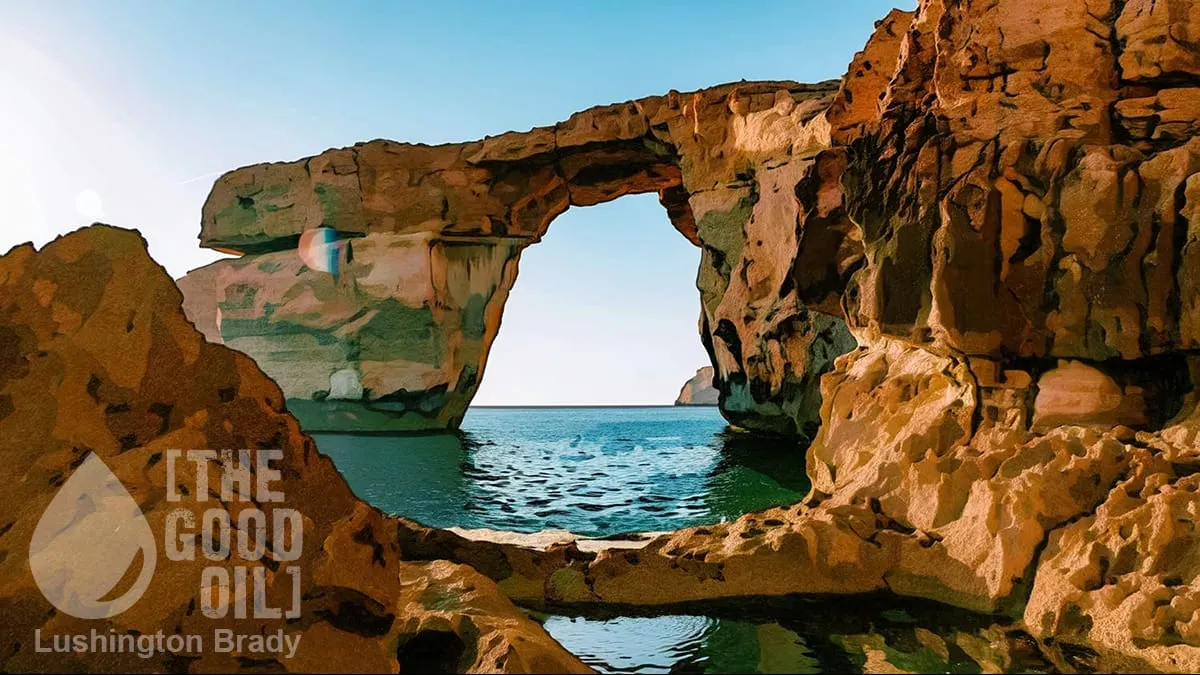
As the Book of Acts famously recounts, when St Paul was shipwrecked on the island of Malta, “the islanders showed us unusual kindness. They built a fire and welcomed us all because it was raining and cold.” Paul so impressed with the Maltese indigenes, and the Roman governor, Publius, that the latter became bishop of the first Christian church on the island. More churches were built over the succeeding centuries and Catholicism is still the religion of 90 per cent of its people.
But the kindness the Maltese showed to Paul was not reciprocated when the scimitar of Islam swept across the island in the ninth century. The Muslim invaders looted Malta so thoroughly that even the cathedral of Melite, now Mdina, was entirely dismantled and its marble taken to build a fortress in Tunisia. As for the people, according to the 14th century Islamic historian al-Himyari, the Muslims left the island an almost-uninhabited ‘desert’.
Recent linguistic studies lend credence to the likelihood that a particularly devastating genocide took place in ninth century Malta, brutally ending a 9,000 year-long story.
That story, it turns out, stretches even further back than the famous Neolithic farmers and temple-builders of Marsaxlokk. New research has shown that European hunter-gatherers were already making repeated, deliberate sea voyages to Malta at least 8,500 years ago, more than a millennium before the arrival of Neolithic agriculture.
It was long assumed that the sort of long-distance sea-voyaging necessary to have settled Malta, even at the time of the last glacial maximum, was beyond the capabilities of hunter-gatherers.
Enter the recent findings from the site of Latnija, on Malta. Did the surprising presence of European hunter-gatherers on Malta reflect a one off, accidental crossing – or perhaps people who somehow became marooned on the island? Conversely, was this Mesolithic presence a reflection of something altogether different, and more complex?
To explore these possibilities, we investigated whether Malta could support a viable forager population size that could have lived in isolation for the 1,000 year occupation of the island during the Mesolithic.
Population modelling based on changing sea levels and ecological productivity makes that clear. After the land bridge to Sicily disappeared around 14,000 years ago, Malta shrank rapidly.
But hunter-gatherer societies need enormous amounts of land compared to their population sizes. From Australia to the Americas, hunter-gatherer populations were characterised by a very small number of people ranging over vast swathes of territory.
Malta does not have vast swathes of territory. It would fit comfortably in Lake Taupō. Without farming, scratching a living for hunter-gatherers would have been a difficult task. Modelling suggests that by the Mesolithic occupation the island could theoretically support only around 170–144 people. Conservation genetics tells us a viable long-term population needs an effective breeding size of at least 1,000, or a total population of 2,500–3,000. Malta simply could not sustain an isolated forager community for a thousand years.
The only alternative is that these Mesolithic hunter-gatherers were making repeated, long distance sea voyages between at least Malta and Sicily, the closest land mass, to maintain the genetic connections that ensured at least a millennium of Mesolithic viability on Malta.
These late European hunter-gatherers were crossing at least 100 kilometres of open sea between Sicily and Malta, again and again, keeping the gene pool viable. They did so thousands of years before the earliest evidence of sails, almost certainly in dug-out canoes, relying on intimate knowledge of winds, currents, stars and the seasonal bounty of a small, semi-arid island.
This is not just a startling new chapter in Malta’s long history: it’s a new insight into the ingenuity of ancient hunter-gatherers. Keeping open a sea-route to Malta nearly 10,000 years ago was not primitive blundering. It required technological competence, navigational skill and ecological intelligence of a high order. Ancient DNA already shows European hunter-gatherer ancestry turning up in pre-Neolithic Tunisia. Malta was not an isolated outpost: it was a node in a hitherto under-appreciated web of Mediterranean sea links that long predated the first farmers.
All of which makes the ninth-century catastrophe still more stark. A human continuum that had endured from the Mesolithic through the Neolithic temples, the Phoenicians, the Romans and the early Christian centuries was nearly entirely wiped out as the blood-soaked tide of Islamic conquest swept the Mediterranean.