Table of Contents
John McLean
Citizen typist. Enthusiastic amateur.
On 13 February 2026, the New Zealand Medical Journal published the results of a study into whether discrimination against certain “Pacific people” in New Zealand’s public health system is associated with these people not using that system.
The article’s title is “Investigating the association between experiencing discrimination in healthcare settings and avoidance of healthcare services among Pacific Rainbow+ in Aotearoa New Zealand”. Insomniacs can read the article here:
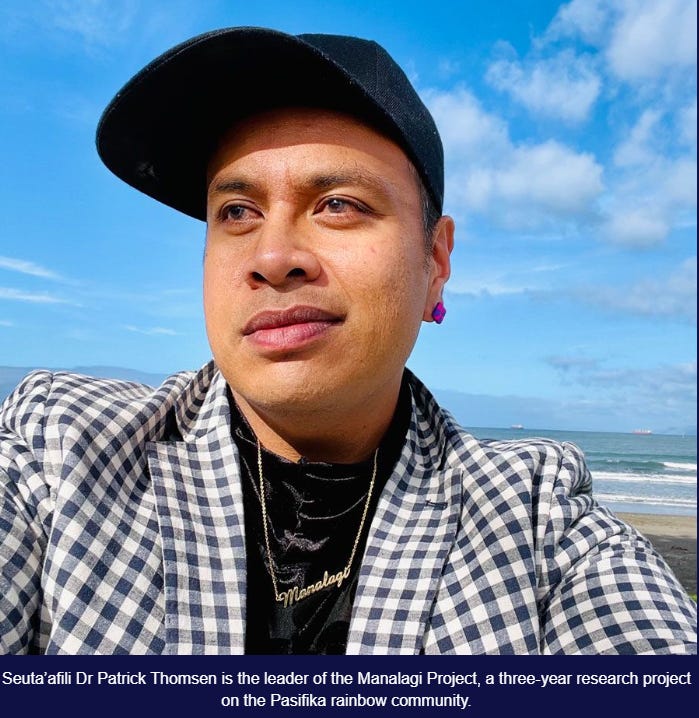
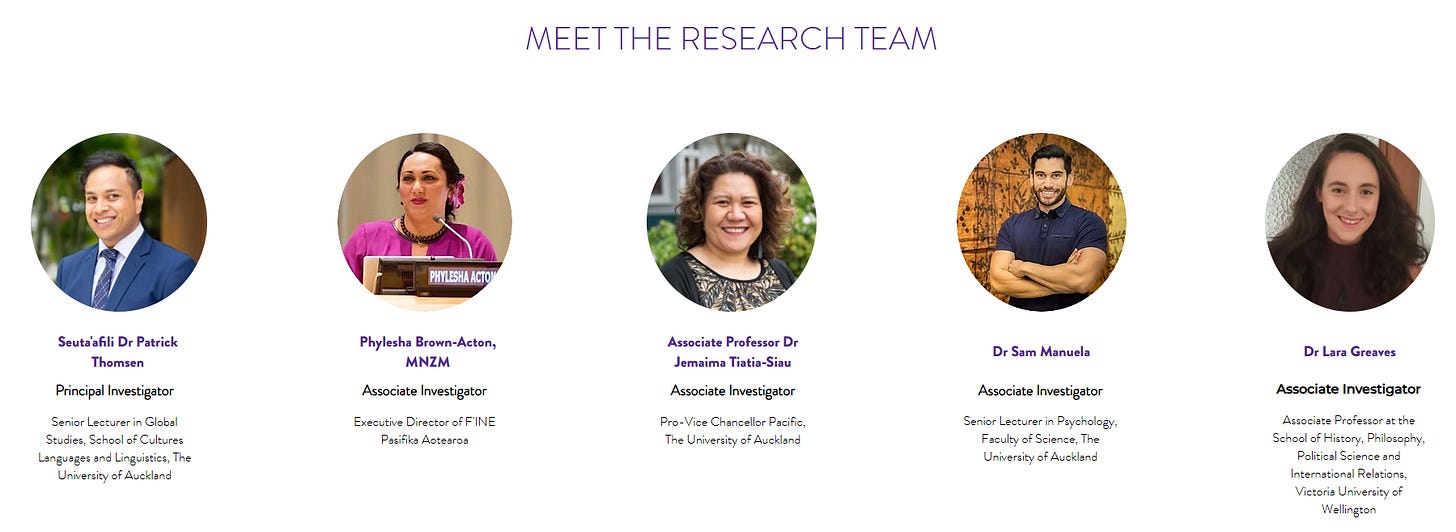
The “lead author” of the study and article is Dr Patrick Thomsen, who is a senior lecturer in social sciences at Auckland University and the head of something called the Manalagi Project.
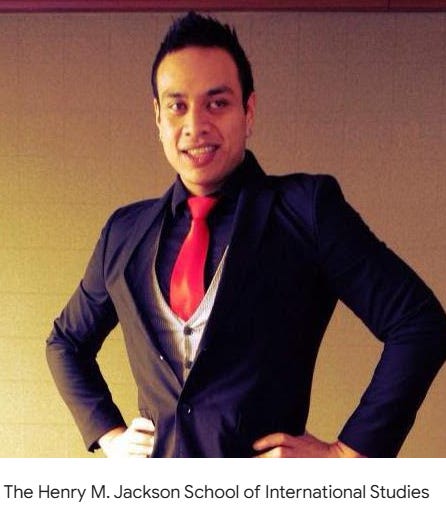
Dr Thomsen is not a medical doctor. He got his doctorate from the University of Washington’s Jackson School of International Studies. His doctoral thesis was entitled “From Sleepless in Seattle to “I Seoul U”: How Korean Gay Men Narrative, Negotiate, and Reproduce Discourses of Race, Culture, Religion, and Sexual (In)Visibility”.
The group surveyed for Dr Thomsen’s Manalagi Project study comprised non-Māori individuals with Polynesian ancestry who identify as either “cisgender sexual minorities” or “trans and non-binary”.
I had to investigate what is a “cisgender sexual minority”. Turns out, a cisgender sexual minority person is a man or a woman who is sexually attracted to people of their own biological sex: in other words, a good old-fashioned homosexual/gay person. Unfortunately, the article doesn’t use the words homosexual or gay. Not once. Which goes with the territory. Obscurantism and an in-house jargon is rife in realms of pseudo-academia.
“Trans”, for the uninitiated, are people who want to be the opposite of their biological sex. “Non-binary” are people who claim they’re neither a man nor a woman.
Dr Thomsen’s study found…drum roll…surprise, surprise…that “experiences of discrimination (racism, homophobia/transphobia) had a negative predictive effect on healthcare service use” and that “experiences of racial and ethnic based discrimination (racism) also increased the likelihood of mental health service usage”.
Dr Thomsen’s article is packed with all the predictable neo-Marxist, post-modernist verbiage – “Pacific specific gender identities”, “persistent systemic racism”, “cultural competence”, bla bla bla.
But, to give Dr Thomsen and his team a little credit, the article does concede:
our regression findings are limited by the cross-sectional nature of the data, which restricts our ability to infer causality. While our results suggest that experiences of discrimination may contribute to healthcare avoidance and increased use of mental health services, alternative explanations remain plausible.
In other words, Dr Thomsen concedes that his study does not come close to proving that discrimination (if it exists) reduces use of the healthcare system or increases the use of mental health services. Predictably however, this concession is simply a hook for more research funding, with the article concluding:
While findings of the study are limited…, the intersectional complexity of the Pacific Rainbow+ experience with the Aotearoa New Zealand healthcare system needs further investigation and research. This will help provide further nuanced data and evidence to better support this multiply [sic] marginalised cohort’s comfortability with, and usage of, services provided by the Aotearoa New Zealand healthcare system.
In fact, alternative explanations for the asserted results are extremely “plausible” indeed. The methodological holes in the study are big enough to drive a bus through.
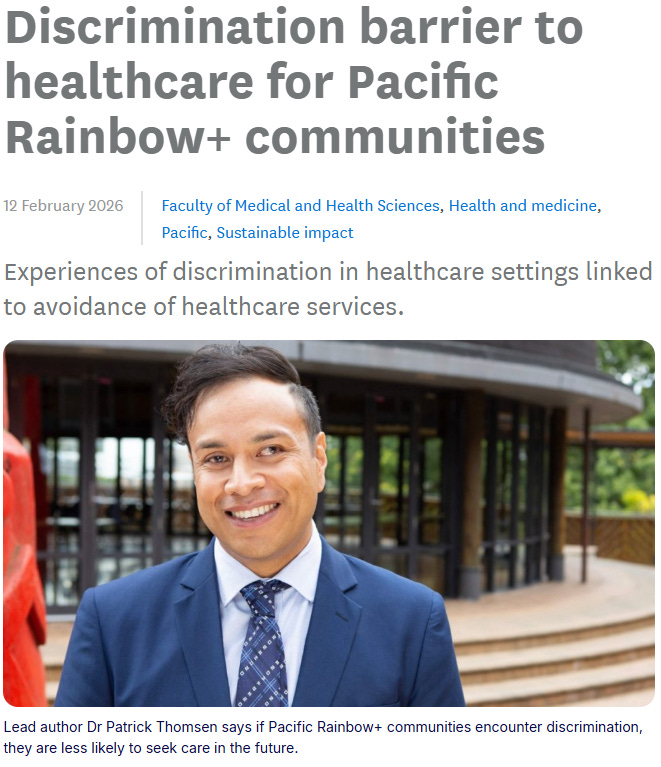
The most glaringly obvious flaw in the study is that it relies entirely on self-reported feelings of being discriminated against. There is no attempt whatsoever to establish whether Pacific Rainbow+ people are in fact discriminated against because they’re homosexual or trans or nonbinary. Relying entirely on self-reporting injects recall and reporting bias, and incorrect subjective interpretation of discrimination (where there is none).
Participants in the study may have simply imagined that they’ve been discriminated against or, worse, deliberately lied that they’ve suffered discrimination. The primacy of feelings and experiences over any attempt at objectivity sticks out like dogs balls, with the survey “results” reported as follows:
Felt you were treated differently from patients who were Pākehā
Felt you were treated differently from patients who were cisgender and straight-presenting
Experienced microaggressions based on your ethnicity/race/gender/sex/characteristics
As cursorily conceded in the article, association is not causation. Even if the Pacific Rainbow+ people “studied” really do suffer discrimination and indeed use the health system less than others, that doesn’t mean discrimination causes such lesser use. Pacific Rainbow+ may just be less inclined to use New Zealand’s health system, through no fault but their own, or be more inclined to use mental health services. Pacific Rainbow+ people could be innately more likely to be mentally ill. No one knows.
This association versus causation problem is exacerbated by “indeterminate temporality” – because the study measured discrimination experiences and healthcare avoidance at the same point in time, there is no way of knowing whether discrimination preceded avoidance or people already avoiding services encounter more discrimination when they do go the clinic.
And another fundamental flaw in Dr Thomsen’s study – there was no attempt to compare the results from the surveyed Pacific Rainbow+ people with results from a control group comprising a sample of non-Pacific Rainbow+ people, i.e., people with no Polynesian ancestry (but including Māori) who are heterosexual and not trans or non-binary. This comparison wouldn’t have been hard to achieve and it’s entirely possible that heterosexual non-Polynesian people may sometimes suffer discrimination in the health system.
In fact, given public health resources are limited and positive health system discrimination in favour of Polynesian (and Māori) individuals has been legislated policy since 2022, it’s entirely conceivable that some non-Polynesian people are being discriminated against – or at least feel that they’re being discriminated against.
There are multiple other methodological flaws as well. Participation in the study was voluntary and the self-selected participants are probably not representative of Pacific Rainbow+ people in general. In addition, Dr Thomsen’s study did not adjust for socioeconomic factors, health literacy, pre‑existing medical conditions or access‑related factors (e.g., transport, cost).
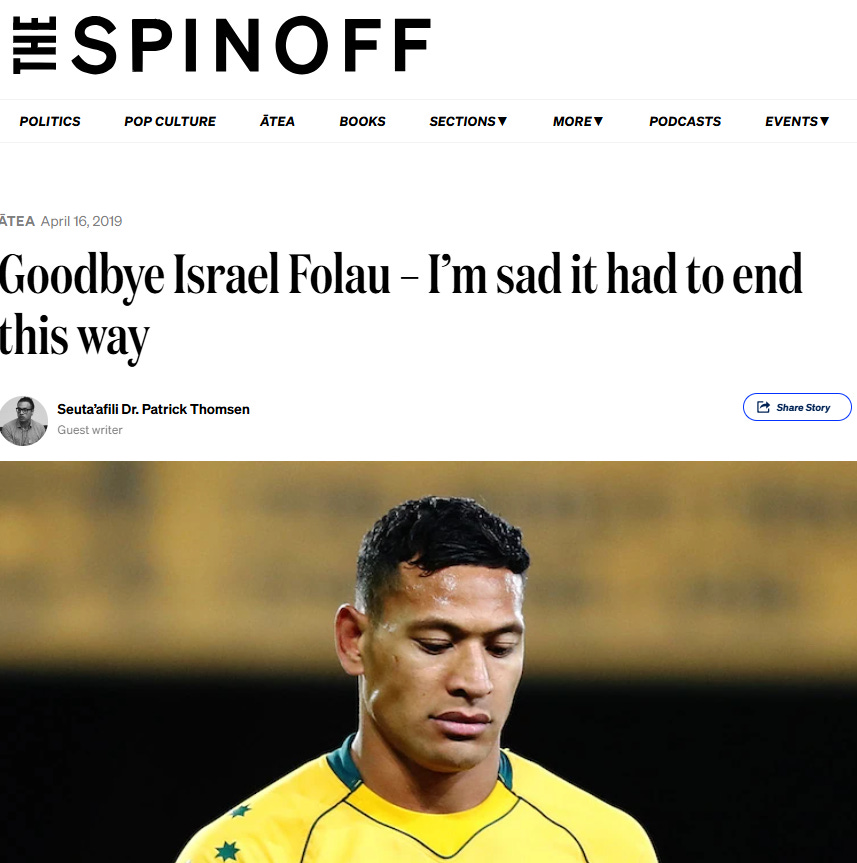
And another thing. From his public pronouncements, one might be inclined to conclude that Dr Thomsen tends to favour his own Pacific Rainbow+ tribe over heterosexual pink-skinned humans. In a 2019 article in the Spinoff, Dr Thomsen supported Australian Rugby’s sacking of Israel Folau (for saying homosexuals go to Hell) and offered tantalizing clues as to what Prissy Patrick really thinks about some of his fellow humans:
But the dude’s a visibly Pasifika (more specifically Tongan) person whose fame is based on his ability to represent sport and entertainment for a richer, whiter-looking crowd.
Homophobia is not a Pacific concept, nor in our cultures a legitimate framework to other and marginalize people.
At its core, his beliefs are just a very wrong interpretation of a text whose creation bears no contextual relation to the one in which our people’s worldviews were forged (yes, colonisation).
It’s a testament to how dreadful Dr Thomsen’s “study” truly is that it wasn’t even covered by any lame stream media outlets like Stuff, Radio New Zealand, the NZ Herald, the Spinoff or TVNZ – media channels that typically lap up Dr Thomsen’s brand of pseudo-academic, Critical Race Theory claptrap.
New Zealand has to do something about the proliferation and leveraging of dodgy ‘doctorates’. At the very least, if someone’s doctorate is not a medical doctorate from a credible New Zealand medical school, the good ‘doctor’ should have to say so, IMO. Pip pip.
This article was originally published on the author’s Substack.