
Table of Contents
Hope for the best and plan for the worst is my motto in a sticky situation, and so I wonder about the government’s plan to extract us from COVID-19 lockdown. We could be stuck for years repeatedly escalating and de-escalating the COVID-19 levels because the government didn’t map a clear way out.
Will they stay true to form in promising much and delivering little? It’s one thing to dramatically fail to deliver housing but quite another to mess about with our health and financial future.
Ardern and Robertson are busy congratulating themselves on dodging thousands of COVID-19 deaths. They are splashing money around without providing details.
A newspaper reported this week:
“A plan is underway to have charter flights bring thousands of Chinese international students back to New Zealand – but this can only go ahead if it gets a nod from the Government.
“The travel ban put in place in February to stop the spread of Covid-19 has prevented more than 11,000 Chinese students who had been due back for their studies from travelling here.”
Will the government bow to pressure from private institutions, schools and tertiary institutions who are financially dependent on funding from overseas students? Will the government resist pressure from China which assiduously dispersed their students around the world?
We’ve been warned if we’re naughty we will yo-yo between levels, but what if the government is naughty and bows to pressure, selectively opening the border to Chinese students? Why wasn’t funding in the budget for the loss of income from overseas students rather than risk them flocking into the country with mutated versions of the disease from ground zero? Variants of the virus might be deadlier and more contagious than the fairly benign version we’ve experienced to date, or they might be innocuous, we just don’t know. Co-lead author Professor François Balloux, at the UCL Genetics Institute doesn’t know either.
“All viruses naturally mutate. Mutations in themselves are not a bad thing and there is nothing to suggest SARS-CoV-2 is mutating faster or slower than expected. So far we cannot say whether SARS-CoV-2 is becoming more or less lethal and contagious.
The small mutations identified in SARS-CoV-2 were not evenly distributed across the virus genome. As some parts of the genome had very few mutations, the researchers say those invariant parts of the virus could be better targets for drug and vaccine development.
“A major challenge to defeating viruses is that a vaccine or drug might no longer be effective if the virus has mutated. If we focus our efforts on parts of the virus that are less likely to mutate, we have a better chance of developing drugs that will be effective in the long run.
How do we manage the risk if an effective vaccine does not eventuate?
“By analysing viral genes from patients infected with COVID-19, a University College London (UCL), UK, led research team has characterised patterns of diversity of the SARS-CoV-2 virus genome, offering clues to direct drugs and vaccine targets.
They identified 198 mutations [of the SARS CoV-2 genome] that appear to have independently occurred more than once, which may hold clues as to how the virus is adapting.
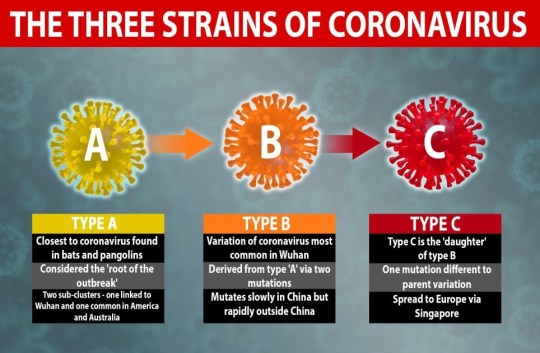
The 198 genetic mutations to date occurred within the three main strains of Covid-19. China / Science explains the relationship between the three strains.
The prime minister and our health professionals must be aware of the vaccine challenge, making the absence of a clear pathway disturbing.
“Prime Minister Jacinda Ardern has warned New Zealanders should get used to border restrictions in New Zealand and overseas, saying they’re likely to be in place ‘for some time’.”
The border is key. Ardern knows border closure will stop new strains of COVID-19 entering the country, so why wasn’t money allocated in this budget to compensate for the loss of dollars from thousands of international students? Does it mean the government wants to let them in, or was this important detail overlooked by a government proven reactive rather than proactive?
“She said border restrictions overseas would likely persist until a vaccine for the novel coronavirus, believed to be one year to eighteen months away at the earliest – some vaccines take a decade to develop.”
What does the prime minister know about a vaccine for COVID-19 that we don’t? Years after coronavirus infections such as SARS, which appeared in 2003, and MERS in 2012, there is no vaccine for either infection.
Why would the government think a vaccine for COVID-19 will be developed in “one year to 18 months?” Pinning our hopes on a vaccine is optimistic in light of the elusive vaccine for SARS or MERS.
This week the WHO released their draft landscape for Covid-19 vaccines, five pages listing the progress of work undertaken by researchers anxious to cash in on the potentially extremely lucrative market.
The CDC outlines the general development stages in the development of a vaccine:
Exploratory stage
Pre-clinical stage
Clinical development
Regulatory review and approval
Manufacturing
Quality control
Clinical development is a three-phase process.
During Phase I, small groups of people receive the trial vaccine.
In Phase II, the clinical study is expanded and vaccine is given to people who have characteristics (such as age and physical health) similar to those for whom the new vaccine is intended.
In Phase III, the vaccine is given to thousands of people and tested for efficacy and safety.
Many vaccines undergo Phase IV formal, ongoing studies after the vaccine is approved and licensed.”
Most of the work in the WHO draft is at the clinical development stage which appears to be part way through a process that could take years, decades even.
The NZ Medical Journal said, “A vaccine is the only clear exit strategy that will allow New Zealand to return to normality.” If normality is cross-border trade of product, services, people, investment and ideas; tourism, hospitality and education, then we need to plan around the probability that this normal is a very long way off. So, what is our plan based on the information to date?
If you enjoyed this BFD post please consider sharing it with your friends.