Table of Contents
We’re constantly finger-wagged and shouted at that there’s a ‘Climate Emergency’. We can be excused for asking, ‘Well, where?’
Is it in increasing desertification? Well, no: even NASA admits that the world has undergone a remarkable ‘Global Greening’ over the past quarter-century, as a direct consequence of rising atmospheric carbon dioxide. How about food shortages? Well, nope: along with all that greening, we’re growing more food than at any time in human history – and using less and less land to grow it on.
By now your average Climate Cultist is spluttering something about rising sea levels. Except that most islands are either stable or growing in size. Even supposed poster children for rising sea levels are experiencing the consequences of their own bad land-use choices rather than climate change. The Arctic remains stubbornly frozen, defying all readings of its obituaries. (Polar bears are doing just fine, too.)
Reduced to a screeching, spitting fit of rage, the Climate Cultist invariably pounces on ‘Storms! Floods! Hurricanes! Dogs and cats living together… mass hysteria!’
Sorry, Cultists: that one’s a bust, too.
Arguments for devastation typically claim that extreme weather (like droughts, floods, wildfires, and hurricanes) is already worsening because of climate change. This is mostly misleading and inconsistent with the IPCC literature. For instance, the IPCC finds no trend for global hurricane frequency and has low confidence in attribution of changes to human activity, while the US has not seen an increase in landfalling hurricanes since 1900. Global death risk from extreme weather has declined 99 per cent over 100 years and global costs have declined 26 per cent over the last 28 years.
We’ve known this all along. Over a decade ago, Bill Nye ‘the not-science guy’ tried to debate Marc Morano on the topic. Nye started gibbering about hurricanes, to which Morano calmly started to reply that, as we know, there is no long-term trend in hurricanes. Realising his tactical error, Nye immediately spluttered, “Well, hurricanes, shmurricanes, if I may…”
Well, no, you may not. You brought up hurricanes, pal. Just because you realised too late that you were going to get shot down with facts doesn’t let you backtrack.
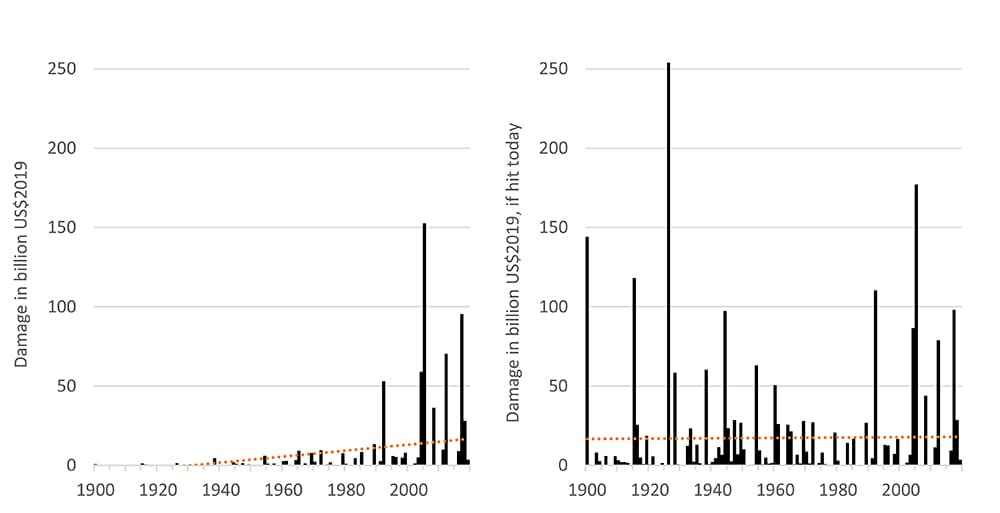
Smarter minds than Nye have also cottoned on that the long-term data on ‘extreme weather events’ isn’t working how they want. So they try a new gambit: pointing to increased insurance bills from extreme weather events. But this is yet another bullshit pea-and-shells gambit. Because what they ignore is that land use has changed dramatically in the past century. A century ago, Florida was largely uninhabited swamps. After WWI, massive drainage projects led to cities like Boca Raton being built from scratch.
But, while the land may have been drained, it was still low-lying and hence vulnerable to completely normal extreme weather events. So, of course the damage bill went up. As Lomborg shows, though, if the land use of the 2020s had been in place a century ago, the damage bill would have been just as high. The adjusted long-term trend in extreme weather damage costs is, once again, flat.
So much for ‘climate emergency’.
There’s no reason to suppose that civil engineers over the next century won’t come up with adaptation measures, just as they have for centuries to date. Sure, it will cost money – but, in the long run, much less money than so-called ‘climate action’ policies witless politicians are pursuing to our gross detriment at present.
Arguments for devastation typically ignore adaptation, which will reduce vulnerability dramatically. While climate research suggests that fewer but stronger future hurricanes will increase damages, this effect will be countered by richer and more resilient societies. Global cost of hurricanes will likely decline from 0.04 per cent of GDP today to 0.02 per cent in 2100.
Climate-economic research shows that the total cost from untreated climate change is negative but moderate, likely equivalent to a 3.6 per cent reduction in total GDP.
Climate policies also have costs that often vastly outweigh their climate benefits. The Paris Agreement, if fully implemented, will cost $819–$1,890 billion per year in 2030, yet will reduce emissions by just one per cent of what is needed to limit average global temperature rise to 1.5°C. Each dollar spent on Paris will likely produce climate benefits worth 11¢.
Does this strike anyone not completely subsumed by Climate Cultism as anything remotely resembling a sane policy?