Greg Bouwer
IINZ
It started with two words. Free Palestine. Someone painted them beneath Dunedin’s Ed Sheeran mural.
You can approve of the message or despise it. You can regard graffiti as political protest or simply as vandalism. But “Free Palestine”, by itself, is a political slogan. It is not inherently antisemitic.
Even the mural’s artist, Tyler Kennedy Stent, wasn’t particularly upset. He reportedly urged the council and building owner to regard the addition as a “valuable collaborative component” of his mural and leave it there.
Palestine Solidarity Network Aotearoa spokeswoman Rinad Tamimi went further. She thought it was “nice”.
Fine.
Then somebody came back. This time they put dollar signs over Ed Sheeran’s eyes. And a Star of David on his forehead. And suddenly this wasn’t quite so complicated.
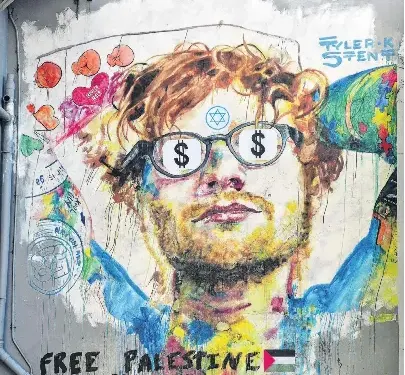
Money. Jews. You would struggle to find an antisemitic trope much older, cheaper or more recognisable.
Apparently even Tamimi realised something had changed. The second intervention, she told the Otago Daily Times, was “taking it a bit too far”.
“A bit.”
We’ll take what we can get. But here is where the story becomes genuinely extraordinary.
The ODT apparently didn’t ask a Jew.
It sought the reaction of a Palestinian representative to imagery combining dollar signs and the Star of David. The word antisemitism does not appear in the article.
Instead, the story is about vandalism, Palestine activism, artistic ownership, Ed Sheeran and Macklemore.
The Jews are missing.
Look around Dunedin
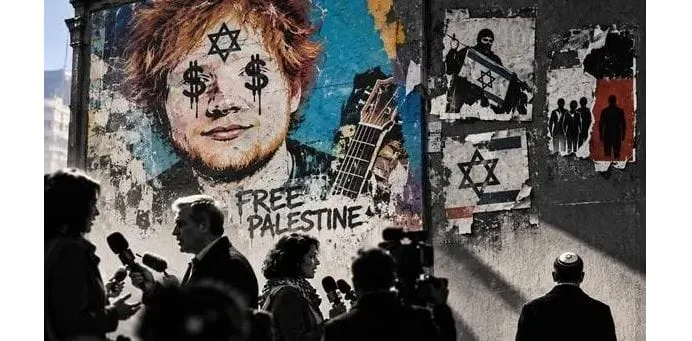
If this were simply one idiot with a sheet of stickers, perhaps that would be the end of it. But it isn’t. Other material has been appearing around Dunedin.
One sticker reads: “Fuck Zionists :)”

Underneath is a masked, armed figure degrading an Israeli flag bearing the Star of David. The smiley face is a particularly charming touch.
Elsewhere, stickers divide humanity into two groups: “Normal people” and “Zionists”.

There it is.
Not supporters and opponents of Netanyahu. Not Israelis and Palestinians. Not Likud and Labour. Normal people. Zionists.
One group belongs within normal humanity. The other apparently does not.
Another piece of material invokes Israel alongside the Star of David and a string of accusations.

None of these photographs tells us who put the material there. They do not implicate Dunedin’s Palestinian community, PSNA, or anyone else. Several photographs are also not enough, by themselves, to prove statistically that antisemitic incidents are increasing across the city.
But they establish something quite adequately. This stuff is out there. And it is becoming increasingly visible.
More importantly, there is a recognisable vocabulary running through it. Zionists. Israel. The Star of David. Money.
Again and again, the categories blur conveniently into one another. Until somebody objects. Then suddenly everyone becomes an expert in drawing distinctions.
The magic word
Zionist has become one of the most useful words in contemporary political language. It allows people to say things that would sound grotesque if they substituted Jew.
“Fuck Zionists.” Zionists aren’t “normal people”. Zionists are uniquely evil. Zionists are collectively responsible.
And whenever somebody notices how familiar the rhetoric sounds, the answer comes automatically: We said Zionists, not Jews. How convenient.
Of course criticism of Zionism is not automatically antisemitic. Criticism of Israel is not automatically antisemitic. Criticising Netanyahu is not antisemitic. Calling for Palestinian statehood is not antisemitic. And writing “Free Palestine” underneath a mural is not, by itself, antisemitic.
Indeed, that is precisely why the sequence on the Sheeran mural is so revealing. “Free Palestine” was political.
Then came the dollar signs. Then came the Star of David. Something changed.
There is a point at which political advocacy crosses into ethnic or religious bigotry. If we become incapable of acknowledging that point, then the distinction between antizionism and antisemitism has ceased to function as a distinction. It has become an alibi.
Everyone gets a voice except the target
There is another revealing detail in the ODT report.
Tamimi was concerned that the vandalism might reflect upon Palestinians in Dunedin. “I really don’t want people to think that we encourage people to do that,” she said. And she is right.
Nobody should blame Dunedin’s Palestinian community for anonymous vandalism. There is no evidence in the article connecting them to it. There is no evidence connecting PSNA to the other stickers photographed around the city either.
Guilt by association would be intellectually dishonest. But consider the asymmetry. The newspaper is sufficiently alert to Palestinian perspectives to ask a Palestinian representative what she thinks. It is sufficiently interested in the artist’s perspective to seek his reaction. It has room for the wider Sheeran-Macklemore controversy.
But somebody has just placed dollar signs and a Star of David together on a public artwork, and apparently nobody thinks: Maybe we should ring the Jews.
Would this happen with anybody else?
Put a racist caricature of Māori on a prominent public mural and see whether a New Zealand newspaper writes the story without asking Māori what they think. Put anti-Muslim imagery on a mosque and see whether journalists decide Muslim opinion is unnecessary.
Take the identifying symbol of almost any minority, combine it with a centuries-old stereotype directed against that minority, and watch how quickly representatives of the targeted community are asked for their reaction.
As they should be.
Yet antisemitism increasingly seems to operate according to different rules. Jews are discussed rather than consulted. Other people decide which symbols are offensive. Other people decide which stereotypes count. Other people decide whether hostility directed towards “Zionists” has anything to do with Jews. Other people decide where anti-Zionism ends and antisemitism begins.
And sometimes, apparently, the Jews themselves don’t need to be asked at all.
Try changing the minority
There is a very simple test for this. Change the target. Take the sticker dividing the population into “normal people” and “Zionists”. Substitute almost any other ethnic or religious minority. Would we need a seminar to decide whether it was bigotry? Of course not.
Take the Sheeran mural. Replace the Star of David with the identifying symbol of another minority, but leave the degrading stereotype beside it. Would a newspaper report the incident without asking that community what it thought? Highly unlikely.
We have spent years being taught a perfectly sensible principle: minorities should have some say in identifying prejudice directed against them. Listen to lived experience. Don’t tell minorities what racism looks like. Don’t dismiss their concerns. Don’t speak over them.
All very reasonable. Until the minority is Jewish. Then everybody else suddenly becomes an expert. That is why this little episode matters.
Not because Dunedin has anonymous vandals. Every city has idiots. Not because ugly stickers exist. Sadly, they always have.
It matters because imagery that should be instantly recognisable has become sufficiently normalised that a newspaper can report dollar signs and a Star of David on the same face without apparently thinking Jewish reaction is necessary.
There is perhaps one final irony. A Palestinian representative looked at the mural and concluded that things had gone “a bit too far”. She could see that a line had been crossed. Perhaps the rest of Dunedin might catch up.
And next time a Star of David appears alongside one of the oldest antisemitic stereotypes in existence, here is a radical suggestion for the media: Ask a Jew.
This article was originally published by the Israel Institute of New Zealand.