
Paul Myron Anthony Linebarger (1913–1966), better known under the pen name Cordwainer Smith, lived one of the more improbable careers in 20th-century American letters. A China-hand, psychological-warfare specialist, academic, intelligence officer and science-fiction writer, he produced a compact but singular body of fiction that has steadily gained reputation among SF cognoscenti long after his early death. His Instrumentality of Mankind stories, and especially the cycle dealing with the Underpeople, remain among the most original constructions in the genre.
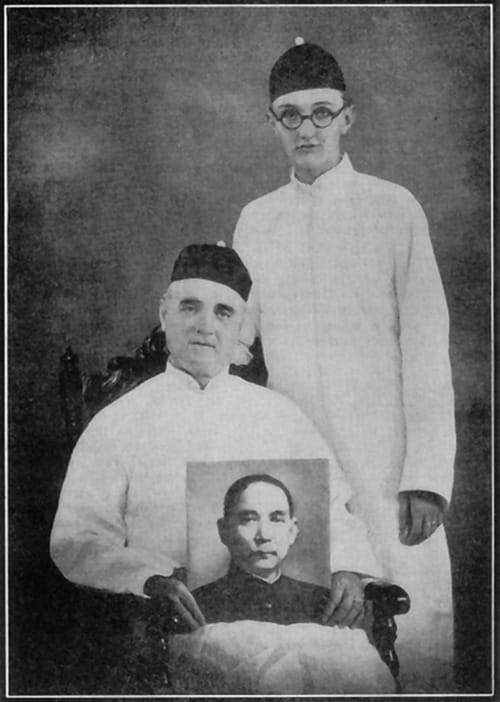
Born in Milwaukee on 11 July 1913, Linebarger was the son of a lawyer and judge who had advised Sun Yat-sen. Sun became the boy’s godfather; the family Chinese name Lin Bai-lo (“Forest of Incandescent Bliss”) later supplied the pseudonym Felix C Forrest. His childhood was spent largely in China, with stretches in Japan, France, Germany and the United States. At six he lost the sight of one eye in an accident and the remaining eye was damaged by infection. By adulthood he spoke English, Chinese and German fluently and had attended more than 30 schools. He took his PhD in political science from Johns Hopkins in 1936, the same year he married Margaret Snow. They had two daughters. The marriage ended in 1949. In 1950 he married Genevieve Collins.
From 1937 he taught at Duke University while publishing on Far Eastern politics. During the Second World War he was commissioned into the army, helped create the Office of War Information and the Operation Planning and Intelligence Board, and organised the army’s first psychological-warfare section. Sent to China in 1943, he coordinated intelligence and psychological operations and became a confidant of Chiang Kai-shek, rising to major.
After the war he moved to the Johns Hopkins School of Advanced International Studies as Professor of Asiatic Studies. He continued as a reserve officer (eventually colonel), advised British forces in the Malayan Emergency, worked with the Eighth Army in Korea and trained CIA personnel in psychological warfare under academic cover. He spent some time as an associate professor at the Australian National University, Canberra, in the late 1950s. He died of a heart attack in Baltimore on 6 August 1966 and is buried at Arlington.
Linebarger’s 1948 book Psychological Warfare (revised 1954) remains a foundational text. He organised the army’s first dedicated psychological-warfare unit and later taught the subject to intelligence officers. His conviction that psychological warfare was the most moral form of warfare rested on a simple observation: leaflets, broadcasts and rumour campaigns do not kill. In a 1951 lecture he noted that conventional warfare is “the lawful exercise of reciprocal violence between public armed bodies”, yet “Who has perished because of a short wave broadcast? Who has ever been stabbed by a loudspeaker? Who has died as a result of wounds inflicted by leaflets?” The German edition of his book was titled Schlachten ohne Tote: “Battles without Dead”.
For Linebarger, influencing the enemy’s will without physical destruction was both more efficient and more ethical than the industrialised slaughter of conventional war. He understood propaganda as applied storytelling: the operator invents a “Propaganda Man,” complete with pre-war biography, prejudices and gossip preferences, then addresses that constructed personality. The same imaginative labour later informed his fiction.
His science-fiction career began late and remained secondary to his professional life. The first published story, “Scanners Live in Vain” (1950), introduced the Instrumentality as a shadowy background authority. Over the next 15 years he produced roughly 30 stories and one novel, almost all set in the same future history. Output was limited by his academic and intelligence duties and by his death at 53. The stories appeared mainly in Galaxy and were later collected – the definitive gathering is The Rediscovery of Man (1993). The single novel, Norstrilia, heavily influenced by his time in Australia, was published in full only in 1975: earlier it had been split into “The Planet Buyer” (1964) and “The Underpeople” (1968).

The Instrumentality of Mankind is the governing power that emerges after the Ancient Wars have devastated Earth. It begins as the police force of the Jwindz (“perfect ones”) and evolves into a hereditary caste of Lords and Ladies who claim ultimate guardianship over the human species. Their rule is not totalitarian in the crude 20th-century sense, but paternalistic, technocratic and devoted to safety. On worlds under direct Instrumentality control, human lifespan is fixed at four hundred years by the drug stroon, harvested from the giant mutated sheep of the Australian-settled planet Norstrilia.
Disease is largely abolished, pain is minimised, children are raised by institutions rather than parents, and genetic programming assigns individuals to specialised roles before birth. Space travel progresses from solar-sail ships to planoforming (instantaneous transit through a higher dimension), the latter made possible by a symbiotic link between pilots and specially bred cats that detect and destroy hostile entities perceived as dragons or rats (“The Game of Rat and Dragon”, 1954).
The price of this security is sterility. Culture, risk, genuine love and the full range of human experience have been engineered away. The Instrumentality eventually initiates the “Rediscovery of Man,” deliberately reintroducing older languages, religions, dangers and emotional extremes so that humanity does not stagnate. Most of Smith’s stories are set against this backdrop, covering roughly 10,000 years.
The Underpeople are the other great invention of the series. Genetically engineered from terrestrial animals and given humanoid form and intelligence, they perform the physical and service labour that “true men” no longer wish to do. They are property, not citizens. An underperson’s name begins with a single-letter prefix indicating species: C’Mell (cat), D’Joan (dog), B’Dikkat (bovine). They can be destroyed when worn out or inconvenient.
Several stories chart their slow, often tragic movement toward recognition as persons. “The Dead Lady of Clown Town” (1964) retells the Joan of Arc story with D’Joan, a dog-derived girl who is burned alive after leading a non-violent demonstration in a human city; her martyrdom begins to unsettle the Instrumentality’s conscience. “The Ballad of Lost C’Mell” follows the cat-girl C’Mell’s alliance with Lord Jestocost to smuggle underpeople into positions of influence. Norstrilia brings the themes together: the young Norstrilian Rod McBan, having accidentally bought the planet Earth, arrives and becomes entangled with the underpeople’s underground. The novel never fully resolves the conflict and Smith’s future history remains deliberately incomplete.
Smith’s prose is highly literate, immediately recognisable and deliberately non-Western. He drew heavily on Chinese narrative traditions, particularly the oral huaben (“prompt-book”) form used by marketplace storytellers. A typical huaben structure comprises an opening verse, an introductory passage that glosses the verse and draws the audience in, the main narrative, a digression or second story, and a concluding verse or moral. Smith adapts these elements. Many stories open with a short poem or ballad fragment. Narration is frequently framed as a far-future legend recounted by a later scholar or storyteller who addresses the audience directly and treats the events as already mythic. The tone is elliptical, symbolic and incantatory rather than realistic. Character names are often multilingual puns (“Norstrilia”: Northern Australia) or Chinese-derived coinages. Norstrilia the novel is influenced by the Chinese classic, Journey to the West (better known to us as “Monkey”).
In “When the People Fell,” the Chinese colonisation of Venus is told through a reporter interviewing an old survivor; Chinese terms are transliterated and explained in a manner that echoes traditional storytelling asides. The overall effect is that of folklore compiled by dubious future antiquarians: exactly the opposite of the hard-edged, contemporary-American prose that dominated American science fiction in the 1950s. Its closest contemporary would be Clifford Simak’s equally remarkable City (1952).
This technique serves thematic purposes. By presenting events as already legendary, Smith emphasises the vastness of time and the smallness of individual actors within historical processes. The same method allows him to treat political and ethical questions indirectly. The Instrumentality’s sterile utopia, the underpeople’s struggle for personhood, and The Rediscovery of Man can be read as parables about authority, compassion and the cost of safety without being reduced to straightforward allegory. Chinese literary models also supplied a tradition of long, cyclical historical narratives and of stories in which the boundary between human and animal is porous, both useful for the underpeople material.
Linebarger’s dual career is not merely biographical colour. The psychological-warfare specialist who argued that the most moral warfare kills no one wrote science fiction in which the greatest threats are not invaders but the internal mechanisms by which a civilisation protects itself into stasis. The underpeople stories ask what happens when a society creates a permanent underclass of intelligent beings and then pretends they are not persons. The Rediscovery of Man asks whether a culture that has abolished risk and suffering has abolished something essential.
These questions have not dated. Contemporary debates over genetic engineering, animal cognition, artificial intelligence, and the rights of non-human or post-human minds echo the underpeople’s predicament. Discussions of “safetyism,” algorithmic governance, and the trade-offs between security and cultural vitality echo the Instrumentality’s dilemma. Meanwhile, the tools of influence that Linebarger helped systematise – targeted narrative, the construction of audience personas, the use of fiction-like techniques in propaganda – have only grown more sophisticated in the age of social media and generative AI.
Cordwainer Smith’s output is small, his future history unfinished, and his style idiosyncratic. Yet the combination of rigorous future-historical scaffolding, moral seriousness about the nature of persons, and a narrative method drawn from Chinese oral tradition produced a body of work that still feels unlike anything else in the genre. The man who organised the army’s first psychological-warfare section and wrote the textbook on battles without dead also invented a far-future civilisation in which the deepest battles are fought over who counts as human and whether a life without danger is still a life. Both projects remain unfinished and both remain relevant.