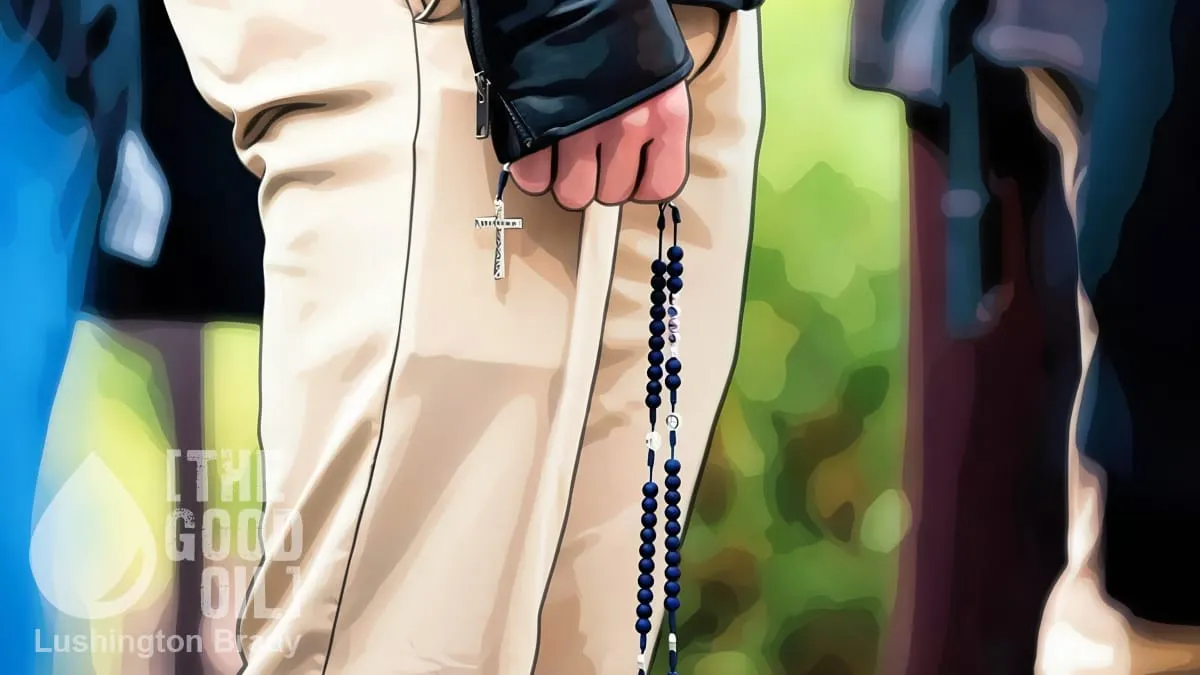
As I wrote recently, young men are not just leading young women in returning to the church, they’re generally doing so for more genuinely Christian reasons. Young women are increasingly chasing a ‘female-driven’ religious experience that is mostly performatively self-centred. It is devotion as aesthetic and clout-chasing: religion as OnlyFans. Young men, on the other hand are pursuing a “desire to become upstanding citizens with good morals and values who are successful in their careers and start businesses”.
Oh, and girls. For some reason, young men are not exactly enthusiastic about swiping right on morbidly obese pink-haired frightbats with septum piercings whose idea of a conversation-starter is screeching that all men are rapists. As Andrew Lohse, author of Confessions of an Ivy League Frat Boy puts it, “Gen Z men face a time of choosing. It’s either porn, drugs, gambling and debt, or truth, beauty, discipline and meeting a pretty girl at mass.”
Anthony Gross, 22, makes his living as a content creator. He has 125,000 followers on Instagram, 48,000 on TikTok […]
“The pendulum is swinging,” he wrote in the caption of one video. “Gen Z is turning back to God.”
Soon after he started posting about his search for a church, a young woman slid into his DMs on LinkedIn and told him to check out St Joseph’s Sunday evening mass. Shortly after his first visit, he abandoned his search for a spiritual home in New York. He had found it.
The data point that ought to cheer anyone who still believes in civilisational continuity is the surge of young men turning up at traditional parishes. At St Joseph’s in Greenwich Village, the 6pm Sunday mass now packs 850 seats plus spill-over on the steps. The pastor, the Rev Boniface Endorf, reports a 20 per cent attendance jump in six months and Easter sacraments leaping from the usual low teens to 88 this year. After mass, the wine social has gone from 60 stragglers to a regular 200.
These are not the terminally online “TheoBros” of progressive caricature. They are blokes in business casual who have had enough of consumerism-as-meaning and big-box worship with dry-ice machines and pop bands. They want incense, altar boys, sacred music and a faith that looks and sounds Catholic. They want a third space that is not a screen, a dating pool that is not a meat market and a moral framework that does not treat them as inherent oppressors.
“Our culture pushes that the meaning of life is consumerism and career,” Father Endorf said. “And they’re looking for something more than what they can produce and what they can buy.”
Not to mention wifey material.
“The joke is that St Joe’s is the ultimate place to date Catholics in New York because it’s all the young, beautiful people that go there,” said Thomas L, 24, a parishioner who spoke on the condition that he be identified only by his first name and last initial because his work involves sensitive government contracts.
If you want a seat, you’d better get there early. By 5:45 pm, all 850 seats were occupied. People too late get standing spots and crane their necks from the steps outside.
Of course, that’s not the whole story. There is still bad news enough.
“I absolutely think it’s a phenomenon,” said David Gibson, the director of Fordham University’s Center on Religion and Culture. But he cautioned against mistaking an uptick in conversions for a full-blown revival.
Gibson cited a 2025 study by the Pew Research Center that found that for every young person coming into the Catholic Church, around 12 young people left.
But the Catholic Church also has something less tangible, but still important: the aura of authenticity. Anglican churches, whose vicars simper that ‘We are all Muslim’ and poncing around in rainbow cassocks, are dying at a rate of knots. Jesus-Lite just isn’t cutting it.
The flashy charm of the Pentecostals, heretofore Christianity’s big growth sector, is also wearing a bit thin for some.
The Rev Dwight Longenecker, the pastor of Our Lady of the Rosary Church in Greenville, South Carolina, said that his parish has attracted “a startling number of young men” who were growing disillusioned with the experience of worshiping in the “big box” churches of the Bible Belt.
“I don’t want to be too disparaging about them because they’re our Christian brothers and sisters, but worshiping in a big former supermarket with dry ice machines and a pop band, it’s not really traditional Christianity,” Father Longenecker said.
His new parishioners are attracted to “very traditional worship with lots of incense and altar boys and sacred music in the traditional style.”
“In other words, they want it to look and sound Catholic,” he added.
Doubting Thomases are also clutching their pearls about ‘TheoBros’ who supposedly reduce Catholicism to rules and power. That is a narrow and uncharitable reading. And even then, Adam Smith had the answer two and a half centuries ago. Self-interest, rightly understood, produces public benefit. A young man who wants to be a reliable husband, a good father, a productive citizen and a business founder is pursuing exactly the sort of enlightened self-interest that builds families, congregations and communities.
That is not less spiritual: it is the very soil in which spiritual life takes root. It’s not some secular add-on. It is the practical outworking of the commandment to love your neighbour as yourself. It is the Body of Christ in action. To be sure, there are the Deus Vult memelords, whose actual faith is questionable, but young men who are parking their arses on the pews are at least taking the first step to the true Christian life. The boys want the collar, the structure and the hard answers, to submit the self to something older, larger and truer than the self. This at least produces stable families, functioning parishes and the next generation of Christians who actually show up on Sunday.
The same impulse for self-improvement that drove the Straight Edge wing of hardcore punk has also found its religious equivalent.
Fitness challenges like Whole30 and 75 Hard dovetail with the Catholic value of harmony between body and soul. The “NoFap” Reddit community and the “No Nut November” challenge are secular forms of chastity. “Sober October” and “Dry January” are pretty similar to giving up a vice for Lent […]
The Rev Mike Schmitz, the creator and host of the “Bible in a Year” podcast, has worked as the chaplain for the Newman Center at the University of Minnesota at Duluth for more than 20 years. It has always had a strong community of Catholic men, but he has found that certain figures in the “manosphere” were attracting men to the faith.
“I noticed there were some people who were showing up with no experience of religion and no experience of Christianity, but they had exposure to people who are – for lack of a better term – ‘faith-adjacent,’” he said. Father Schmitz specifically mentioned Jordan Peterson and Andrew Huberman, who recently started talking about the benefits of prayer on his health podcast.
“These faith-adjacent people have not necessarily led people through the door, but they’ve pointed out, ‘Hey, that door that’s open over there? That is not unreasonable,’” Father Schmitz said.
Entrepreneurship dinners in business formal, apps for prayer and mortification and content creators filming ‘My Sunday night as ambitious Catholic living in NYC’: none of this is pure, maybe. Still, young men are rejecting the resentful hollowness of modernism: they are choosing, in other words, to become the sort of men who build rather than burn.