As I wrote a few weeks back, another domino in South America’s tottering ‘Orange Revolution’ was set to topple (again) in Brazil. Would the country’s looming presidential elections deliver a Bolsonaro the Younger? I wondered. Lo and behold:
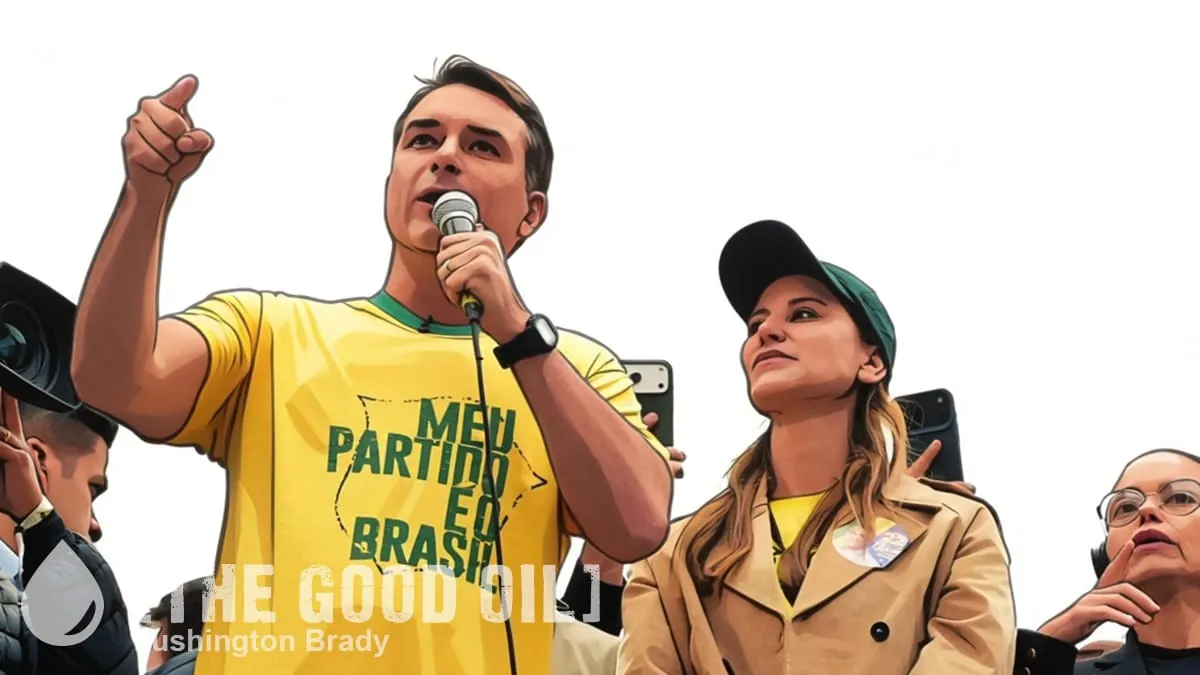
Brazil’s Flavio Bolsonaro heads to a runoff election buoyed by sweeping gains in Congress, after a shock first-place poll finish hailed by US President Donald Trump as a “big victory”.
(Here’s the secret to looking like a canny political prognosticator: trumpet the ones you get right and quietly ignore the ones you didn’t. This time, I look like I have got it right: I’ll take it.)
The right-wing senator finished two percentage points ahead of leftist President Luiz Inacio Lula da Silva, who faces an uphill battle to secure a fourth term win on October 25, and cement his legacy.
The 45-year-old Bolsonaro, who was little known until a few months ago, outperformed the first-round election results of his father, the far-right former president Jair Bolsonaro in 2018 and 2022 elections.
It’ll be interesting to see what tricks the Brazilian left pull this time. Bolsonaro the Elder was stabbed in 2018, convicted in what his son calls a “sham”, and barred until 2030. Enter Bolsonaro the Younger, no doubt wearing a bullet-proof vest.
The younger Bolsonaro did not arrive at this vantage point by peddling the customary gauzy platitudes favored by Latin America’s socialist grandees. His platform is built on old-fashioned, meat-and-potatoes conservatism: pruning the overweening apparatus of the state, slashing taxes, imposing iron fiscal discipline in the face of runaway public debt and taking a truncheon to rampant violent crime.
It’s an agenda that mirrors the tectonic shift seen across South America, from Javier Milei’s chainsaw economics in Argentina to Nayib Bukele’s stunning crackdown that has, almost overnight, turned El Salvador from the murder capital of the world to one of the safest (and given the self-described “coolest dictator” a 90 per cent approval rating). Even Donald Trump chimed in from Washington to laud the result as a monumental triumph.
History, moreover, is distinctly on the younger man’s side. Since Brazil re-entered direct presidential elections in 1989 following decades of military rule, every single candidate who finished ahead in the initial round went on to seize the presidency in the runoff.
Political analyst Thomas Traumann told AFP the election Sunday had shown a "tsunami of anti-PT sentiment," referring to Lula's Worker's Party, which has governed for much of the past two decades.
That tidal wave has carried the Bolsonaro brand right back to the precipice of supreme power. While patriarch Jair remains under house arrest, serving a draconian 27-year term for alleged coup-plotting, the family took their case directly to the ballot box. Flavio has already promised an amnesty for his father if he takes the presidential palace and the voters seem entirely unswayed by the establishment’s legal vendettas.
The legislative gains were nothing short of a rout. The Liberal Party nearly doubled its presence in the upper house and stormed the Chamber of Deputies. Former first lady Michelle Bolsonaro secured a Senate seat, while two more of Jair’s sons walked into legislative posts.
“The end of the era of Lula’s Workers’ Party has been decreed,” a triumphant Bolsonaro declared on Sunday in Brasilia.
For the octogenarian Lula, the arithmetic of the October 25 runoff looks decidedly grim. The minor candidates who collected nearly eight per cent of the first-round vote sit almost entirely on the right-hand side of the political aisle. To stay in office, the old Marxist must somehow cajole the 33 million citizens who simply stayed home into turning out for his re-election.
His strategy so far has been an utter masterclass in political tone-deafness. Rather than addressing the brutal kitchen-table realities grinding down ordinary Brazilians, Lula chose to campaign on abstract notions of national pride and his own historical grandeur, while picking fights with Trump over tariffs.
“Brazilians are concerned with concrete matters, such as supermarket prices, the fear of being mugged, and credit card debt, rather than abstract concepts like sovereignty or Lula’s historical significance,” said Traumann.
While Lula’s courtiers were busy admiring the old lion’s historical legacy, everyday citizens were watching their wages being swallowed by inflation, dreading their credit card balances and looking over their shoulders on the street.
And that sounds pretty much like here in Australia. We can only hope for a similar tsunami of anti-establishment sentiment of our own, come the next election.




![[The Good Oil] Stuff Up of the Day](https://storage.ghost.io/c/31/f4/31f4e20a-0315-499e-83ff-139e8eab53bf/content/images/size/w1304/format/webp/2024/09/Stuff-up-image-1.webp)