
Table of Contents
Martin Hanson
Martin Hanson is a retired high school science teacher, born and educated in the United Kingdom, but spent most of his teaching career in New Zealand.
“Whom The Gods Would Destroy They First Make Mad” – ancient Roman proverb
Part 1: Powell vindicated
On April 20th 1968 Enoch Powell, UK Member of Parliament for Wolverhampton South West, made a speech to the West Midlands Area Conservative Political Centre, in which he strongly criticised the rates of immigration from ‘new commonwealth’ countries.
Powell illustrated his speech by reference to conversations with his constituents – an uncommon phenomenon these days, and arguably the cause of much of the disconnect and cynicism in today’s politics:
A week or two ago I fell into conversation with a constituent, a middle-aged, quite ordinary working man employed in one of our nationalised industries.
After a sentence or two about the weather, he suddenly said: “If I had the money to go, I wouldn’t stay in this country.” I made some deprecatory reply to the effect that even this government wouldn’t last for ever; but he took no notice, and continued: “I have three children, all of them been through grammar school and two of them married now, with family. I shan’t be satisfied till I have seen them all settled overseas. In this country in 15 or 20 years’ time the black man will have the whip hand over the white man.”
Powell continued:
Here is a decent, ordinary fellow Englishman, who in broad daylight in my own town says to me, his Member of Parliament, that the country will not be worth living in for his children. I simply do not have the right to shrug my shoulders and think about something else. What he is saying, thousands and hundreds of thousands are saying and thinking—not throughout Great Britain, perhaps, but in the areas that are already undergoing the total transformation to which there is no parallel in a thousand years of English history. ... Those whom the gods wish to destroy, they first make mad. We must be mad, literally mad, as a nation to be permitting the annual inflow of some 50,000 dependents, who are for the most part the material of the future growth of the immigrant descended population. It is like watching a nation busily engaged in heaping up its own funeral pyre. So insane are we that we actually permit unmarried persons to immigrate for the purpose of founding a family with spouses and fiancées whom they have never seen.
In his peroration he said:
As I look ahead, I am filled with foreboding; like the Roman, I seem to see “the River Tiber foaming with much blood” alluding to a prophecy from Virgil’s Aeneid (Powell was a distinguished classical scholar).
Which is why his speech became known as the ‘rivers of blood’ speech.
He ended with this warning:
Only resolute and urgent action will avert it even now. Whether there will be the public will to demand and obtain that action, I do not know. All I know is that to see, and not to speak, would be the great betrayal.
The Reaction
Over half a century after ‘rivers of blood’, Powell’s speech is seen by many as prophetic. Even more prophetic than the speech itself was its political reception, showing that German philosopher Georg Hegel was right when he sagely pointed out that:
We learn from history that we do not learn from history.
The explanation for the inability to learn from Powell has more to do with deep tribal undercurrents in politics than with the issue in question, and I shall have more to say about this later.
In meantime, it’s sufficient to say that Powell’s speech exposed the deep disconnect between the voters and their elected representatives, as illustrated by the reaction of the political ‘establishment’.
Edward Heath, leader of the opposition Conservative party, telephoned Powell to inform him that he had been sacked from his position as Shadow Defence Secretary. Labour MP Ted Leadbitter said he would refer the speech to the Director of Public Prosecutions, and the Liberal Party leader Jeremy Thorpe said there was a prima facie case against Powell for incitement. Lady Gaitskell, widow of Hugh Gaitskell (who had been Leader of the Labour Party 1955–1963), called the speech “cowardly” (though many would have said it was the precise opposite).
Leading Conservatives were incensed by the speech: Iain Macleod, Edward Boyle and Quintin Hogg threatened to resign from the front bench unless Powell was sacked.
On the other hand some Conservative MPs on the right of the party – Duncan Sandys, Gerald Nabarro and Teddy Taylor – were critical of Powell’s sacking.
In a Panorama interview, Heath said:
I dismissed Mr Powell because I believed his speech was inflammatory and liable to damage race relations. I am determined to do everything I can to prevent racial problems developing into civil strife … I don’t believe the great majority of the British people share Mr Powell’s way of putting his views in his speech.
In saying that he believed that the great majority of the British people did not share Mr Powell’s views, Heath’s statement proved to be wishful thinking, because at the end of April a Gallup poll found that 74 per cent agreed with what Powell had said in his speech and 15 per cent disagreed. Sixty-nine per cent felt Heath was wrong to sack Powell and 20 per cent believed he was right. Whereas before Powell’s speech, 75 per cent felt immigration should be restricted, after it had risen to 83 per cent. According to George L Bernstein, the speech made the British people think that Powell “was the first British politician who was actually listening to them”.
While Powell’s warning was centred on immigration from Caribbean countries such as Jamaica, and therefore about ethnicity (“race”), 20 years after ‘rivers of blood’, hints began to emerge of an altogether different nature that was to prove far more serious and intractable, and have now reached crisis level.
Enoch Powell died in 1998, but even in his wildest nightmares he couldn’t have foreseen the state of Britain half a century after his ‘rivers of blood’ speech. While the speech has been described as ‘prophetic’, that word is inadequate to describe what is happening in Britain today; although the country of my birth is not (quite) yet an Islamic theocracy, at the time of writing there are strong indications that it is heading in that direction.
* * *
What follows is not for the faint-hearted
The young girl, still a child, was held down while the man raped her. And then another man, and another. Throughout this gang rape by queues of men, she was held hostage, locked up for days on end so she couldn’t escape. While held prisoner as a sex slave, she had to listen to the screams of girls in neighbouring locked rooms while they had to endure the same ordeal. Men ejaculated and urinated in the girls’ mouths, violating them in every orifice.
You might think the perpetrators were members of Boko Haram in Nigeria, or ISIS in Iraq or war-torn Syria. After all, sex slavery and ‘marriage’ of prepubescent girls is legitimized, and indeed encouraged, in the Qur’ân; Mohammed married Aisha when she was six and consummated his marriage when she was nine.
But these horrors were not being perpetrated in the Middle East or Nigeria: the girls were being treated like toilet paper in towns across the United Kingdom.
Violent sexual abuse of children is an extremely emotive topic and the authorities and media normally spare no effort in dealing with it. But when it involves a minority group it has, until the last few years, been the ‘third rail’ of politics and journalism, to be avoided at all costs. The issue is the organized pimping and gang rape of young schoolgirls by Muslim gangs. If the UK police and media had not looked away, tens of thousands of young girls, some as young as 11, would not have had their lives ruined in one of the most shameful episodes in the last century.
Incredibly, the media were silent on the worst of these details. If the reason for this was political, it might go some way to explaining why after four decades, the greatest scandal in UK history is still not being dealt with.
* * *
The Sikh Experience
The earliest signs were in the 1980s. Muslim men, the vast majority of whom were of Pakistani heritage, were befriending Sikh schoolgirls, impressing them with expensive cars and plying them with alcohol and illegal drugs. The following are extracts from a BBC documentary Inside Out with the words that one 13-year-old victim had to say about her experience, together with words of the presenter:
He seemed like a really sweet guy. I started skipping school just to go out with him. Then he’d buy me stuff and pay for my stuff, and then he bought me a phone to stay in contact with him. He made me feel like I was a centre of attention.
He spent weeks, slowly gaining her trust, but he had a hidden agenda.
He’d take me out to a hotel, and gave me a drink. I don’t know what happened after that.
Next morning, ‘Jaswinder’ (not her real name) woke up naked, and realised her drink had been spiked. The man she thought she could trust had taken obscene photos of her, and threatened to show them to her parents unless she agreed to have sex with other men. The blackmail and abuse continued for over 18 months. Jaswinder claimed that the man who forced her into prostitution initially hid his true identity.
He didn’t say he was Sikh, but the way he acted and talked, and his appearance ... He had a gold Khanda, and he had a kara: his appearance was just like a Sikh.
By wearing sacred symbols of Sikhism, she said he had deceived her into thinking he was from the same religion: in fact he was a Muslim. She says she has very loving parents but in this Asian community, family honour is paramount. She’s been warned by her mother against bringing the subject up at home, and forbidden from telling her father the full details.
Parents are the last ones to find out if anything is wrong.
I was scared to tell my dad. There’s some stuff you just can’t tell them. I just tried to keep myself to myself, and not talk to anyone about it.
After growing awareness within his community that young children were being sexually abused, Mohan Singh set up the Sikh Awareness Society in 1998.
It is a massive problem. We’ve got a 24-hour helpline, which never stops ringing. The more we dig into it, the more we’re finding. Currently we’re dealing with 19 cases, in Leeds, Bradford, Birmingham, Southall.
The stigma of sexual abuse is so devastating to a Sikh girl’s future that girls are often sent away from the family home, sometimes permanently. For this reason, Sikh victims are deeply reluctant to talk about their abuse, making it nearly impossible for them to give evidence in court. This, coupled with the fact that the groomers found it easy to pass themselves off as Sikhs, made the Sikh community particularly vulnerable to the grooming gangsters and in all likelihood, their earliest targets.
The tensions between Sikh and Muslim communities was first aired in 1988 in Gang Warfare in Birmingham, the BBC current affairs programme Network East, in an item looking into violent incidents between Sikh and Muslim gangs in Birmingham. The incidents stopped in July when police arrested members of both gangs. The Sikhs claimed that the Muslims were abducting and raping Sikh girls. They said they gave the names and car registration numbers of the men involved to the police, but the police denied ever having been given such information. In light of developments in subsequent decades, this seems like fear of rocking the multicultural boat. Despite this oblique mention of the looming problem, the only national newspaper to report that grooming lay behind the incidents was Saturday, June 24, 1989, when the Independent headlined a short article, “Sikh girls used as sex slaves”.
As a small minority culture, the abuse of Sikhs by Muslims remained largely below the media radar, but working class girls in the indigenous white community were far more numerous and in that sense, presented greater opportunities. Over succeeding years, it became clear to anyone paying attention that Muslim gangs were exploiting the rich pickings of vulnerable working class white girls in towns throughout the UK.
Rotherham: intimidation of a whistleblower
In response to concerns in Rotherham in the 1990s about what was called ‘child prostitution’, an organisation called Risky Business was established in 1997. Its role was to work with young people being abused through prostitution, and by the late 1990s it had identified girls and young women on the streets of Rotherham.
From 1999 to 2011, Risky Business was run by Jane Senior, and in 2011 she was asked to produce a report on the concerns about abuse of children that she had been raising for several years. She compiled and submitted a 42-page document containing the names of known perpetrators. But instead of taking action, the police and council dismissed her work as “rubbish”, and the council shut down Risky Business.
When Senior expressed her concerns, she was accused “rocking the multicultural boat,” and that confronting the issue would inflame racial tensions.
An insight into the warped minds of some individuals on the council is that reportedly, she was accused of breaching the “human rights” of perpetrators.
When she found that an earlier report of hers had been sanitized to remove references to sexual abuse, Senior realised she would have to go public, so she contacted Andrew Norfolk of the Times.
Andrew Norfolk
In January 2011, the grooming gang scandal was exposed in a Times article titled: A Nation’s Shame: Hundreds of Girls Sexually Abused by Networks of Men. Norfolk described how children were befriended, plied with alcohol and illegal drugs, and used for sex in Greater Manchester, Lancashire and West Yorkshire.
Among Norfolk’s disclosures was the experience of a 15-year-old girl from Rochdale who told police how she was passed around by members of the British Pakistani community for sex. Police took no action to protect her, and during the next four months she was subjected to sustained sexual exploitation by at least 21 men.
The article followed the conviction of nine members of a sex-grooming gang. During their trial, the court was told that a 15-year-old girl was used for sex by 25 Asian men in one night. She had gone missing 19 times in three months for periods up to two weeks, during which she was subjected to repeated sexual abuse.
Norfolk’s article was significant because it stated that of the nine convicted men, eight were of Pakistani heritage and one was an illegal immigrant from Afghanistan. Norfolk also reported that the Chief Crown Prosecutor for northwest England had said that the convicted men all considered women to be inferior, an attitude characteristic of Muslim societies.
Her revelations led to the inquiry by Alexis Jay, which became a turning point.
The Jay Report
Fear of being accused of ‘racism’ or ‘Islamophobia was allowing Muslim grooming gangsters to operate freely. Then came Andrew Norfolk’s sensational disclosures in The Times in 2011. Stung into action, Rotherham Metropolitan Borough Council (RMBC) commissioned an enquiry by Alexis Jay. The Independent Inquiry into Child Sexual Exploitation in Rotherham, 1997–2013 was published in August 2014, and was a turning point.
The report did not mince words. The following extracts pull no punches:
It is hard to describe the appalling nature of the abuse that child victims suffered. They were raped by multiple perpetrators, trafficked to other towns and cities, abducted, beaten, and intimidated. There were examples of children who had been doused in petrol and threatened with being set alight, threatened with guns, made to witness brutally violent rapes and threatened they would be next if they told anyone. Girls as young as 11 were raped by large numbers of male perpetrators.
At an operational level, the Police gave no priority to CSE [Child Sexual Exploitation], regarding many child victims with contempt and failing to act on their abuse as a crime. Further stark evidence came in 2002, 2003 and 2006 with three reports known to the Police and the Council, which could not have been clearer in their description of the situation in Rotherham. The first of these reports was effectively suppressed because some senior officers disbelieved the data it contained. This had led to suggestions of cover up.
In two of the cases we read, fathers tracked down their daughters and tried to remove them from houses where they were being abused, only to be arrested themselves when police were called to the scene. In a small number of cases (which had already received media attention) the victims were arrested for offences such as breach of the peace or being drunk and disorderly, with no action taken against the perpetrators of rape and sexual assault against children. By protecting the rapists, the police were enabling their crimes, yet none has been prosecuted.
The impact sexual exploitation had on them was absolutely devastating. Time and again we read in the files and other documents of children being violently raped, beaten, forced to perform sex acts in taxis and cars when they were being trafficked between towns and serially abused by large numbers of men. Many children repeatedly self-harmed and some became suicidal. They suffered family breakdown and some became homeless. Several years after they had been abused a disproportionate number were victims of domestic violence had developed long-standing drug and alcohol addiction and had parenting difficulties with their own children resulting in child protection/children in need interventions. Some suffered post-traumatic stress and other emotional and psychological problems often undiagnosed and untreated. Some experienced mental health problems.
* * *
The Jay Report had put Senior’s concerns in the national and international crucible, but the council had learned nothing. Council officials and police harassed and threatened Senior, and even threatened her with imprisonment for breaching confidentiality.
By concluding that between 1997 and 2013, at least 1,400 girls aged 11–15 had been systematically raped in Rotherham by organised gangs of British-Pakistani men over a period of 16 years, the Jay report had taken an important step in removing this protection. For the first time the British public had been made aware of an issue that dare not speak its name: the deep misogyny characterising many Muslim countries had taken root among immigrant communities. It was now politically possible to mention that the perpetrators were over-represented by men of Pakistani heritage.
At last, the ‘P’ word was out of the political closet. Until then the media had been referring to the perpetrators as ‘Asians’ which, apart from being inaccurate to the point of meaningless, was a gross insult to Sikhs, who had been among the chief victims.
Less sensational, but arguably more significant in the wider context, was the following, on page 83 of the report:
A chapter of a draft report on research into CSE in Rotherham, often referred to as ‘The Home Office Report’, was written by a researcher in 2002. It contained severe criticisms of the agencies in Rotherham involved with CSE. The most serious concerned alleged indifference towards, and ignorance of, child sexual exploitation on the part of senior managers. The report also stated that responsibility was continuously placed on young people’s shoulders, rather than with the suspected abusers. It presented a clear picture of a ‘high prevalence of young women being coerced and abused through prostitution.’ Senior officers in the Police and the Council were deeply unhappy about the data and evidence that underpinned the report. There was a suggestion that facts had been fabricated or exaggerated. Several sources reported that the researcher was subjected to personalised hostility at the hands of officials. She was unable to complete the last part of the research. The content which senior officers objected to has been shown with hindsight to be largely accurate. Had this report been treated with the seriousness it merited at the time by both the Police and the Council, the children involved then and later would have been better protected and abusers brought to justice. These events have led to suspicions of collusion and cover up.
The Jay Report had forced the organised rape of young non-Muslim girls into public consciousness, but with hindsight there had already been indications of what was to come. In November 2010, five men were given lengthy jail terms after they were found guilty of grooming teenage girls in Rotherham for sex.
Oxford: ‘Operation Bullfinch’
Following the conviction of the ‘bullfinch’ gang in Oxford in 2013, in March 2015 a serious case review found that over 370 children may have been targeted for sex by gangs of men in Oxfordshire in the previous 16 years, and that the figure could be conservative. The review blamed a failure by social workers, police, doctors and nurses to ask whether children truly consented to sex, because of a “well-meaning” desire to be “non-judgmental”. Opportunities to intervene were repeatedly missed and cited as an example a whistleblowing council worker who, as an ex-detective, was effectively silenced by social services chiefs in 2007, four years before the gang was finally arrested.
Maggie Blyth, the independent chair of the safeguarding children board that produced the report, said it was likely that the figures were the “tip of an iceberg” and the pattern could be repeated across the country.
The police were also heavily criticised for ignoring evidence of rape and violent sexual abuse, and even telling parents it was none of their business. In one case they refused to tell a couple where their daughter was because she seemed “happy” with her abusers. They also described victims as putting themselves at risk by “prostituting themselves”.
The report urged the government to carry out research into why there was a particular problem with child sexual exploitation within the Muslim or Pakistani community. Sara Thornton, chief constable of Thames Valley Police, said the force was “ashamed”. Jim Leivers, director for children, education and families at Oxfordshire council, said: “We fully accept that we made many mistakes and missed opportunities to stop the abuse.”
Telford
In 2018 the Sunday Mirror conducted an investigation into child sexual exploitation in the Shropshire town of Telford. The investigation found that around 1,000 children could have been sexually exploited over a 30-year period. In response, Telford and Wrekin Council launched a public inquiry chaired by Tom Crowther QC. The report was published in four volumes on 12th July 2022, and summarised in the Daily Mail. Among its findings were:
- More than 1,000 Telford children were exploited ‘over decades’
- Obvious signs of child sexual exploitation were ‘ignored’
- Exploitation was ‘not investigated because of nervousness about race’
- Information was not properly shared between agencies, with some bodies dismissing child exploitation as ‘child prostitution’ and even blaming the children instead of the perpetrators
- Teachers and youth workers were ‘discouraged from reporting child sexual exploitation’
- Offenders were ’emboldened’ and exploitation ‘continued for years without concerted response’
- Police and the council scaled down specialist teams to ‘virtual zero – to save money’
Newcastle: Operation Sanctuary
In September 2017, 17 men and one woman were convicted of sexual abuse of girls, some as young as 14.
In view of the well-publicised finding of the Jay Report that the majority of the perpetrators in Rotherham were of Pakistani heritage, it shouldn’t have been too difficult to draw similar conclusion from the names of the perpetrators and their police photographs below (the woman’s name is italicised):
Nashir Uddin, Saiful Islam, Yasser Hussain, Mohammed Azram, Jahangir Zaman, Mohammed Hassan Ali, Badrul Hussain, Abdul Sabe, Mohibur Rahman, Habibur Rahim, Carol Ann Gallon, Abdulhamid Minoyee, Taherul Alam, Monjur Choudhury, Nadeem Aslam, Prabhat Nelli, Eisa Mousavi, Redwan Siddique.
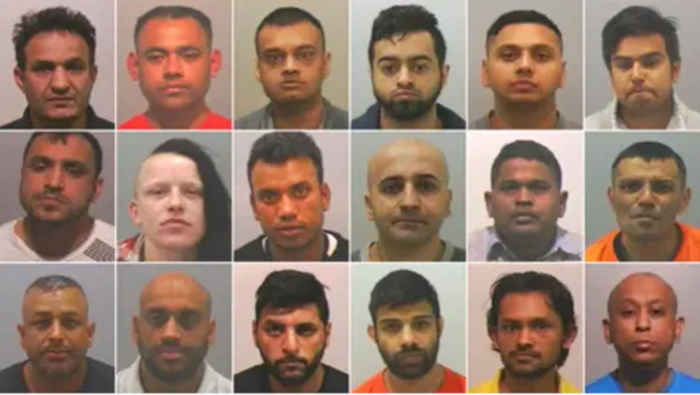
Yet some politicians refuse to acknowledge the glaringly obvious. In a Sky News interview, Nick Forbes, Leader of Newcastle City Council, went to extreme lengths to avoid seeing what everyone else could see, repeatedly ducking invitations to utter the ‘P’ or ‘M’ word.
* * *
Whistleblowers ignored and intimidated
Even after the publication of the Jay Report, anyone raising the issue of grooming gangsters was labelled racist or Islamophobic. Despite the opprobrium, some of these brave campaigners were eventually vindicated.
Ann Cryer
The scandal first began to come to light in 2003 when Ann Cryer, MP for Keighley in Yorkshire, reported that she had been approached by seven mothers who had come to her saying that their 12- and 13 year-old daughters were being used for sex by families of Pakistani men.
The women told her they were struggling to get through to the authorities about their young daughters, whom they said needed to be protected from their British-Pakistani “boyfriends”, but police, social services and Imams were refusing to listen.
The issue grew as more media outlets reported on it – and the British National Party began to protest over the scandal.
Despite many meetings with the West Yorkshire police and social services, Cryer was told there would be no point in trying to prosecute, so she asked a Muslim councillor friend to go to the imams at the local mosque with a list of 35 names and addresses of the alleged perpetrators. She was told that the elders had said that it was nothing to do with them. Cryer says that she can’t have been the only politician to have heard such stories, and that local and national politicians all over the country who were afraid to speak out for fear of being labelled a racist. https://archive.ph/LzChy
In a healthy society the revelations in the Sunday Times and the Times of the organised rape and trafficking young white girls would have been treated with the utmost seriousness by local authorities, police, and Westminster.
But such was the fear of being tarred with the label of ‘racism’, or, even worse, ‘Islamophobia’ that after the initial ripples, not a lot happened. Even worse, whistleblowers were treated with scorn.
Obstruction from above
Adele Weir
The first ‘smoke alarm’ was a study by Adele Weir, a Yorkshire solicitor, into child prostitution in Rotherham. Weir found poor professional practice by the council and police, and child protection issues were “disregarded, dismissed or minimized”.
Not only that, when she presented evidence that 54 children were being abused by a network centred around one Muslim family, she was told by the police that it was ‘unhelpful’. On 23 October 2001 she sent a letter to the Chief Constable of South Yorkshire Police, saying:
I have been visiting agencies, encouraging them to relay information to the police. Their responses have been identical – they have ceased passing on information as they perceive this to be a waste of time. Parents also have ceased to make missing person reports, a precursor to any child abduction investigation, as the police response is often so inappropriate ... Children are being left at risk and their abusers unapprehended.
Her letter infuriated the council and local police. She was warned never to refer to Asian men and sent on a two-day ethnicity and diversity course. Later, on returning to work after a weekend she found that her data had been removed from filing cabinets and that the password-protected computer had been accessed. Documents had been deleted, and somebody had created a file showing that she had agreed not to submit data to Home Office without council consent. In fact, Weir had not attended any such meetings, one of which was while she was overseas.
Far from local
If anyone were to argue that lack of moral backbone is limited to corrupt local councils, they could not be more wrong: fear of investigating the grooming gangs extends to the top echelons of political power. In 2020 Jayne Senior wrote to Keir Starmer, leader of the opposition with her concerns, he refused to meet her or mount an inquiry into the undermining of her work by Labour councillors.
In light of these attempts at bullying, the Chief Executive of Whistleblowers UK, in an article in the Telegraph, Georgina Halford-Hall wrote:
Too many professionals who raised concerns about the rape and abuse of children quickly became persona non grata and exited amidst allegations about their conduct.
It’s not only the left that is intimidated into paralysis by the threat of ‘Islamophobia’. When Senior urged Home Secretary Suella Braverman to take action in Rotherham, giving a detailed account of the abuse that was still continuing, she got no response. Clearly, the problem extended across the political spectrum to the Conservative government.
In March 2021 Senior quit as councillor, citing ceaseless bullying.
Half a century earlier, Enoch Powell had learned of the suffocating power of ‘racism’ label. Now it was fear of the ‘Islamophobia’ jibe.
An MP pays the price for telling the truth
Following publication of the names of perpetrators, Sarah Champion, Labour MP for Rotherham and member of the shadow cabinet, was foolish enough publicly to draw the same conclusion that pretty well everyone else had drawn. In an article in the Sun newspaper August 10, 2017, she wrote:
Britain has a problem with British Pakistani men raping and exploiting white girls. There. I said it. Does that make me a racist? Or am I just prepared to call out this horrifying problem for what it is?
The response of the leader of the Labour Party, Jeremy Corbyn, was to force Sarah Champion to resign from the Shadow Cabinet, saying: “it was wrong to “demonise whole communities”.
Well, yes. Though it is perfectly obvious to most of people that she did not mean anything like the majority of Pakistani heritage men, perhaps she should have made it made it explicitly clear that it was only a minority – and a small minority at that, who were grooming and raping non-Muslim girls. It just goes to show how some members of the left will miss no opportunity to get political mileage by misrepresenting what those most concerned with child protection are actually saying.
For what did she actually say? Nothing more than Alexis Jay had said in her official report on Rotherham grooming, published three years earlier, for among a dozen other mentions of ‘Pakistani-heritage’, is this:
The Deputy Council Leader (2011–2014) from the Pakistani-heritage community ... was one of the elected members who said they thought the criminal convictions in 2010 were ‘a one-off, isolated case’, and not an example of a more deep-rooted problem of Pakistani-heritage perpetrators targeting young white girls. This was at best naïve, and at worst ignoring a politically inconvenient truth.
Rather than face the evidence, it seems that Corbyn’s response to a serious and growing problem is to stick his wetted finger up into the wind. In doing so, he will have lost a lot of respect from those voters who demand a combination of courage, integrity, and realism. Sarah Champion is one such politician and in the long run will have earned far more respect than her boss.
* * *
With friends like these, the victims had no need of enemies
The Police
Following the publication of the Jay report in 2014, the Independent Office for Police Conduct (IOPC) began to investigate cases of police malpractice, ranging from turning a blind eye to the rape of young white girls by Pakistani rape gangs, to active complicity. ‘Operation Linden’ covered the period 1997 to 2013 and cost £6 million.
Eight years later, in 2022, its findings were published. A few examples:
- Failure to investigate an older man after they were found undressed in a bedroom with the survivor.
- Failure to respond appropriately to a child abduction case which ended with the survivor being handed over to officers by the CSA/E perpetrator as part of a ‘deal’ not to arrest him.
- Officers who responded to an assault that the survivor had reported did not take appropriate action, or follow the right procedures, when they told them their assailant had had a firearm.
- Police did nothing after approaching a parked car which the survivor and their sister were sat in with a CSA/E perpetrator, despite the perpetrator mentioning that they had just had a sexual act performed on them by a survivor.
- A survivor’s father spoke to the police about their daughter and sexual abuse and told us that the officer said to him nothing could be done because of racial tensions and this had been happening for a considerable time.
These are a small sample of the findings, but after 265 separate allegations had been made by more than 50 complainants, and 47 current and former officers had been investigated, none was fired or even prosecuted.
“The Office of Constable; The bedrock of modern day British policing”, is a document published by The Police Federation of England and Wales. On page six it states (emphasis added):
Holding the Office of Constable means a police officer executes their duty independently, without fear or favour.
In dealing with the Pakistani rape gangs, the actions of local police forces were a travesty of the above.
The Media
Andrew Norfolk was not the first journalist to deal with the grooming gang scandal. In an article in the Sunday Times in September 2007, Julie Bindel reported that schoolgirls in Yorkshire and Lancashire were being preyed upon by gangs of Pakistani men. Despite the fact that two men had been convicted and jailed, the authorities seemed reluctant to get involved for fear of being branded ‘racist’, and the issue died down, until Andrew Norfolk’s Times article that forced it into public consciousness.
The cover-up of the organised, industrial-scale rape of non-Muslim girls by Muslim gangs is arguably the greatest scandal in the last century of UK history, so in this context it’s appropriate to examine the role of the media. In a democracy, the ‘fourth estate’ is, or should be, the chief bulwark against the misuse of power, especially by governments.
But with the honourable exception of the Times, the chief perpetrators of the grooming gang cover up have been the media.
Social scientist Matt Goodwin has the evidence. In an analysis of media treatment of the grooming gang scandal, he found that, until Andrew Norfolk’s disclosures in 2011, the media had largely ignored the red flags that the BNP and the EDL had been waving.
With the aid of Lexis, a database used by researchers to analyse media coverage, Goodwin found that from 2011 to 2025, there were a total of 4,659 articles on grooming gangs.
That sounds like a lot, but compared with other topics it was minimal. Below is a small sample of the numbers of mentions of other scandals and terms. For each, I’ve added in parenthesis the number of times greater than the 4,659 for grooming gangs:
- “anti-Muslim”: 17,152 (3.6)
- “Islamophobia”: 23,461 (5)
- “anti-racism”: 34,484 (7)
- “George Floyd”: 38,824 (8)
- “far right”: 231,540 (49)
- “racism”: 382,069 (82)
Evidently the media considered the decades-long, organised drugging, rape and trafficking of thousands of girls in this country to be only an eighth the importance of the death of one man, George Floyd, in another country.
But it’s even worse:
- The media devoted nearly 50 times the coverage to the ‘far right’ as to the very valid reasons for their concern.
- When whistleblowers say that a high proportion of grooming gangsters are of Pakistani heritage, they are accused of ‘racism’, but the reverse is actually the case. Numerous victims have testified that their rapists called them “white slags” and “white whore”. One Rotherham survivor described the mentality of her rapists thus:
White girls and non-Muslim girls are bad because you dress like slags. You show the curves of your bodies (showing the gap between your thighs means you’re asking for it) and therefore you’re immoral. White girls sleep with hundreds of men. You are the other girls. You are worthless and you deserve to be gang-raped.
Quite apart from victims’ testimonies, the leader of the Rochdale gang, Shabir Ahmed, expressed his views on racial superiority and hatred of white people most explicitly. At his trial, in front of the judge, jury, and journalists, he declared:
We are the supreme race, not these white bastards … You destroyed my community and our children. None of us did that. White people trained those girls to be so much advanced in sex.
Here was proof, if any were needed, that ‘race’ was an inherent part of the rapists’ motive.
Among the worst media offenders are the Guardian and the BBC. Between 2011 and 2025 the Guardian had 113 articles on grooming gangs compared with 3,325 for “Islamophobia”.
And as for the BBC, in BBC News 24 and BBC Radio 4 transcripts, there were 357 specific mentions of the grooming gang scandal, compared with 7,537 for “George Floyd”, 3,219 for “Stephen Lawrence”, 7,416 for “Black Lives Matter”, and 2,259 for “Islamophobia”.
The take-home message is that thousands of rape gang victims were never a priority for the media.
In contrast, with their historical animosity to Pakistan, Indian media had no such inhibitions:
India Today Jan 13th, 2025, headlined “Drugged, gang-raped, burned alive: five cases reveal horror of UK grooming gangs”.
And the Hindustan Times Jan 9th, 2025: “What is UK’s ‘Pakistani grooming gangs scandal? Why is Elon Musk slamming PM Keir Starmer?”
The Times of India Jan 8th, 2025, reports that: “British Indians furious at being smeared with ‘Asian grooming gangs’” (97 per cent of Asians are not of Pakistani heritage).
Must Britons resort to overseas media to find out what is happening in their own country?
* * *
What, if anything, had Rotherham Metropolitan Borough Council (RMBC) learned?
To the public, the finding of the Jay report that for 16 years, gangs of Pakistani heritage men had been allowed to violently sexually abuse at least 1400 young girls with near impunity, verged on the unbelievable.
The refusal of the authorities to protect children who were so clearly being subjected to the most appalling abuse is a clear example of the power of political correctness to throttle the ability of ordinary people to distinguish between right and wrong. Indeed, failure to hold a minority group accountable for such actions is to exempt Muslims from normal moral standards, as if they can’t be expected to know better. Such condescension is appropriately referred to as cultural exemption, and is racism of the most odious and politically most dangerous kind.
How ironic then that the worst offenders are on the political left, which claims the moral high ground in protecting the oppressed from the powerful, and thus acting as recruiting sergeants for their declared enemies.
That said, one would have expected the authorities in Rotherham to have been sufficiently chastened to set their house in order, but the opposite appears to be the case. Following publication of the Jay report, the government appointed Louise Casey to carry out an inspection of Rotherham Metropolitan Borough Council to find out what the council had learned and what measures it had taken to rectify the situation.
Eric Pickles, the government minister who had ordered the Casey inquiry, said that the report showed that the council was ‘not fit for purpose’, demonstrating ‘a resolute denial’ of what had happened in the borough. The council denied knowledge of the scale of child sexual exploitation (CSE) and that it remained a serious problem. Casey pointed out that by failing to take action against the perpetrators of CSE the council had ‘inadvertently fuelled the far right and allowed racial tensions to grow’ and had thus ‘done a great disservice to the Pakistani heritage community and the good people of Rotherham as a result.
If the RMBC was ducking the issue of CSE in order to avoid ethnic tensions, the result was the opposite of that intent. As pointed out in the Casey report, political correctness was driving support for groups such as the English Defence League and their more malodorous cousins, the British National Party. The harder the left tried to deny the reality, the more the victims’ families and friends found that the only people who would listen to them were members of the BNP.
As more and more cases came to trial, despite the overwhelmingly Muslim names of the perpetrators that were published in the press, the politicians and some media chose not to see what was blindingly obvious to the public. Judging by the names of 265 men convicted to date, 238, or 90 per cent, were Muslim. Muslims are only five percent of the population in England, so one might have expected five percent of the 265 convicted men to be Muslim, or about 13. The actual figure of 235 is 18-fold higher.
The first rule of holes is, if you’re in one, it’s best to stop digging, but the left continued their course of denial. Corbyn’s sacking of Sarah Champion had been an act of political masochism, but to add to his troubles, one of his closest parliamentary allies, Naseem (‘Naz’) Shah, a Labour front bencher, wielded the sadist’s whip on him by reportedly re-tweeting and thus by implication, endorsing, a twitter (now X) comment: those abused girls in Rotherham and elsewhere just need to shut their mouths. For the good of #diversity!
She must have quickly realised this was a colossal bloomer, for after eight minutes she deleted it. But too late, it seems. Naz Shah had handed the Tories a gift beyond their wildest fantasies.
Corbyn has made plenty of parliamentary enemies, including some from his own party, but with friends like Naz Shah, he has no need of enemies.
That was back in 2017. Plenty of time, one might have thought, for Labour to learn from these mistakes, but it seems not.
YouTube documentaries have given more details of the extent of Child Sexual Exploitation (CSE). Examples are Britain’s Sex Gangs and, most recently, the BBC documentary The Betrayed Girls: the Rochdale Scandal 2017 and Grooming gangs: Britain’s shame.
End of Part 1. Part 2 will be published on DTNZ this week.
This is the first installment of a six-part series by Martin Hanson examining the legacy and consequences of Enoch Powell’s infamous 1968 “Rivers of Blood” speech. Far from fading into history, Hanson argues that Powell’s warnings about mass immigration and political denial have proven disturbingly prophetic. In this opening part, he revisits the speech in its full historical context, explores the immediate and long-term reactions it provoked, and draws a direct line to one of the most harrowing and underreported scandals in modern British history – the widespread, organized sexual exploitation of young girls by grooming gangs, and the institutional failures that allowed it to continue unchecked.
This article was originally published by the Daily Telegraph New Zealand.