There are a number of grim certainties you can count on when trying to have a serious discussion with a leftist about immigration. The first is that they will immediately pretend that there is no difference between legal and illegal immigration. The second, especially with Americans, is that they will regurgitate a half-remembered bowdlerisation of Emma Lazarus’ risible doggerel, “The New Colossus”, as if a handful of badly rhyming couplets by a 19th century tilty-head ‘progressive’ should be taken seriously as policy.
The third, also particularly with Americans, is that they will sing glowing paeans to the Great Migration, the wave of European immigrants who passed through Ellis Island in the late 19th century, which, of course, they know almost nothing about except what they dimly gleaned from The Godfather II and the Marxist ramblings of the odious Howard Zinn.
But, by all means, let them bring up Ellis Island: because, in fact, it’s the best argument against current mass migration policies we could bring to the table.
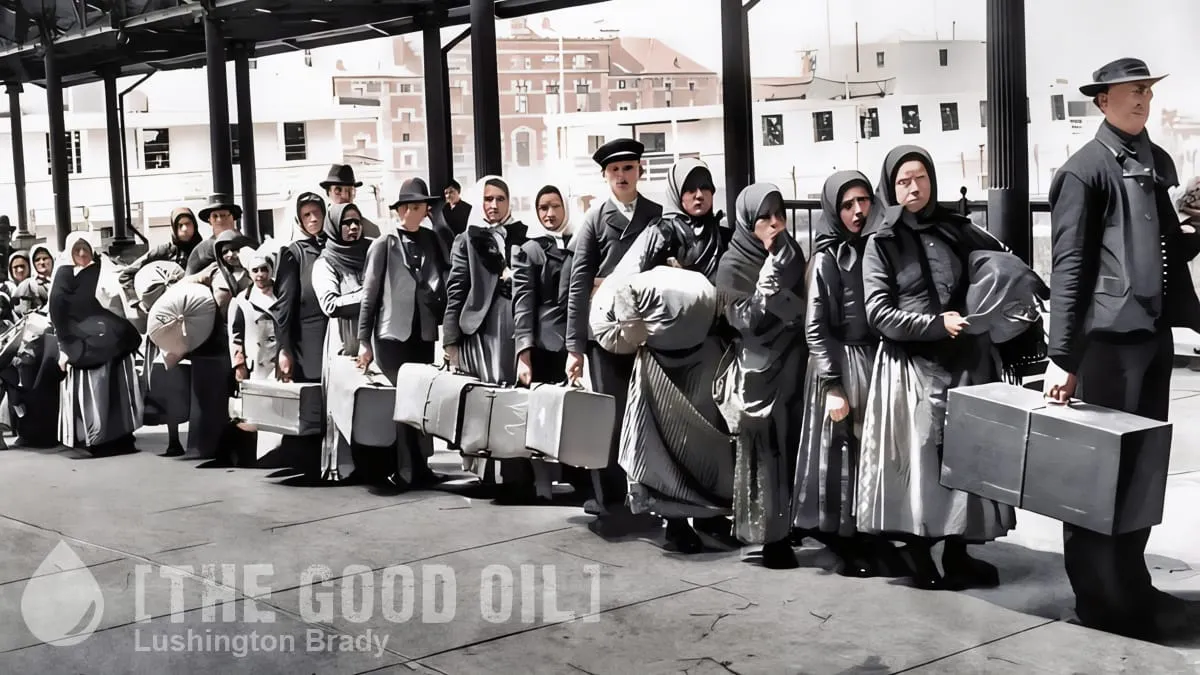
Sure, in just four decades between 1892 and 1924, roughly 12 million immigrants passed through Ellis Island, the busiest US entry point during the peak of the Great Migration. But there the comparisons with the open borders insanity of the early 21st century evaporate, in a puff of cold, hard, facts. Because, contrary to the Hollywood narrative, Ellis Island was a stirling exercise in cold, hard, border control.
And, unlike today’s illegal border-crashers, nobody had to forcibly remove the Great Migration immigrants: between one-third to half of them voluntarily went home again.
Left wingers like to pretend that Ellis Island was an ‘all-comers-welcome’, no-control open borders socialist utopia. The reality couldn’t be further from the truth. The wiser heads of the 19th century knew perfectly well that open borders were a recipe for disaster in what was one of the most intense periods of globalisation in human history. So, they passed the 1891 Immigration Act.
The Immigration Act federalised border control and enforced a raft of measures by which migrants could, and were, turned back. Measures that, if enforced today, would slow Third World immigration into America – and the wider West – to a trickle. Grounds for exclusion included “paupers or persons likely to become a public charge” (LPC), those with contagious diseases, criminals and contract laborers.
That would automatically close the gates to the Islamic world and sub-Saharan Africa in an instant. Not to mention the ludicrous ‘skilled migration’ that is, in fact, anything but and which serves to do little else than replace the native-born, especially youngsters trying to enter the jobs market with low-paid Third Worlders.
Because, back then, even New York actually enforced America’s border laws. With almost brutal rigour.
At Ellis Island, US Public Health Service doctors and legal inspectors conducted medical and legal exams. Steerage passengers endured rapid ‘six-second’ inspections: eyes checked for trachoma with buttonhooks, scalps for lice or defects, and general health assessments. Ship manifests (filled out in Europe) recorded funds carried (often $20–$25 was the minimum expected: $700–900 in today’s money), occupation, destination and US relatives. Inspectors flagged anyone without visible means of support or job prospects.
Overall exclusion was low, probably because the welfare bludgers and crims were turned away before they even had the chance to leave Europe. Deportation costs fell on steamship companies, meaning that much pre-screening was done abroad.
Relatives or friends in the US were decisive for LPC cases. Manifests asked about US contacts: unaccompanied women, children or those with little money were often detained until a male relative arrived to claim them or post a bond (typically $500: nearly $20,000 today). Boards of Special Inquiry reviewed cases and frequently admitted flagged immigrants if family or groups accepted financial responsibility. Without this network, detention or deportation was likely. This system prioritised immediate self-support or private guarantees over government reliance.
So, that’s goodbye to you, Johnny Somalia.
Public health was absolutely non-negotiable. Steerage passengers faced scalp inspections for lice (typhus carriers). Those with vermin underwent bathing, hair treatment or shaving, and clothing was steamed or chemically cleaned. Sick or suspect individuals were hospitalised on the island, where disinfection was mandatory before release or deportation. The US Public Health Service integrated these steps to prevent epidemics: far stricter than casual modern portrayals suggest. While not every arrival endured a full ‘bath ritual’, hygiene checks were routine for lower-class passengers and directly tied to admissibility.
Most striking, though, is just how many 19th century migrants didn’t squat in America forever. Instead of eight-months’ pregnant Hondurans lobbing up in a ‘sanctuary city’, squeezing out an anchor baby and demanding a lifetime of welfare, nearly half of the Great Migration immigrants eventually went home again. Between 1908 and 1923 alone, 3.5 million migrants left, against 10 million arrivals.
While the overall remigration rate was between 25–40 per cent overall, return rates varied wildly depending on country of origin. Contrary to the Godfather narrative, Southern Italians were the biggest remigrators. As many as half of these ‘birds of passage’ went back to Italy within five years. They came to America to earn some scratch, then went home with their pockets full to start a business or buy a farm. My wife’s Maltese grandfather was a classic case: migrating to America and Canada for a few years as a young man in the early 19th century, then returning home, buying a farm and starting a family.
Many Northern and Western Europeans returned at lower rates (10–25 per cent), and the Irish were probably the least likely to go back. Returns also fluctuated with the US economy: during the 1893 and 1907 panics, returns spiked.
What this shows is that the Great Migration was in fact a temporary labour movement. The poor, ‘the huddled masses’ of the Great Migration’s millions viewed America as a workplace, not permanent home, something rarely highlighted in ‘nation of immigrants’ folklore.
All of this makes the Great Migration a stark and telling contrast with the Great Replacement.
Ellis Island enforced strict upfront selection: legal entry, health clearance and proof against becoming a public charge, at a time when welfare was minimal.
Contrary to Ellis Island screening, nearly half of illegal immigrants in the US today (an estimated 11–13 million freeloaders) are visa overstayers, meaning they bypassed any screening at all.
As for welfare, the modern welfare state simply did not exist in the Ellis era. More than half of legal immigrant households in the US today are on welfare (echoing similar patterns in other Western countries). Rates of welfare dependency for non-citizens are even higher, around 59 per cent. Put simply, the Ellis Island generations were given nothing and were expected to pay and earn their own way. Those migrants ‘built the country’ because they had no choice to do so, or be sent right back.
So, by all means, let the left gibber about Ellis Island. It produced a highly selected flow of motivated workers with low public dependency. Many came temporarily, sent remittances and remigrated.
It’s long past time for a whole lotta remigration again.