
Bruce Cotterill, writing in the Weekend Herald, discusses how we might deal with the overhang hangover. He has a suggestion about what the answer might be to get rid of the overhang entirely. Before getting to that he makes some salient points that are instructive when considering how the recent election panned out. The answer would solve a number of other issues and festering sores when considering parliament as a whole, how it runs, and our electoral system in general.
The first point Bruce makes about the overhang is that it is costly. This is probably of no consequence to the left but, to those of us on the right who understand economics, it is an important point: more MPs mean more of everything that they need to perform their duties. We are talking desks, chairs, staff, office space, travel expenses and that’s before we get to their salaries. Then there are the lavish perks. All this is a further burden on the taxpayers. Something we can do without.
Bruce makes the point, which is something I think is overlooked, that we have had overhangs before. This election will be the fifth occasion in which the Māori Party has benefitted from an overhang. What that means is that in half the elections held under MMP a race-based party has been able to manipulate the system. My use of the word manipulate is deliberate because that is the exact word Chris Hipkins used to describe how National “managed to still be in the race to form a government”. If calling for “two ticks blue” is manipulating the system then presumably he did likewise by calling for “two ticks red”. Notice he didn’t mention the Māori Party.
For Mr Hipkins’ future reference, National did not manipulate the system but the Māori Party did and very successfully too. If, by reason of some unfortunate way the final numbers pan out, he does get to form a government, he’ll have the Māori Party manipulating the system to thank. The consequences of that will be dire. This leads on to Bruce’s next point and that is, for the first time in the history of MMP, the right, in the form of National, have also benefitted from an overhang. As a result some on the political left are saying the system needs to change. He then references the nonsense coming from Hipkins.
This is so typical of the left. ‘What’s good for the goose is good for the gander’ never seems to apply in their case. It’s one rule for them and another for everyone else. The response to Hipkins’ claims is Luxon’s “two ticks blue” campaign. Bruce goes on to point out that the election that catapulted Hipkins to the government benches in 2017 saw his party form a government with a party vote of just 36.9 per cent compared to National’s 44.4 per cent. The term short memories comes to mind. He’s right. Is Hipkins mentally fit to hold the office? Are we witnessing the ‘Prince Harry’ of New Zealand politics, i.e., not very bright.
Bruce makes another valid point and that is that it's only this time, when the right have also derived benefit from the overhang, that more than 40 ‘constitutional experts’ have signed an open letter calling for changes to MMP. They make it so obvious what their game is. Can we label them a bunch of Prince Harrys too? I regard these types as highly paid irritants. They have an air of ‘we know what’s best’ about them. They resemble ‘nosey parkers’ doing nothing more than paddling their own canoes of self interest.
So what is Bruce’s solution? One thing not to do, and I agree, is to revert to First Past the Post. That train has long left the station. He wants a system with no possibility of an overhang and one that is easy to understand. Here it is: reduce parliament to 90 seats and no more. Sixty of those are voted by the electorates they serve, with the remainder allocated in the proportions delivered by those electorate votes. Such a ratio would limit the extent to which ‘the tail gets to wag the dog’ – that refers to Opportunity, a brand new chimeral party with people in parliament about whom we know little, possibly deciding who forms the next government which is ridiculous.
Bruce’s preference is to give people only one vote. One vote for an electorate MP and an analysis of those votes to determine the make-up of the non-constituency MPs or the list. Given the latest results, such a scheme would deliver an equally close race. Here are the benefits it would bring: fewer MPs, a limit on the size of parliament, one vote per voter and a simpler system that everyone understood. Bruce concludes with “Would it be perfect? No. But democracy never is.” And for this idea to work to maximum effect, the Māori seats must be disposed of. They are no longer required and are a festering sore on our democracy.
By George, I think he’s got it! What say you?
By George, I Think He’s Got It
Here are the benefits that Bruce’s idea would bring: fewer MPs, a limit on the size of parliament, one vote per voter and a simpler system that everyone understood.

Related

Seymour Finally Caught Up With Winston
David Seymour told Midday Report on 24 November that ACT “may well” push a binding referendum on abolishing the Māori seats. New Zealand First put that referendum on the table in February. If the Crown’s authority hangs on seven seats, ask the people.

Quick Hit: What Happens After Friday
Official results are due on Friday 27 November. Interest.co.nz says 2pm. The writ’s last day is 3 December, unless a recount delays it. Opportunity’s seven list seats remain preliminary until Friday. Talks can run well beyond that.
Seven List MPs Don’t Pick the Foreign Minister
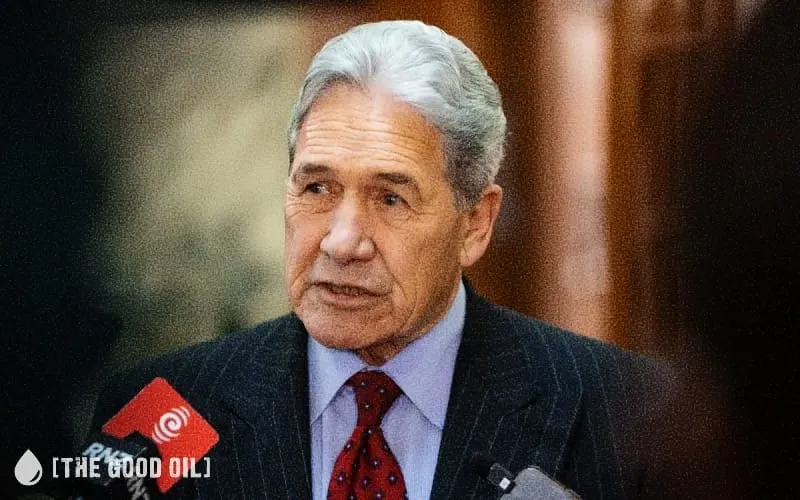
Opportunity, on preliminary numbers, has seven list seats and has already vetoed Winston Peters as foreign minister, the same condition Chris Hipkins set on 4 August. Friday’s official results will test those seats. Seven list MPs don’t pick the foreign minister.

Do We Even Value Toddlers?
That’s the value placed on the life of a member of the future generation. Sixteen months. There’s no call from those petitioning for a Future Generations Act for toughening sentencing for killing babies and toddlers. Quite the opposite.
Latest
Seymour Finally Caught Up With Winston
David Seymour told Midday Report on 24 November that ACT “may well” push a binding referendum on abolishing the Māori seats. New Zealand First put that referendum on the table in February. If the Crown’s authority hangs on seven seats, ask the people.
Quick Hit: What Happens After Friday
Official results are due on Friday 27 November. Interest.co.nz says 2pm. The writ’s last day is 3 December, unless a recount delays it. Opportunity’s seven list seats remain preliminary until Friday. Talks can run well beyond that.
Seven List MPs Don’t Pick the Foreign Minister
Opportunity, on preliminary numbers, has seven list seats and has already vetoed Winston Peters as foreign minister, the same condition Chris Hipkins set on 4 August. Friday’s official results will test those seats. Seven list MPs don’t pick the foreign minister.
Good Oil General Debate
Please read our rules before you start commenting on The Good Oil to avoid a temporary or permanent ban.