Table of Contents
Jessica Colby
Liberty Itch
In recent years there has been growing push to censor creative works that are deemed controversial or offensive. This can come from governments, lobby groups or even large corporations. Officials can apply pressure and demand private entities censor on their behalf, making it more difficult to know where the censorship is coming from or to even know it is happening.
In this article, I discuss a variety of incidents in which media creatives have been confronted with the prospect of censorship, and what they did. Many of these strategies can also be useful when facing censorship of a political publication.
In 1999 the infamous Harvey Weinstein, then more notorious for violating creative visions, received a sword from Studio Ghibli producer Toshio Suzuki with the message “no cuts”. This was in a response to demands by Harvey Weinstein and his production company to censor and cut down the English dub of Princess Mononoke.
Hayao Miyazaki, the contentious creative behind Studio Ghibli, had a ‘not cuts’ policy incorporated in contracts with foreign companies, a policy adopted after the significant censoring of his film Nausicaä Valley of the Wind. His position was that the movie was to be released uncensored or not at all.
In this case, Miyazaki and Studio Ghibli employed two strategies to effectively fight censorship. The first was to protect the work though contractual agreement. This can be helpful when you rely on a third party to help in the publication of your work as it allows you to reject censorship demands and gives the third party an excuse to reject demands from lobby groups and government agencies.
The censorship is a direct or indirect government mandate and self-publication won’t help you avoid censorship.
The second was to give an ultimatum regarding censorship of his creative work. This is useful against not just private entities but also governments. There can be benefits to refusing to release an uncensored version of your work.
Even if your work is not initially released, there is always a chance censors may back down or give up under public pressure, resulting in your work being released uncensored. If that doesn’t happen, people will eventually realise that a particular piece of creative media is not available due to censorship, become upset, and develop workarounds to access it from which you may still profit.
In an incident that occurred earlier this year, DreadXP and game developer Cara Cadaver faced pressure to censor her analogue horror game Vile: Exhumed. The demand came from the game hosting website Steam, which was pressured to ban and censor thousands of online games after a feminist group Collective Shout successfully pressured payment processers to demand censorship of online games they claimed contained problematic subject matter.
Cara Cadaver, ironically also a feminist, did not appreciate what she viewed as an attack on her creative vision and artistic freedom, especially given that Vile: Exhumed was a deeply personal project inspired by her own experiences with stalking and violence.
The game included confronting visuals that alluded to but didn’t show sexual assault and violent acts through the lens of an old 1990’s computer with the intent to educate players on what she viewed as ‘misogyny and male entitlement within society’. When confronted with demands of censorship from Steam, she chose to release the uncensored version for free to ensure access to her uncompromised creative vision.
Cases like this show that it is always important to consider whether self-publication is an option, albeit that it is more difficult and requires more responsibility. In cases of censorship driven by financial restrictions, such as the case above, releasing the creative work for free can also be an option if you are not under pressure to make money.
If censorship is unavoidable and you don’t have the contractual power of Miyazaki and Studio Ghibli, you aren’t in a financial position to release your creative media for free like Cara Cadaver, and the censorship is a direct or indirect government mandate and self-publication won’t help you avoid censorship, there are other options.
In 2014, the creators of South Park released a South Park based game called South Park: The Stick of Truth. When the game was released, the game faced censorship demands from a wide variety of countries, including Australia. Although the creators complied with the censorship demands, they made sure that the censorship would not go unnoticed.
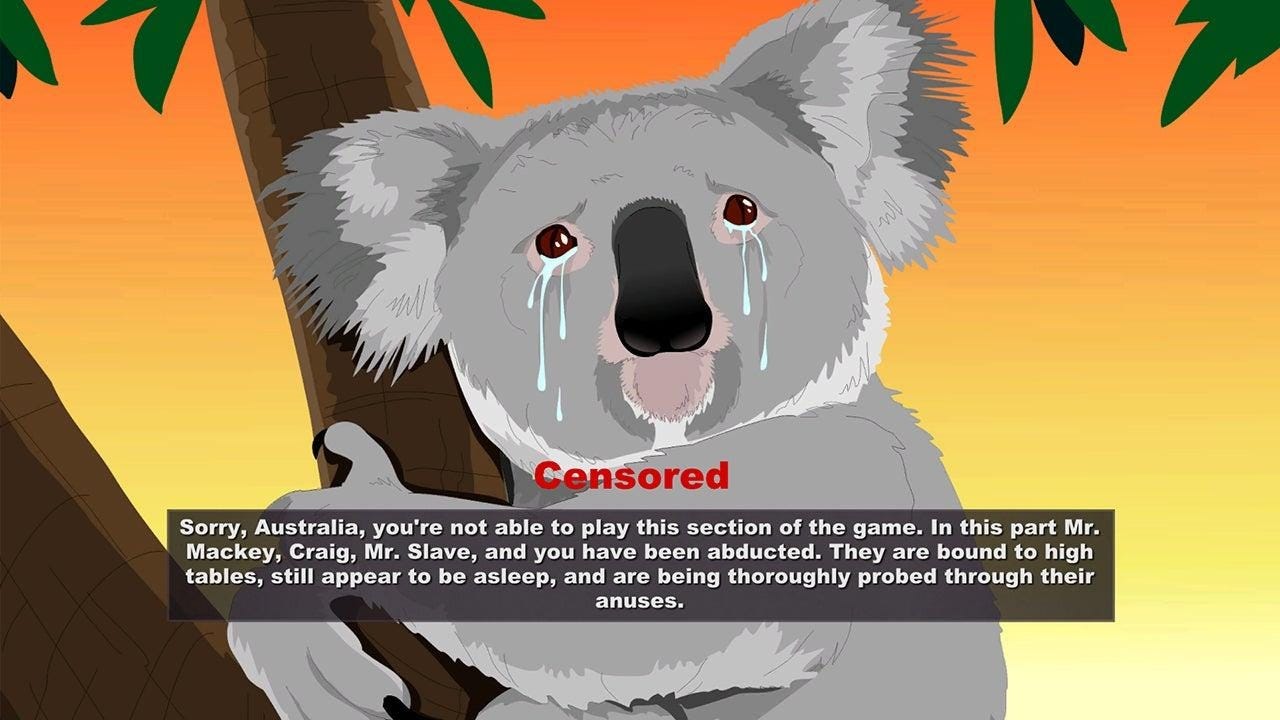
As shown in the image, censorship and an explanation of what has been censored are shown. The Australian Classification Board argued the scene in question ‘promoted sexual violence’ despite clearly being satirical. The image also states the region (Australia) affected by the censorship and shows a koala to further drive home the point.
Officials can apply pressure and demand private entities censor on their behalf, making it more difficult.
This strategy is a form of malicious compliance that allows creators of creative works to technically comply with censorship demands but ensure the viewer or the reader knows they have encountered censorship and are informed and have the option of taking action.
A variety of Japanese anime animators use a similar strategy in which they use black bars and lighting to block nudity and other things that must be censored on Japanese television, but the home media version remains uncensored. As for written creative media, the equivalent would be blacking out words and sentences but leaving the blacked-out passages in place to indicate the work has been subject to censorship.
Putting a disclaimer at the beginning of a movie, TV show, video game or book informing the viewer that the creative media is affected by censorship is another way of which a creator can inform the viewer that censorship is present.
There is of course one last strategy of resisting censorship. That is to engage in censorship in manner that is obvious and absurd. This might be covering nudity with smiley faces, weapons with cucumbers, and placing penises over swastikas. It is not uncommon for people in China to replace words censored by the Chinese government with absurd and bizarre replacements. Such a strategy can easily be applied to creative media where words and dialogue are the targets of censorship.
The purpose of this strategy isn’t just to make censorship obvious, but to mock it.
Finally, there is a strategy which is the most important of all – to fight government policies that force and enable censorship. Even if censorship is currently directed against an individual or group that you do not like, it can still be expanded to affect creative media that you do like and political publications that you support. And is certain to be imposed in an idiotic and arbitrary manner.
This article was originally published by Liberty Itch.