Ani O’Brien
Like good faith disagreements and principled people. Dislike disingenuousness and Foucault. Care especially about women’s rights, justice, and democracy.
Politics often rewards shamelessness. If a politician can survive the first bad headline, deny everything for long enough, and hang in there for the news cycle to move on, there is every chance the public will simply forget. Memories fade and journalists chase the next outrage. Before long the politician who should have been answering uncomfortable questions is back on television talking confidently about everyone else’s failures. Shamelessly.
Chris Hipkins appears to be betting his political future on exactly that phenomenon.
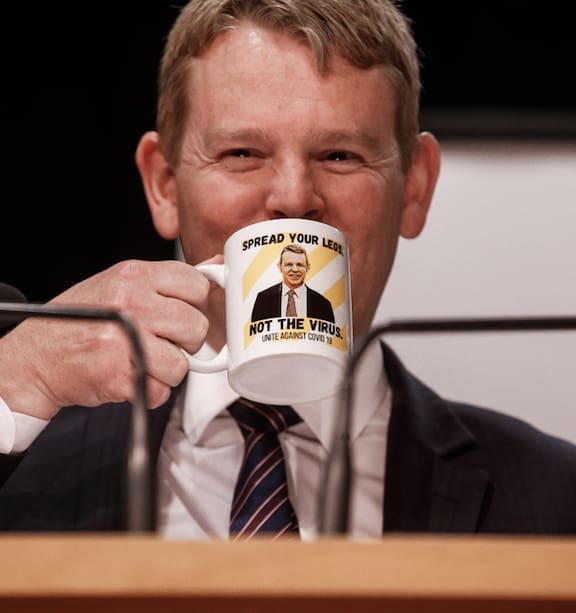
Former Prime Minister John Key earned the nickname “Teflon John” because nothing seemed to stick to him politically. Chris Hipkins has achieved something slightly different. It’s not just that scandals don’t stick: it’s that accountability never seems to either. Every new revelation produces another explanation, another reason why responsibility lies somewhere else. He has become New Zealand’s Teflon politician not because he avoids controversy, but because he manages to dodge accountability and distract journalists with his cheeky chappy ‘oh shucks’ relatable Chippy routine.
In the months since the release of Phase Two of the Royal Commission into New Zealand’s Covid-19 response, Hipkins has distanced himself from one of the most controversial periods in our history. His strategy has not been to defend every decision that was made by him and a handful of others who have largely dodged scrutiny too. Instead, it has been to plead ignorance of the ugly bits. To argue that he simply did not know, the advice wasn’t provided, and the officials didn’t tell him. If mistakes were made, they occurred somewhere beneath Hipkins. And this was, politically speaking, a clever defence. Ministers cannot act on advice they never receive. But it was throwing officials under the bus in a big way and thanks to the information (or lack thereof) provided by Hipkins, a particularly important finding by the royal commission has now been proven false.
The problem for Mr Hipkins is that the ignorance defence has over time collapsed as more documents have entered the public domain and journalist Derek Cheng from the NZ Herald has dug into them.
When the royal commission released its report earlier this year, it concluded that advice from the Covid-19 Vaccine Technical Advisory Group warning against requiring two vaccine doses for 12- to 17-year-olds had not been provided to ministers. The advice, apparently not provided, raised concerns that a compressed two-dose schedule could expose young people to an unnecessary risk of myocarditis and that the low transmission risk in this age group did not justify making the course mandatory.
The finding that ministers were not provided this advice appeared to explain why ministers had maintained vaccine mandates for teenagers despite experts advising against it. If ministers never saw the advice, responsibility appeared to lie with officials who failed to give it to them.
Hipkins relied heavily on that conclusion allowing the media to inform the New Zealand public that the unnecessary risk exposure to young Kiwis’ health was entirely the fault of officials at the Ministry of Health. This is spectacular ruthlessness as many of these officials had been named publicly at various times and in documentation. He repeatedly maintained that had the advice been presented earlier, he would have followed the advice and not mandated the two dose course for young people. He emphasised, expressing frustration and anger, that he could not be blamed for information that never reached his desk. Officials failed and they put all Kiwi children aged 12 to 17 at risk.
Except we now know that is not the whole story.
Just to remind you of the facts: a cabinet paper, in Chris Hipkins’ own name, was considered by ministers in March 2022, and explicitly contained the advice the royal commission believed had never been provided. When a cabinet paper is in a minister’s name it means they (or their office) have prepared it. Even if staff have written it, the minister will have instructed them and certainly should have read it before giving it to the 19 other cabinet ministers to consider. In light of this, officials have now acknowledged that the commission’s finding on this point was incorrect. Rather than the advice never reaching ministers, it had in fact been included in cabinet material circulated by Hipkins.
Despite telling parliament and media that had he known he would have acted differently, nothing changed after he presented ministers with the advice in March 2022. The two-dose mandate for young people remained in place.
Remember by March 2022 New Zealand had already lived through prolonged lockdowns, vaccine passes, employment mandates, and some of the most extensive restrictions imposed on a democratic society in peacetime. Tens of thousands of teenagers were still yet to receive their mandated second dose and the decisions ministers made at that point still had very real consequences. They could have prevented many young people being exposed to risk unnecessarily had they heeded the advice and removed the mandate on 12–17-year-olds.
It is also worth reminding ourselves what the advice actually said because much of the subsequent debate has become clouded by political spin.
The advice did not argue that young people should never receive the Pfizer vaccine nor did it claim the vaccine was unsafe. Rather, it reflected the evolving international evidence that younger people faced a comparatively low individual risk from Covid-19, that transmission among under-18s did not justify requiring a two-dose schedule, and that administering two doses over a short timeframe may unnecessarily increase the risk of myocarditis in this population.
This was not advice that could be dismissed as fringe speculation. It wasn’t Joe Rogan giving medical advice on his podcast nor from dissenting scientists. Though much of what both of those said ended up being true. It was formal advice from the government’s own expert advisory structures.
In my own examination of Official Information Act documents, I found these concerns had not suddenly materialised in December 2021 either. As early as July 2021, officials were discussing myocarditis risk following mRNA vaccination, particularly after the second dose and particularly among younger males. Throughout the second half of 2021 the issue appeared repeatedly in advisory group minutes, ministry papers, and operational guidance. By October it was an established topic of discussion.
Chris Hipkins’ public explanations have become difficult to reconcile with the documents on record. For his ignorance to be genuine he must not have been reading much of the most important documents from the various advisory groups he was supposed to be relying on.
Of course, as more has been revealed, his position has evolved. When ignorance became too implausible he had to adjust.
Instead of the ministers never receiving the advice, he now could not possibly be expected to remember every piece of advice received over three years. The implication was no longer that the advice never existed, but that it had become lost among the enormous volume of pandemic briefings.
Perhaps that explanation will satisfy some New Zealanders. It should not satisfy journalists.
We are not talking about remembering a routine briefing on road cones or fisheries quotas. We are talking about one of the most consequential public policy decisions in New Zealand history. About compulsory vaccination requirements affecting thousands of young people during the largest expansion of executive power most of us will ever witness. If a minister cannot remember receiving advice directly relevant to one of the defining decisions of his political career, that raises profound questions about either his recollection or his oversight.
There are, as I see it, only a handful of plausible possibilities.
Perhaps Hipkins genuinely never absorbed the information despite it appearing in papers bearing his name. If so, that raises serious questions about how carefully cabinet material was being considered before decisions affecting millions of New Zealanders were made.
Perhaps officials did provide the advice but failed to properly highlight the bits they themselves regarded as incredibly significant. If so, Hipkins remains accountable because ministers are responsible for the systems they oversee.
Or perhaps the advice was received, understood, and weighed, but ministers ultimately decided other policy priorities outweighed it. Governments are entitled to depart from official advice and they do so frequently. But if that is what happened, then New Zealanders deserve an honest explanation rather than years of obfuscation.
None of these possibilities reflects particularly well on the man asking voters to make him prime minister in November. Again.
This is no longer about the original decision really. Governments make mistakes, especially during crises, and Covid presented every democratic government with impossible choices, incomplete evidence, and extraordinary uncertainty. I have always acknowledged that New Zealand’s initial response was reasonable and that many difficult decisions were made in good faith.
The more troubling issue is what has happened afterwards. It is, as they say, not the crime, but the cover up that gets you.
Instead of accepting responsibility, acknowledging uncertainty, and explaining the difficult trade offs ministers faced, Chris Hipkins has constructed an elaborate narrative in which responsibility always seems to belong to someone else. Officials failed him, the ministry failed him, the royal commission misunderstood events, documents are remembered differently, and contexts have changed.
This was a defining characteristic of Hipkins' time in charge of the Covid response. He had an almost pathological inability to accept responsibility and apologise. Time and again, when government policy collided with ordinary New Zealanders, Hipkins’ instinct was not to admit error but to defend himself and allow others to wear the consequences.
When journalist Charlotte Bellis found herself stranded in Afghanistan while pregnant because of New Zealand’s MIQ system, Hipkins initially hid behind process rather than acknowledging the cruelty of forcing a New Zealander to seek refuge with the Taliban before she could return home. And he repeatedly refused to apologise to her for how she was treated until the pressure from media became too much.
When two women travelled from Auckland to Northland after receiving exemptions to attend a funeral and subsequently tested positive for Covid-19, Hipkins stood by as rumours spread that they were sex workers flouting the rules, despite knowing those claims were false. Their names were dragged through the mud while the government said nothing to correct the record.
When 26-year-old Dunedin plumber Rory Nairn died from vaccine-induced myocarditis, Hipkins did not pause to acknowledge the tragedy or reflect on whether the government’s messaging around risk needed to evolve. Instead, he publicly reassured New Zealanders that the risk of Covid-19 “far outweighs” the risk of myocarditis and continued encouraging vaccination. He has since made the audacious claim that he never personally gave out medical advice. Even in the face of an exceptionally rare but devastating outcome, the priority remained protecting confidence in the government’s strategy rather than openly grappling with its limitations.
The same instinct was evident in the government’s approach to Managed Isolation and Quarantine. As heartbreaking stories emerged of New Zealanders unable to return home to see dying parents, attend funerals, access medical treatment, or simply come back to their own country, ministers consistently defended MIQ as a fair and necessary system. DJs got special exemptions to bypass systems, however.
Rather than acknowledging that something had gone profoundly wrong with a policy that prevented citizens from returning to their own country, Hipkins remained defensive. It took sustained public outrage and international embarrassment before he softened his position.
At every stage, he was able to dodge accountability for some time before things caught up with him. And even then the news cycle would quickly move on. Most New Zealanders can forgive honest mistakes. They understand that the pandemic was messy, frightening, and ministers were operating under immense pressure. Hindsight is a luxury that was unavailable to decision makers at the time and we get that.
What is much harder to forgive is the appearance that accountability itself is something to be managed or avoided rather than accepted with good grace and strength of character.
The election later this year should not simply be a referendum on Christopher Luxon’s leadership. It should also be one of Chris Hipkins’ chequered record and judgement on whether he is deserving of another chance to lead the country.
That decision should not be made on the carefully curated image of “Chippy” as the reassuring, pragmatic everyman in dad sunglasses. It should be made with full knowledge of the record he left behind. And he has not faced a proper reckoning about his refusal to take accountability and his brazen lies to the public and to parliament.
The evidence is all there. There is a paper trail that does not match his narrative, and cabinet papers do not mysteriously appear in ministers’ names without their knowledge. The statements he made in the House have also been proven false, but as Derek Cheng reports:
The Herald understands a complaint has been laid over whether the House was misled, but a spokeswoman said Hipkins had been advised he didn’t need to correct anything because he was talking about what the commission’s report said, rather than whether ministers had received the advice.
Another very slippery response in attempt to wriggle away from scrutiny.
Ministers in the current government are now faced with a tricky situation. The royal commission’s findings in relation to the matter are now accepted to be wrong because they were not given the material necessary to draw the accurate conclusions. Simeon Brown is the minister tasked with responding to the report, but how does a minister respond to the findings of a report when at least some of it is wrong? Can the rest of the findings be relied upon? No doubt there will be learnings that he will want the government to take from the report, but its credibility has been damaged by this.
And what will become of Teflon Chris? If history is any indicator, none of this will stick to him. He will receive more seemingly endless benefit of the doubt and continue his campaign to be our prime minister once more, one sausage roll at a time.
I want to acknowledge the work done by Derek Cheng on this subject. He has continued reporting on this when no one else seems to understand or care about the seriousness of it. You can find his reporting on the NZ Herald website.
My previous writing on the subject can be found here:
Covid Inquiry should raise serious questions about Chris Hipkins’ leadershipAni O’Brien 10 Mar Read full storyWe don’t hate the media enoughAni O’Brien 11 Mar Read full storyMore advice ignored, Hipkins prioritised vaccine targets over safetyAni O’Brien 3 Apr Read full storyHe knew: The paper trail Chris Hipkins can’t explainAni O’Brien 29 Mar Read full story
This article was originally published by Thought Crimes.