Table of Contents
Summarised by Centrist
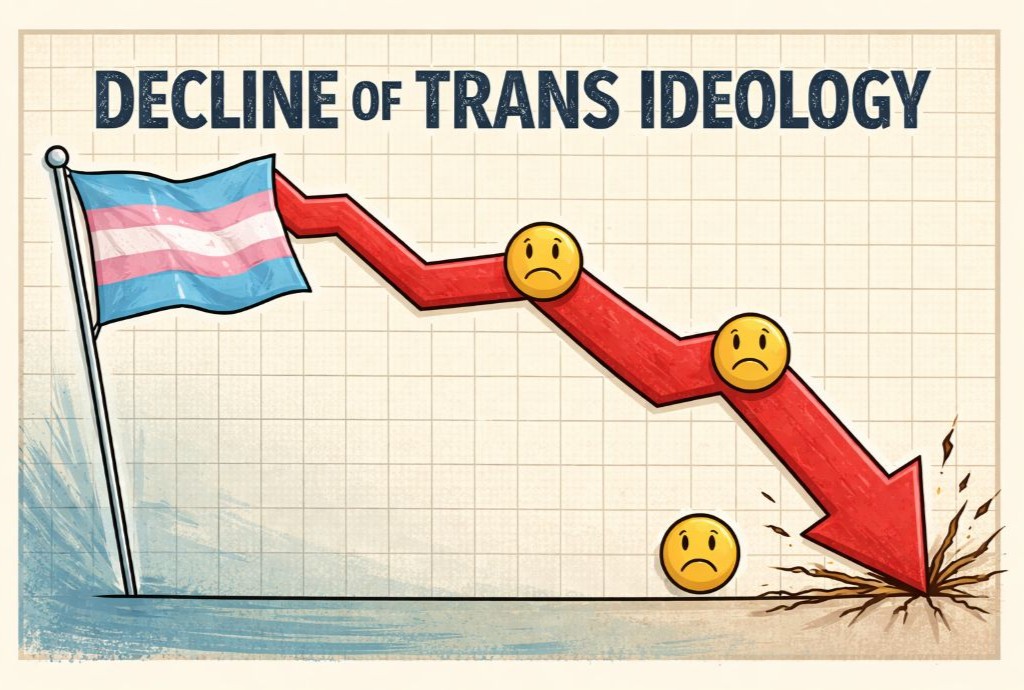
Researcher Ala Pomelile argues that transgender identification among young people in the United States has fallen sharply since 2020, challenging claims that rising trans identification represents a permanent cultural shift.
Pomelile draws primarily on analysis by US sociologist Professor Ryan Burge using data from the Cooperative Election Study (CES), a large-scale, repeated national survey.
According to that analysis, the proportion of US adults identifying as transgender fell from about 2.5 percent in 2020 to roughly 1 percent in 2024. Among young adults born in the late 1990s, identification reportedly dropped from about 7.5 percent to around 2 percent over the same period, while identification among women aged 18 to 22 declined from around 7 percent to near zero.
Pomelile argues the decline is not limited to Gen Z, noting reductions across multiple age cohorts, including people in their 30s and 40s.
Pomelile attributes the decline to three factors: a reassertion of biological sex as a defining category, clearer political and cultural boundaries around language and sex-based spaces, and the stabilising influence of religion and family structures.
She characterises the earlier rise in transgender identification as a form of social contagion and argues that clearer norms have reduced its appeal, particularly among young women.
“This ‘snap back’ to reality suggests that when the true costs of gender ideology are exposed, the ideological house of cards begins to fold,” she writes.