Ani O’Brien
Like good faith disagreements and principled people. Dislike disingenuousness and Foucault. Care especially about women’s rights, justice, and democracy.
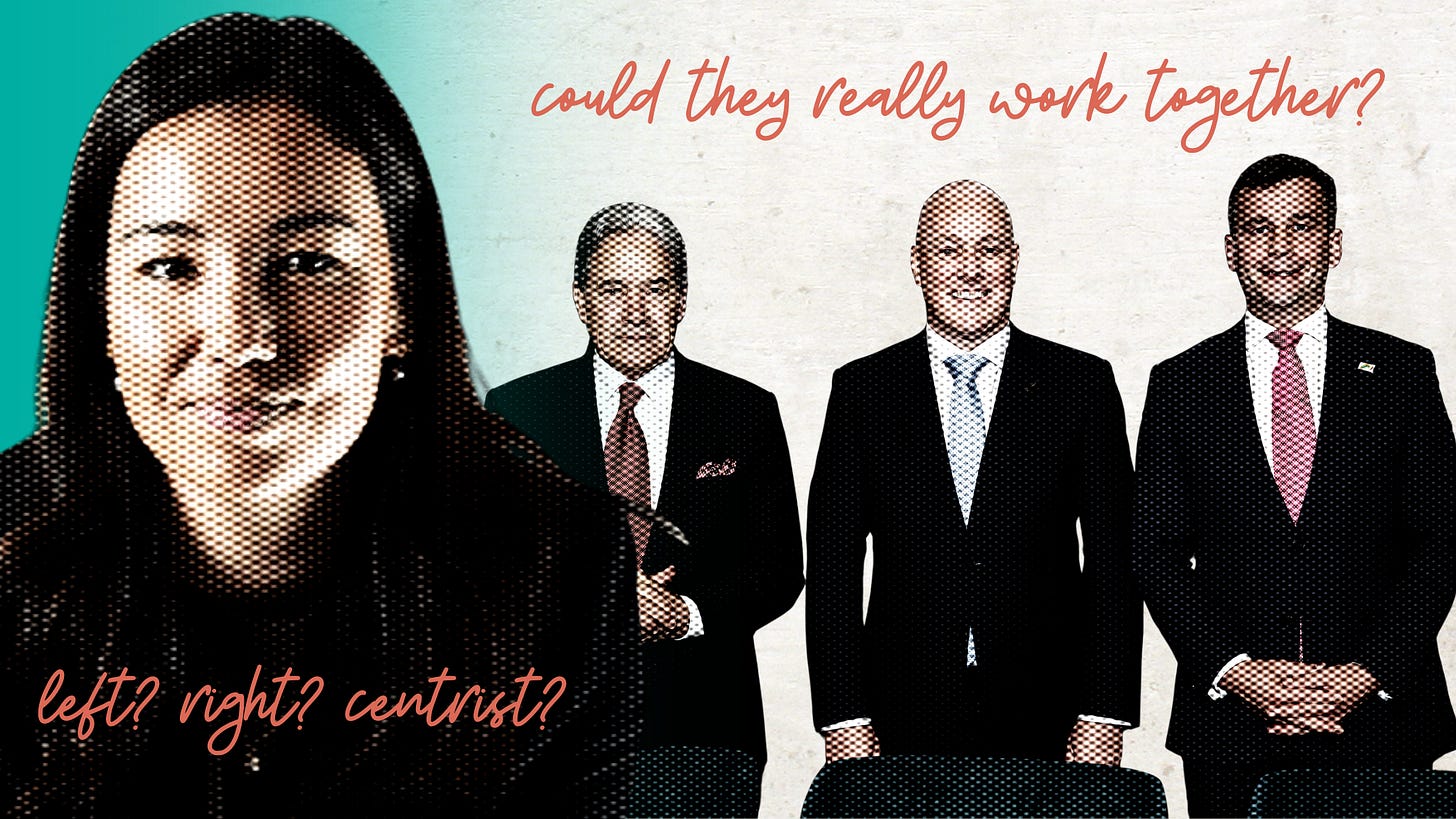
Ask whether the Opportunity Party are left or right and they tell you they are neither. They are “centrist”, they say, and they are teal. The three pillars that underpin their ethos are “Unity, Innovation, and Nature” and they describe themselves as a “blue-green party”. They believe that industry and nature can grow together, rail against “divisive, pendulum politics”, and promise to be a constructive MMP kingmaker rather than just another tribal appendage of either bloc.
Until this week they had resisted setting coalition bottom lines. That changed this week, when leader Qiulae Wong announced the five “non-negotiable” minimum commitments Opportunity would require in return for supporting the next government. She named stronger powers and greater independence for the Commerce Commission, regulation of lobbying and caps on political donations, a ten-year health plan, the beginning of a phase-out of bottom trawling, and recommitment to the Paris Agreement alongside protection of the Climate Change Commission.
Perhaps more interesting than what made the list is what did not. Opportunity’s two most distinctive economic policies, its Land Value Tax and Citizen’s Income, are not, it turns out, bottom lines. Wong says the party does not expect tax reform to happen overnight and that these five are the changes it considers achievable in a first term. The rest of its policies remain on the table, but are negotiable. Not exactly a strategy from the Winston Peters school of deal making.
For many Kiwis, Opportunity have presented a limited but pretty appealing pitch. God knows New Zealand could use a little less of the increasingly Americanised belief that every policy question must be sorted into Team Red or Team Blue. And Opportunity does have some interesting policy ideas, and several places where it overlaps with parties of the current government. But claiming to be “teal” and “centrist” is one thing, whether that translates into candidates and policies that can truly be considered capable of working with either side is an entirely another.
So, as requested by several respondents to my post a couple of weeks ago asking what you want me to write about prior to the election, I have done analysis on both the candidates and policies of Opportunity.
What I found is that in practice they are not a mild technocratic centrist party offering a few evidence-based adjustments around the edges. Opportunity is proposing a comprehensive rearrangement of the economic incentives, environmental rules, public institutions, and Treaty architecture of New Zealand. Candidates frequently use the language of “transformative change” and “system-change reforms”. Of course, this might make the party more appealing to some voters, but they are unlikely to be the ones looking for a centrist common sense alternative to the two main parties.
Starting with fundamental policies around the economy and tax, Opportunity has radical proposals for change. They propose what they have rebranded as a “Citizen’s Income” but has previously been called a Universal Basic Income (UBI). This was a key policy that is very much attached to their brand, but as we learnt, not a deal breaker. But basically, they would turn the entire country into beneficiaries with everyone receiving up to $370 a week. They say this would replace much of the existing welfare system.
However, Opportunity admits that “top-up support” would need to remain for people whose needs are not met by the universal payment because they promise that nobody already receiving a benefit will be worse off, which would be most existing beneficiaries. They call this a simplification, but it is really a new layer of universal welfare dependence for everybody, with a second layer of targeted assistance sitting on top for the people who do not have personal income to supplement the government payment.
UBIs may be popular with progressives but the universality makes it a very expensive and blunt instrument. Instead of concentrating limited public money on people who genuinely cannot support themselves, the state gives a hand out to people who plainly do not need it… and then has to claw much of that money back through higher taxes elsewhere. The Organisation for Economic Co-operation and Development (OECD) has found it is also a relatively inefficient way of reducing poverty.
In an ideal world in which they can enact all their policies, Opportunity say they would fund their UBI with a national Land Value Tax of 1.75 per cent a year on urban land and 0.5 per cent on rural land. Far from a small levy, it is meant to change the very economics of owning land. The tax applies irrespective of whether the property produces any income and Opportunity say the purpose is to make land banking and large property portfolios less attractive, redirect capital into businesses, encourage denser development, and drive property prices down.
The party explicitly say they want property prices to fall, forecasting a 10–15 per cent reduction in property prices due to their policies. Those buying into the market may benefit from the lower prices, but it is disastrous for the many Kiwis who already own land. The value of debt does not fall when the value of land does. Someone who bought recently with a large mortgage could find the asset they borrowed against deliberately pushed down in value while simultaneously having to pay a new annual tax.
And Opportunity more or less acknowledge the redistribution that would occur. They say some “asset rich, cash poor” people will need to make “different choices”, like an older couple might downsize or sell up and rent, a farmer might change land use or sell part of the farm, or property investors may sell up and put their capital elsewhere. In other words, the policy is consciously designed to change behaviour by making existing patterns of ownership more expensive to maintain. It is socially and economically coercive.
The vision for a UBI and LVT should therefore be understood as part of one large redistribution project rather than two unrelated policies. A household could simultaneously receive thousands of dollars in Citizen’s Income and face thousands in new land tax.
Opportunity’s plan to alter where New Zealanders put their capital, reduce the attractiveness of holding land, and universalise welfare, is hardly consistent with the visions of the property rights advocates on the centre-right. The party calls the package a “bold, transformative plan”. The coalition parties, meanwhile, are campaigning against new taxes, presenting an enormous philosophical divergence.
Opportunity are very ambitious when it comes to infrastructure and some of their ideas in this space do align with coalition parties’ objectives. Some not so much. Opportunity wants 60p per cent of future infrastructure expenditure directed to maintenance and renewal, compulsory readiness assessments before major projects get money, demand management measures such as time-of-use charging considered before simply building more capacity, and a much stronger Te Waihanga (New Zealand Infrastructure Commission). There is certainly alignment with particularly National here. Chris Bishop has advocated for many of the same things.
Where they depart ways, however, is in the considerable institutional muscle and public money Opportunity want to apply to it. They want Te Waihanga elevated into the coordinating core of a National Infrastructure Agency, with Treasury allocations conditional on its assessments. They propose raising up to $60 billion in additional infrastructure borrowing over 10 years. Their philosophy is that long term projects should not be constrained by the three-year political cycle and that the Crown should borrow more aggressively for intergenerational assets. This approach is coherent, but it does not fit with the objective of lowering our country debt.
Until very recently I would have said that Opportunity had little in common with National and ACT when it comes to competition policy. However, National’s recent proposal to break up Foodstuffs changes that. Opportunity also wants the state to be charge in and force asset sales or structural separation in the private sector. They imagine the Commerce Commission having the power to seek court orders to do this. Like basically everyone except ACT, the party points to banking, supermarkets, and electricity generation as the likely targets of their interventionist policies.
So there really are strands running through Opportunity that don’t sit too uncomfortably with the centre-right parties. Some of them at least. But then we get to climate, Te Tiriti, natural resources, and justice, and the distance from the current governing parties is vastly widened.
Opportunity is aggressive in the “green” space. They want to usurp the Greens as the party with solutions to climate change and carbon emissions. They are plainly not in centre-right territory here. The coalition government legislated a 2050 biogenic-methane target of 14–24 per cent below 2017 levels, whereas Opportunity wants the target reset to 35–47 per cent. Furthermore, while ACT is calling for the abolition of the Climate Change Commission, Opportunity want to give it greater authority and protecting it is now on their list of non-negotiables. The party’s policy document describes a climate action as a “moral duty” and economic necessity.
On the Paris Agreement, Opportunity find common ground with National who also say remaining in the agreement is a bottom line, but ACT and NZ First are both in favour of withdrawal.
The party has attempted to apply nuance to the matter of offshore oil and gas exploration, but they still ultimately land on the left. Their position is that reinstatement of Labour’s oil and gas ban is “probably unnecessary”, but it also say they would not oppose another governing party reinstating the ban. Cop out?
Their fourth bottom line is in super-green territory. Opportunity wants to begin phasing out bottom trawling, working with the fishing industry, iwi, and coastal communities on the transition. But ending bottom trawling as a key policy sits right in the middle of the tension running through Opportunity’s whole pitch. It presents itself as a party that believes environmental protection and productive industry can coexist, but on this issue it is explicitly prepared to use government power to wind down an existing commercial practice.
The coalition parties take quite different approaches to bottom trawling. National is open to tighter restrictions and has promised to review its use in parts of the Hauraki Gulf, while ACT prefers targeted regulation and making higher-impact fishing methods bear more of their environmental costs rather than banning them. New Zealand First is the furthest from Opportunity. Shane Jones has defended bottom trawling as economically important and favours reducing its environmental effects where practicable, not phasing it out.
The health bottom line is probably the least ideologically contentious of the five and is unlikely to meet much resistance in principle. Opportunity wants the next government to develop a cross-party 10-year health plan, worked through with health professionals, covering funding, workforce, and infrastructure so the system is not repeatedly reset every three years.
Then there is the Treaty of Waitangi. Opportunity would reverse the changes the current government made to the Marine and Coastal Area (Takutai Moana) Act. The coalition made the changes to address the fact that almost our entire coastline was under application by iwi for customary rights. Opportunity also wants Treaty analysis built more explicitly into the lawmaking process, so legislators and the public can see which obligations have been considered and how they affected the resulting legislation.
More substantially, its Māori development policy says “Rangatiratanga should have practical expression in the way the government makes decisions and delivers services.” Beyond simply delivery through a Māori provider, the party says the level of Māori authority would range from consultation through to co-design, delegation and, where appropriate, independent decision making. They say Māori organisations should have more control over decisions and services in their communities, with “genuine independence to act”.
The party’s view on Treaty obligations obviously sits much more comfortably alongside the left-wing parties with longer term constitutional change on the table. Their public policy demonstrates an explicit willingness to move actual decision making authority out of ordinary government structures and into Māori institutions. The exact inverse of the approach at least of ACT and New Zealand First to move New Zealand toward a future of equal rights without race-based law.
In fact, Opportunity’s enthusiasm for universalism ends where race enters the picture. They are advocates for the kind of separatist concepts that often get folded under the label of “DEI”. That is that they wish to treat Māori as exceptional by enabling preferential policy throughout the public service and economy. They argue that collectivist Māori ownership structures are disadvantaged by our financial system, and propose working with iwi and other Māori asset owners to create alternative financing. They also express a desire for Māori businesses to be explicitly plugged into their innovation, investment, commercialisation, and export programmes.
The Greens and Te Pāti Māori refer to Matike Mai as a key framework for the constitutional reform they wish to see in New Zealand. It is a document reimagining of the governance of our country in which Māori have separate authority to the Crown. While Opportunity does not take their policy as far, they leave the constitutional reform question very open, saying New Zealand has unresolved questions about the relationship between parliamentary democracy, Te Tiriti, and the exercise of rangatiratanga. They want a formal national constitutional conversation rather than to allow those questions to be settled piecemeal through ordinary parliamentary majorities. Furthermore they propose using their “citizens’ assembly” model to work through it with Māori participating specifically “as a Treaty partner”, alongside wider democratic participation.
Opportunity’s language is generally more managerial and conditioned on demonstrable outcomes than Labour, the Greens’, and definitely Te Pāti Māori, but the direction of travel on statutory Treaty obligations, Māori devolution, and constitutional consideration is similar.
Justice provides another sharp contrast between Opportunity and the right bloc. Opportunity calls its approach “Prevention – Rehabilitation – Victim focused – Reintegration”. They want more specialist courts, including expansion of therapeutic and kaupapa-based court programmes, and want money redirected from what their policy document calls the current government’s “demonstrably ineffective” military-style academies into prevention and rehabilitation. The government has funded the academies further in Budget 2025 and argues that its wider youth-offending programme is producing results.
The government has performed strongly in the law and order space this term, making an almost immediate impact on violent crime and ram raids. They too have used the language of being “victim focused”, however they clearly envisage the meaning of the words differently from the team in teal. The government has made interventions in toughening up penalties for crime via law changes such as the introduction of the stalking and harassment law and returning Three Strikes legislation. Opportunity say they totally oppose Three Strikes. It is difficult to take their claim of being “victim focused” seriously when their policy tends toward getting violent criminals out of tough sentences rather than removing them from the community so they cannot continue to do harm.
One of Opportunity’s most controversial policies has been walked back after significant blowback. They had been advocating to raise the age of criminal responsibility to 25. Yes, you read that right. They wanted to treat criminals under 25 as young people subject to lighter sentencing and special courts. Can you imagine housing a 24-year-old rapist with a 16-year-old with burglary convictions? It totally disregarded the reality of male offending, as violent offending is heavily concentrated in early adulthood. The New Zealand Police have previously noted that while property offending tends to peak in the teenage years, violent offenders are more likely to be in their 20s. The 18–24 cohort are adult men at the peak time of committing serious violence.
The language of their justice policies closely echoes the Greens’ 2026 manifesto, which says community safety should be pursued through “prevention and rehabilitation” and attacks the government for “packing prisons”. Both Opportunity and Greens are upstream of the far-left explicit prison abolition movement represented by extremist groups like People Against Prisons Aotearoa, which argue that prisons themselves cause harm, should ultimately be consigned to history and should be replaced with “transformative justice”.
Again aligning with its Green friends, Opportunity supports legalising recreational cannabis. Their Smart on Crime policy says regulation would “undercut organised crime and reduce youth incarceration”. Chloe Swarbrick continues to argue that prohibition has failed, wastes police and court resources, and should be replaced with what the Greens call “sensible, evidence-based regulation”. There are some respectable arguments for that position, and plenty of people who are hardly hemp-wearing revolutionaries supported legalisation in the 2020 referendum. But politically it reveals again that Opportunity are far from a law and order party.
All of the policies explored thus far did not spring from the ground organically. They are the products of the people who wrote them and their politics. Now I will turn my attention to exploring who these people are.
They are an impressive bunch on paper. They have a lot of university qualifications and some interesting careers. Collectively, however, they are very technocratic, very interested in the Environmental, Social, and Governance framework (also known as ESG), big on climate change, and keen to kick off constitutional reform. It is not my argument that they are idiots or that individually many of them wouldn’t make useful contributions to parliament. What analysing them confirmed is that these are people who belong firmly on the left of politics. They are fundamentally incompatible with right-wing parties.
Party leader Qiulae Wong’s career before politics included human rights, ethical fashion, B Corp, KPMG sustainability work, and the Wellbeing Economy Alliance. Human rights, sustainability, wellness. She moved from leading the New Zealand B Corp movement into helping major corporations make the low carbon transition. For those unfamiliar with it, B Corp is a global certification movement run by the non-profit B Lab. Companies are assessed against ESG standards covering things such as workers, communities, climate impact, transparency, and how corporate decisions account for stakeholders rather than shareholders alone. B Lab describes its mission in terms of changing the economic system itself to create a more “inclusive, equitable and regenerative” economy.
Before becoming party leader, Qiulae sat on the board of WEAll Aotearoa, whose purpose is shifting economic policy toward human and ecological wellbeing rather than treating GDP as the overriding measure. Wong herself wrote in 2022 that moving from a Wellbeing Budget to a Wellbeing Economy required “transformation” and in 2024 she criticised the coalition government’s budget from a left-wing perspective on inequality and environmental spending. She also raised capital gains and wealth taxation as ways the wealthy could contribute more.
Much of her professional life has been spent trying to prove that profitable businesses can be redesigned around environmental and social purpose. So she is in a sense a capitalist green, but her intellectual history is not one of keeping government out of markets and preserving economic incentives. She is plainly for greater government interventions and reforming the system in a way that looks more red/green than blue.
Deputy leader Daniel Eb’s Opportunity biography calls him a “progressive voice for reform” and says he has spent years working toward a “just, regenerative food system”. He was selected as a 2021 Nuffield scholar, which he used to write ‘The Home Paddock: A strategy for values-led redesign of the domestic food system’ which asks what food and farming might look like if treated more like healthcare and education and argues that the system should place more weight on social and environmental value rather than volume and market value alone. His central argument was that New Zealand agriculture had become exceptionally good at generating export and market value, while neglecting social, cultural, and environmental outcomes.
He also served as an officer in the New Zealand Army Reserve, and later worked in marketing/PR including overseas. He founded the agri-communications business Dirt Road Comms. And in August 2026, Eb said Opportunity opposed the Gene Technology Bill in its current form and wanted it withdrawn and redesigned, including protections for organic certification.
Daniel’s mother is Deborah Pead, the well known New Zealand public relations consultant and founder of Pead PR.
Jessica Hammond is a long-serving member of the party returning for another crack at getting elected. She stood for TOP in 2017, 2020, and 2023, although she actually resigned from TOP after the 2017 election, during the implosion of Gareth Morgan’s original TOP, saying that “various things” had happened that did not align with her values. Yet by the end of 2018 she was back and contested the party leadership coming third.
Hammond lives in Khandallah, and has spent her working life primarily as a public servant and policy adviser. A fully fledged member of the lanyard class, she describes herself as trained in philosophy, economics, and psychology and her government work has ranged across transport infrastructure, health and disability legislation, and Māori economic development. Opportunity has given her a sprawling set of portfolios to focus on in 2026, including Health, Social Development and Employment, Public Services, Children, and Seniors. She says she is “completely out of patience with tinkering and bandaid solutions”.
Canadian Kayla Kingdon-Bebb is a stand-out beacon of where Opportunity’s politics are really situated. The party describes her as a Treaty law and natural resource policy expert who worked at the Ministry for the Environment before becoming director of policy at DOC, and then chief executive of WWF-New Zealand. Most significantly for our purposes of establishing her politics, she was one of the authors of He Puapua, the independent working-group report on implementing the UN Declaration on the Rights of Indigenous Peoples. She later wrote that she hoped He Puapua would help make rangatiratanga and indigenous self-determination manifest in New Zealand’s “laws, institutions and policies”.
In her role heading up WWF, she has been a vocal opponent of this government. She has been particularly critical of fast-track consenting, mining, and other extractive projects. Naturally, she submitted in opposition to the Treaty Principles Bill saying Te Tiriti was “a gift to Aotearoa New Zealand”.
Eden Skipper’s record points in a similar philosophical direction. Opportunity describes him as working in environmental restoration and indigenous development, and researching “alternative economic futures”. He was co-chair of the youth-led climate justice organisation Generation Zero, worked in natural resource policy, and participated in Te Tiriti-based community governance structures. Notably, he was trained as a Climate Reality Leader through Al Gore’s organisation and has been involved with World Economic Forum Global Shapers.
In his own account of an MFAT internship he completed he objected to reducing the Māori economy to a dollar value through a “colonial lens” and warned against policy becoming so data-driven that it neglects perspectives outside neoclassical economics.
He worked at the Ministry for the Environment and later at MPI as a Specialist Adviser – Māori Capability. A Biological Heritage profile says a central focus of his career has been helping public systems deliver better community outcomes while “strengthening the position of Te Tiriti in Aotearoa”.
Jodie Kuntzsch’s world is seafood, aquaculture, innovation, and the “blue economy”. But the blue economy model does take us into similar territory as Wong and Eb with ESG. It goes beyond conventional GDP measures, combining commercial value with ecological, cultural, and social wellbeing. Kuntzsch led that strand of the Sustainable Seas programme. She also led Moananui, which has a core objective to “To harmonise economic prosperity with environmental stewardship.” Her own conclusion is that economic development and social and environmental goals are “intrinsically linked”. In addition, she acted as lead consultant for an international At-Sea Operations working group involving the UN Food and Agriculture Organisation.
Her work with The Aotearoa Circle may not appear particularly right wing, but it is a “public–private partnership”, which those of the centre-left tend to be less enthusiastic about. The programme looked at how the seafood sector should respond to climate change, and examined questions including capital access, alternative fuels, and climate risk forecasting.
She is an American immigrant who grew up “about as far from an ocean as you could get” and originally came to New Zealand more than 20 years ago intending to backpack for three months and stumbled into work relating to the marine world. Kuntzsch is married to Volker Kuntzsch, the current chief executive of the Cawthron Institute.
It cannot be ignored that five of the six have spent significant parts of their careers working on wellbeing economics, regenerative food systems, environmental regulation, Treaty and indigenous governance, climate justice or blue-economy models in which ecological and social outcomes are built directly into economic decision making. They have a real mixture of national origins as well. Wong was born in Fiji, Eb in South Africa, Kingdon-Bebb in Canada, Kuntzsch in the US, with Skipper and Hammond New Zealand-born.
After the top six, the list becomes more occupationally diverse but the same themes keep reappearing. Sarah Lucas (#7) is a small-business owner and former social worker and mental health manager who now works in conservation strategy and has substantial local government experience. Dave Bainbridge-Zafar (#8) also has local government experience as an infrastructure and asset-management specialist who has held senior roles at Dunedin City Council, Health NZ, and Gore District Council. Holly Knill (#9) comes from the tech sector and has recently researched AI and productivity. Pāpā Wharewera (#10) has a real ‘service’ biography with military and Fire and Emergency, mixed with professional rugby, small business, and elected local government.
Bianca Beebe (#11) takes the list back into activist territory. She is a public health researcher and labour organiser, co-founded Fired Up Stilettos and has worked on “sex worker”, HIV, and drug-policy advocacy. Romeo Tevaga (#12) has a law and public service background, Ben Wylie-van-Eerd (#13) is a scientist, PSA delegate, and repeat TOP candidate, Rachel Ward (#14) is an ecologist and wildlife sanctuary manager, and Naomi Pocock (#15) is another long-serving TOP figure with corporate, academic, and climate education experience.
Further down, the list there are paramedics Cody Marsh and Blair Smith, pharmacist Kevin Huang, medical laboratory scientist Adrian Mee, health-tech worker Jamie Attenborough, teachers Robert Mason, Matt Shepherd and Netra Ghimire, architect Michael Carter, engineer/project manager Almo Wong, logistics specialist Paul Jackson, tourism executive Ben Lane, and engineering/infrastructure veteran Matt Harris. Mark Roach is a long-time music industry figure and Luke Ross is a former parliamentary service and council video producer. Fun fact: I was briefly Luke’s manager in parliament. He is a lovely young man. Sacha Haskell was a police detective and member of the Armed Offenders Squad, played international football, and has held senior executive roles. Finn Liley organised a School Strike for Climate and later led Young Opportunity and Evan French, a maths/ecology graduate, co-leads the youth wing now.
The overall pattern of the top six continues throughout the list. But no matter the make up of their potential caucus, there are some other people we need to take into account, because to a greater degree than any other party, the decisions made by Opportunity’s caucus would not belong to them alone. The party’s constitution gives its board extraordinary relevance to any post election negotiations and Parliamentary decision making. The leader can even be removed by a 75 per cent board vote likewise they can overrule a caucus decision if they believes that decision clearly prejudices the party charter. After media push back, the party indicated it would look to change the latter provision, but I cannot find confirmation that they did. Additionally, elected Opportunity MPs may negotiate a coalition agreement, but it cannot take effect until 75 per cent of the board approves it. This is far less democratic than we ordinarily expect from a political party and means board members have a lot of political power without needing to get elected.
So obviously the board deserves almost as much scrutiny as the parliamentary list. Chair Penny Fairbrother comes from environmental science and public sector policy at Greater Wellington, Darren Savage is a long time Opportunity policy figure working in public health and refugee support, Dan Thurston Crow is another veteran candidate who chairs Sustainable Taranaki and talks openly about tackling systemic declines in “health, wellbeing, equity and environment”, Scott Pollok brings a more commercially orthodox background in engineering, patent law, and small business, and Alan Wilderland, a co-founder of Serato, supplies both technology business experience and substantial financial support to the party.
Wilderland is Opportunity’s most prominent donor. Electoral Commission records show $180,000 in three disclosed personal donations above $20,000 during May and June 2026 alone. The party also received another $41,160 from Alajamber Ltd, a company associated with Wilderland, bringing the publicly reported 2026 total connected to him at that stage to $221,160. Opportunity’s 2025 annual return additionally records $50,000 from Wilderland that year.
None of those donations is unlawful, but he is not a passive supporter. Wilderland sits on the board, has been involved in party strategy, and was involved in the process that selected Wong as leader. His donations also sit awkwardly with the party’s policy to cap donations at $30,000 and prohibit company donations. In August, Wong had to defend the party having accepted more than $400,000 from six donations above the very $30,000 ceiling the party wants to legislate. Her answer was that Opportunity must “play the game with everyone else” under the current rules and change those rules once in parliament.
So where does all of this leave the claim that Opportunity could work with either bloc?
There are some bridges to the current right-of-centre parties. Their science and commercialisation policy offers one and their competition policy offers another, particularly with New Zealand First. Infrastructure maintenance, independent project appraisal, and time-of-use charging overlap strongly with things National is already doing. Opportunity also frequently uses market pricing, private investment, tax incentives, and competition as tools in policy. On energy they want vastly more generation than the rest of the left and accept the need for investment and market reform. Probably most importantly, their environmental philosophy explicitly rejects the idea that business and environmentalism must be enemies.
A National/ACT/New Zealand First arrangement involving Opportunity would still present a long list of major bargaining roadblocks. The announcement answers some questions. Opportunity has conspicuously left its Land Value Tax, Citizen’s Income, 35–47 per cent methane target, Treaty and constitutional reforms, justice policies and opposition to military-style academies off its list of bottom lines. But those policies have not disappeared. It only softens some of the most obvious obstacles in that National would not necessarily have to abandon its “no new taxes” promise, nor would ACT and New Zealand First necessarily have to sign up to Opportunity’s broader constitutional or justice agenda simply to secure its support.
The harder questions now sit around the five things Opportunity says it will not trade away. Could ACT accept protecting a Climate Change Commission it wants abolished? Could New Zealand First accept recommitting to the Paris Agreement and beginning a phase-out of bottom trawling? Competition reform and a 10-year health plan are easier territory for agreement, while political donation and lobbying reform would come down largely to the detail.
BUT. And it is a big butt, I cannot lie. The problem is in the whole picture. Put all of their policies together and they just do not gel with the centre-right. ESG, climate change, and Treaty politics are woven throughout all of their platform. It is fair to say that a deal with the present centre-right coalition would require detailed and visible compromise across several of the issues that are most core to their identity and purpose. There is far more synergy with their platform and Labour/Greens/Te Pāti Māori.
The big question for this election is which coalition you want. We are either going to get National/ACT/NZ First or Labour/Greens/Te Pāti Māori (TPM may not be needed if Opportunity get in). Which bloc one wants in power should form a central part of the decision of whether they vote for Opportunity or not. If you want this government to return, voting for Opportunity is very likely to contribute to the opposite outcome.
This article was originally published by Thought Crimes.