Table of Contents
Deep sea mining has been a theme of science fiction for decades. One of my favourite juvenile novels was Tom Swift and His Subocean Geotron, which, among other things, features the young hero picking up nodules of manganese from the deep ocean floor. Arthur C Clarke’s The Deep Range and Frank Herbert’s The Dragon in the Sea also explored themes of deep-sea resource harvesting. James Cameron’s The Abyss featured a deep-sea drilling rig.
The 2010 Deepwater Horizon disaster put a damper on undersea oil drilling, but other resource-harvesting efforts are taking their first steps. In particular, rare earths mining. With China dominating – and shamelessly manipulating – the global rare earths supply, it’s perhaps unsurprising that Japan is one of the first nations to seriously embark on undersea rare earth extraction.
Japan has launched the world’s first test to extract rare earth elements from deep-sea mud, aiming to reduce its reliance on Chinese supplies amid rising geopolitical and trade tensions.
Chikyu, a government-backed Japanese mining vessel set sail on Monday for waters near Minamitori Island, a remote coral atoll in the Pacific, to study seabed mud rich in rare earth elements at a depth of about four miles. If successful, the project would mark the first sustained attempt globally to lift rare-earth-bearing sludge from the ocean floor directly onto a ship.
The US is not far behind. The Trump administration is well aware of what numpties like Anthony Albanese are only dimly beginning to comprehend: controlling energy and strategic materials is inseparable from power projection. This was, in fact, the sole reason for the creation of the infant EU. The post-war Coal and Steel Union was expressly designed to control Germany’s access to vital war-making materials.
An unexploited wealth of minerals lies on the beds of the world’s oceans.
In the Pacific, most attention today is on nodules in the Clarion‑Clipperton Zone (CCZ), a vast area between Hawaii and Mexico. This zone is administered by the International Seabed Authority (ISA), an intergovernmental body responsible for safeguarding the deep sea.
Nodules, which appear like potato-sized rocks, are found scattered across seabed plains four to six kilometres beneath the surface. These nodules are rich in nickel, cobalt, copper and manganese – metals used in electric vehicle batteries, smartphones and wind turbines.
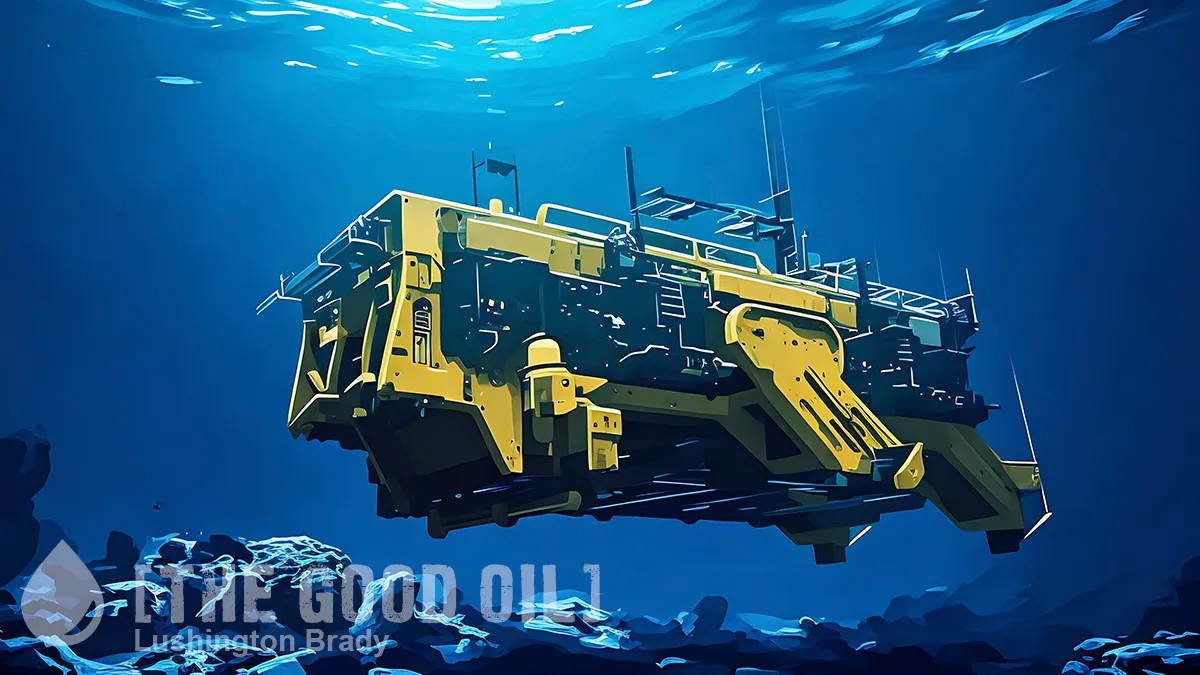
Mining them involves driving a robotic “vacuum” over the seabed, pumping nodules up a riser pipe to a ship, and shipping concentrates ashore for processing.
Nodules aren’t the only target. Companies also eye sulfide deposits at hydrothermal vents and cobalt‑rich crusts on underwater mountains.
Wherever there is mining, though, you can bank on armies of eco-activists following.
Mining plumes – clouds of sediment and metals stirred up at the seabed and discharged at the surface – could spread tens to hundreds of kilometres horizontally and hundreds of metres vertically.
Hundreds of metres vertically? Oh, no! Which will bring it within a whole… thousands of metres of the densest-biomass depths of the oceans.